


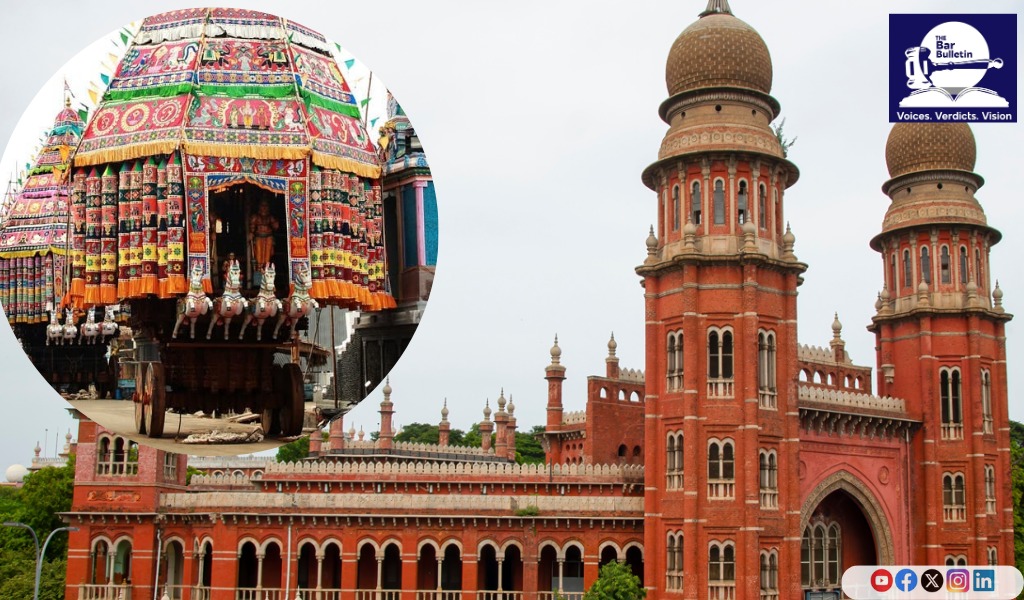

In a writ petition filed under Article 226 before the Madras High Court to direct the respondents and other Hindus to permit the petitioner and the people of his community to enter the Muthu Kolakki AmmanTemple at Puthagaram Village, a Single Judge Bench of Justice P.B. Balaji allowed the petition and directed the respondents to ensure that no form of discrimination takes place while allowing people to worship the deity. The respondents were also directed to ensure that the Temple car festival is conducted peacefully on the new route, which covers the Dalit colonies.
The said petition was filed by the petitioner not only to seek permission for his community to enter the Temple, but also to seek permission to worship and perform local rituals, and to participate in the Muthu Kolakkiamman Temple Car festival by allowing the temple car to go to the Dalit colony.
The petitioner submitted that there was resistance by the upper caste against people from the downtrodden sections. It was contended that discrimination persisted despite the Temple being under the control of the Hindu Religious and Charitable Endowments Department (HR&CE). It was further submitted that the people of the Scheduled Caste community were prevented from participating in the Temple car festival. Thereafter, several representations led to a Peace Committee Meeting, at which the representatives of the upper caste were adamant about their decision.
By an order dated 04-09-2025, the Court directed the respondents to permit the petitioner and other devotees to worship the deity and to conduct a field inspection regarding the Temple car procession. The respondents submitted a status report and contended that there was no prohibition on the petitioner and other members of the Scheduled Caste community from entering the temple or participating in the car festival.
The respondents contended that the route for the Temple car procession had been followed for the past several decades, and any alteration would lead to complications in the future. While denying the allegations of casteism and untouchability, it was contended that towards the end of the procession, people of the SC and ST community are permitted to put up Padayal without which the procession is deemed to be incomplete.
A detailed field inspection made it clear that the requested extension to the field plan was feasible without affecting the historic character of the procession.
The Court stated that Article 17 of the Constitution abolished untouchability and that, therefore, no one can dictate who is entitled to stand before the deity and worship. The Court proceeded to record the stand of the respondents, whereby it was stated that there was no bar for any person to enter the Temple.
The Court took note of the report by the District Collector and noted that extensions from the old route were possible, while stating that faith could not be fenced in by caste or creed, and that divinity could not be confined by human prejudice. It was also said that no street is unworthy of the chariot or the God it carries, as God never discriminates.
Further, the Court said that resisting change by invoking settled custom, tradition, and practice can never be a valid defence available to the private respondents, and found that there were no impediments to the implementation of the proposed route approved by the District Collector.
Thus, the Court allowed the writ petition and directed respondents 1 to 5 to ensure that no form of discrimination is practiced or permitted regarding the worship of the deity. The report of the District Collector was accepted, and the Temple car was directed to proceed on the new route during both the trial run and the main run. The official respondents were directed to ensure that the procession is conducted peacefully, whereas the Inspector of Police was directed to ensure sufficient police protection during the same.
Appearances:
For Petitioner – Mr. S. Kumaraswamy, Mr. D. Parventhan
For Respondents – Mr. M. Murali, Mr. L. Baskaran, Mr. N.R.R. Arun Natarajan, Mr. G. Karthikeyan, Ms. A. Jagadeeswari, Mr. R. Thirumoorthi
