


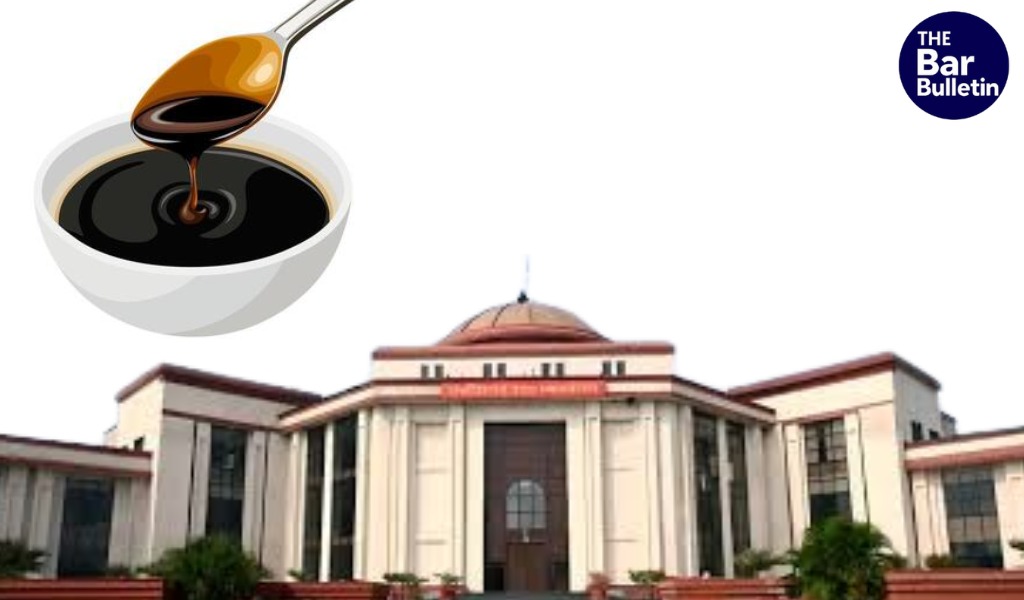

The High Court of Chhattisgarh at Bilaspur Bench has clarified that any Rules/Legislation framed cannot enlarge the scope of its parent statute and cannot travel beyond the Preamble or the object for which the said Rules/Legislation is framed. Thus, it held that bringing Molasses within the regulatory fold of the Excise Act, without statutory backing, is impermissible.
The High Court ruled that the Chhattisgarh Molasses Control and Regulation Rules, 2022, by extending control to non-intoxicant uses, imposing licensing and duty, and regulating ordinary trade activity, travel beyond the scope of the Chhattisgarh Excise Act, 1915, and are therefore ultra vires the Constitution.
The Division Bench comprising the Chief Justice Ramesh Sinha and Justice Ravindra Kumar Agrawal observed that Molasses is not an ‘excisable article’ under Section 2(6) of the Excise Act, nor is it an ‘intoxicant’ under Section 2(11-a) or an ‘intoxicating drug’ under Section 2(12) of the Excise Act. The preamble of the Excise Act states that it is expedient to consolidate and amend the law relating to the import, export, transport, manufacture, sale and possession of intoxicating liquor and of intoxicating drugs, and the Rule/legislation cannot be contrary to its preamble.
The Bench noted that Section 8(c) of the Excise Act provides the State Government the power to make suitable provisions for the effective control of Mahua or ‘any other base’ which is or which can be utilized for the manufacture of liquor. However, the words ‘any other base’ cannot be stretched to include molasses in its raw, non-intoxicant form. Such an interpretation would override the definition provisions, expand the Act beyond its object, and violate settled principles of statutory interpretation.
Further, the Bench observed that Section 62 of the Excise Act empowers the State to make rules for the purpose of carrying out the provisions of the Act, and it is a settled principle that rules cannot enlarge the scope of the parent statute. The State’s attempt to regulate Molasses on the ground that it may be used for producing alcohol amounts to an over-extension of legislative power, and accepting such a contention would permit the State to regulate any substance capable of fermentation, which is constitutionally impermissible.
Briefly, the petitioners are traders and manufacturers who deal in Molasses purely for non-intoxicant purposes, such as the manufacture of cattle feed and Gudakhu. Molasses is a by-product in the manufacture of sugar from sugarcane or gur, and in its basic form, it is neither potable nor does it have any intoxicating effect on human beings, as it does not contain alcohol unless fermented through a complicated industrial process.
In the meantime, the State of Chhattisgarh enacted the Chhattisgarh Molasses Control and Regulation Rules, 2022, purportedly in exercise of powers conferred by the Chhattisgarh Excise Act, 1915. Under these Rules, the Excise Authorities insisted that all persons dealing in molasses, irrespective of the end-use, must obtain an Excise licence under Rule 8 and pay a molasses duty at the rate of Rs. 200/- per ton under Rule 11.
The petitioners challenged the Rules of 2022 as being ultra vires the Constitution of India, arguing that the State lacks legislative competence under Entries 8 and 51 of List II of the Seventh Schedule to regulate neutral commercial trading in Molasses. They contended that such regulation operates as an arbitrary and unreasonable restriction violating Articles 14 and 19(1)(g). Further, Molasses is subject to the Central Goods and Services Tax Act, 2017, whereas intoxicants are kept out of the purview of the GST Act, establishing that Molasses per se is not an intoxicant.
Appearances:
Senior Advocate Manoj Paranjpe, along with Advocates K. Rohan, Kabeer Kalwani, T.K. Tiwari, Amit Sharma, and Manish Nigam, for the Petitioner
Additional Advocate General Shashank Thakur and Advocate Pankaj Singh, for the Respondent/ State
Deputy Solicitor General Ramakant Mishra, along with Advocates Roop Ram Naik, Annapurna Tiwari, Amitesh Kumar Pandey and Rishabh Dev Singh, for the Respondent/ Union of India
