


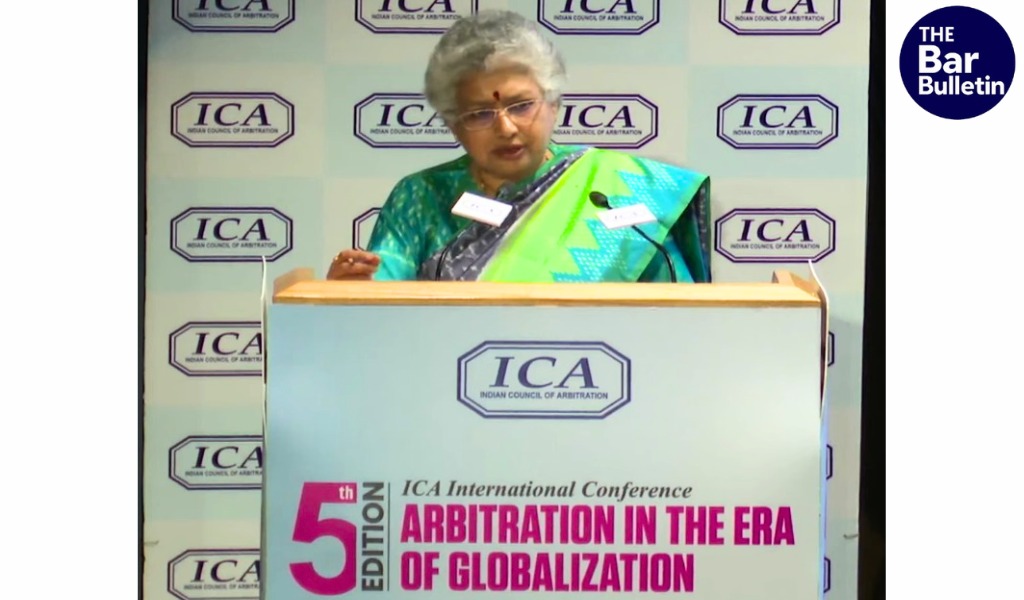

Speaking at the 5th ICA International Conference on “Arbitration in the Era of Globalisation,” Justice B. V. Nagarathna highlighted the growing role of alternative dispute resolution in an increasingly sophisticated and interconnected society, stating that disputes today are not merely legal issues but also social questions. She emphasised that ADR should function as a parallel system to litigation rather than being treated as an alternative.
She noted that arbitration remains the most preferred method for resolving cross-border disputes, particularly in a global economy shaped by investment treaties and foreign investor protections, with subject-specific arbitration developing in areas such as construction, energy and maritime sectors. At the same time, she pointed out that for India to emerge as a global hub, institutional strength and practical efficiency are necessary.
On mediation, she described it as a confidential and party-centric process that facilitates dialogue, especially in family, community and commercial disputes, including those arising in supply chains and business relationships. Referring to the Mediation Act, 2023, she observed that while it is an important legislative step, several provisions remain unnotified and the Mediation Council has not yet been constituted, indicating gaps in implementation.
She stressed that pre-litigation mediation under Section 12A of the Commercial Courts Act, 2015, should not be treated as a “mere formality” before filing the suit, highlighting the prevailing practice where parties briefly enter mediation before filing a plaint, allow it to fail within a short span, and then proceed directly to litigation without any genuine attempt at settlement.
She called for better coordination between mediation centres, legal services authorities and related institutions to ensure effective use of the ADR mechanisms.
Justice Nagarathna also referred to hybrid mechanisms such as Med-Arb and Arb-Med-Arb, noting their relevance in commercial disputes if carefully structured, and observed that arbitral institutions should have trained mediators to follow these methods. Further, she described Negotiation as an “underappreciated form of dispute resolution” capable of resolving matters before they escalate.
She concluded by noting that no single mechanism can address all disputes and that a “mature legal system” requires multiple dispute resolution methods to function together, particularly in light of concerns such as delays, rising costs and adversarial approaches in existing processes.