


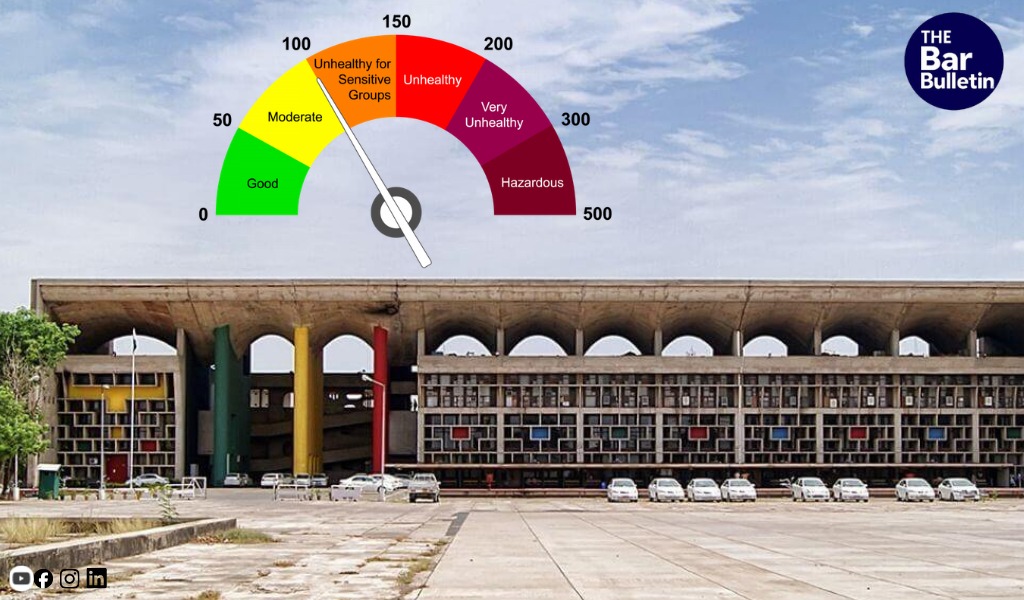

The Punjab and Haryana High Court has sought detailed data on air quality trends in Chandigarh while hearing a public interest litigation highlighting alarming pollution levels in the Tricity region.
The PIL raised concerns over severe air pollution, stating that the Air Quality Index (AQI) in Chandigarh had touched “disaster-level” figures, reportedly reaching between 353 and 438 during December 2025.
Taking note of the submissions, a Bench comprising Chief Justice Sheel Nagu and Justice Sanjiv Berry directed the petitioner to place on record data reflecting the worst AQI levels recorded in Chandigarh for each month over the past five years. The Court indicated that such data would be necessary to assess the extent and pattern of environmental deterioration.
The petition contends that despite recurring and predictable air quality crises, authorities have failed to implement structured and enforceable measures, including a region-specific graded response mechanism similar to the Graded Response Action Plan (GRAP). It highlights that the Chandigarh–Panchkula–Mohali region operates as a single airshed, yet governance remains fragmented, resulting in ineffective pollution control.
The plea further argues that prolonged exposure to hazardous air quality violates the fundamental right to life under Article 21, particularly impacting vulnerable populations such as children and the elderly. It seeks directions for constitution of a joint action committee and implementation of coordinated, time-bound pollution control measures.
The matter has been listed for further hearing on May 14, 2026.
Appearances:
For the Petitioner: Ms. Srishti Sharma, Petitioner in person; Mr. Abhinav Sood, Addl. Standing Counsel, UT Chandigarh, Mr. Himanshu Malik, Junior Standing Counsel, UT Chandigarh, Mr. Akshay Sharma, Advocate. Mr. Salil Sabhlok, Senior DAG, Punjab. Mr. Neeraj Gupta, Addl. Advocate General, Haryana.
