


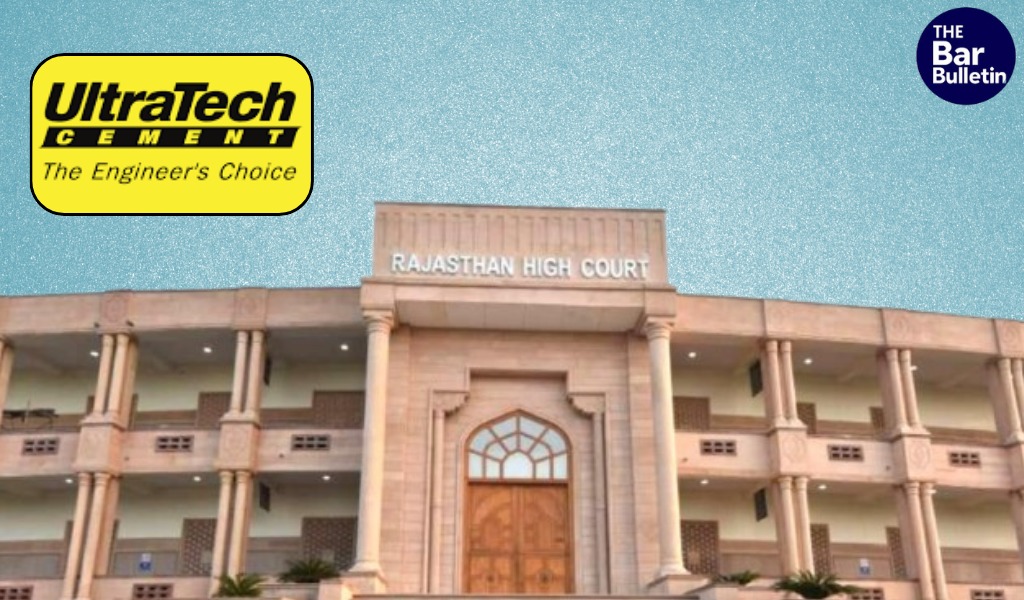

The High Court of Rajasthan at Jodhpur Bench has clarified that the State can alter, amend, or withdraw its policy in the larger public interest and/or fiscal requirements, but cannot take away accrued rights. Accordingly, the Court held the petitioners entitled to the limited benefit of the exemption promised under the Solar Policy, 2019, only in respect of those projects which have already been commissioned prior to the impugned amendment of the Solar Policy.
The Court also held that the impugned amendment, withdrawing the assurance of exemption from payment of electricity duty for 7 years and making it subject to government orders, cannot operate retrospectively to divest accrued rights and can only have prospective effect.
The Division Bench comprising Justice Arun Monga and Justice Sunil Beniwal observed that the Solar Policy, 2019, though executive in nature and not legislative, was a conscious and unequivocal representation intended to induce investment in the renewable energy sector, and not a mere vague policy guideline. Thus, the essential ingredients of promissory estoppel, namely a clear representation, intention to induce action, actual reliance, and resulting detriment, stand satisfied.
The Bench stated that the State’s contention that the exemption could only be granted by a statutory notification does not defeat the petitioners’ claim, as the State cannot be permitted to rely upon its own failure to issue a notification as a defence to defeat a promise consciously made. Hence, governmental representations, even if not backed by statute, are enforceable in equity where they have been acted upon to the detriment of the promisee, unless an overriding public interest justifies their withdrawal.
The justification of financial constraint advanced by the State fails to withstand scrutiny, as a mere bald assertion of fiscal burden, in the absence of substantive material, cannot suffice to defeat vested rights and legitimate expectations. Withdrawal of a specific and unambiguous assurance, after inducing substantial investment, without cogent justification, is manifestly arbitrary and unsustainable on the touchstone of Article 14 of the Constitution, added the Bench.
Lastly, the Bench emphasised that while the State retains the power to amend or modify its policies, such modification cannot operate retrospectively so as to divest accrued or vested rights, and at best, a change in policy can have prospective operation.
Briefly, Section 3 of the Rajasthan Electricity (Duty) Act, 1962 empowers the State Government to levy electricity duty and also to exempt it fully or partially in the public interest. In pursuance of the same, the Government of Rajasthan introduced the Rajasthan Solar Energy Policy, 2019, which provided for an exemption from the payment of electricity duty for a period of seven years from the Commercial Operation Date (COD) for captive solar plants registered under the policy.
Acting upon this representation, Petitioner No. 1 (UltraTech Cement Limited) altered its position and invested approximately Rs. 89 crores in setting up captive solar power plants at Aditya Cement Works and Kotputli Cement Works. On May 10, 2022, the Government of Rajasthan issued an impugned notification amending Clause 16.4 of the Solar Policy, 2019, withdrawing the assurance of exemption from payment of electricity duty for 7 years and making it subject to government orders and notifications issued under the 1962 Act.
Consequently, the Chairman of Ajmer Vidyut Vitran Nigam Ltd., Jodhpur Vidyut Vitran Nigam Ltd., and Jaipur Vidyut Vitran Nigam Ltd. (Rajasthan Discoms) raised bills levying electricity duty on the consumption of self-generated energy from the petitioner’s captive power plants.
Appearances:
For the Petitioner: Senior Advocate Vikas Balia and Advocates Sharad Kothari, Lakshyajit Singh Badhwal, Sachin Saraswat, Shridhar Mehta, Abhishek Aggarwal, T.C. Sharma, Sunil Joshi, Kuldeep Bishnoi, Ankur Mathur, Kalpit Shishodia, Chirag Soni, Samikrith Rao, Kunal Kaul, Abhishek Howt, Dinesh Kumar Bishnoi, Priyansh Arora, Gopal Sandu, Varsha Paliwal, Yashraj Singh Kanawat, Lakshya Bagadwat, Punit Choudhary, Manish Priyadarshi, Ayush Goyal, Vijay Bishnoi, and Sachin Lohia, and Mridul Chakravarty.
For the Respondent: Advocate General Rajendra Prasad, AAGs Mahaveer Bishnoi and Nathu Singh Rathore, along with Advocates Anirudh S. Shekhawat, Dheerendra Singh Sodha, Anurag Jyani, Harshwardhan Singh Chundawat, Arpit Samaria, Manvendra Singh, and Bhavyadeep Singh.