


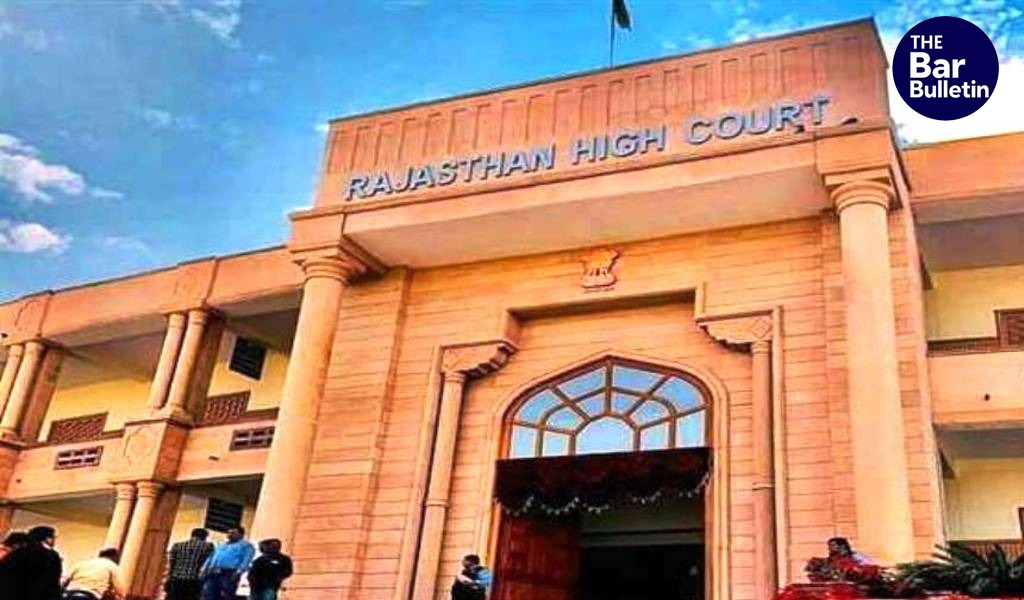

The Rajasthan High Court (Jodhpur Bench) has held that the State of Rajasthan is under a clear constitutional obligation to translate the mandate of the Supreme Court into tangible policy by carving out a distinct and effective reservation framework for transgender persons. While matters related to the structure of reservations, whether vertical or horizontal, are exclusively within the legislative and executive domains and beyond the permissible scope of judicial intervention under Article 226, the State Government must undertake a comprehensive and in-depth study through a committee to assess the extent of compounded marginalization suffered by transgender persons and formulate a workable framework to achieve substantive equality.
Pending such policy decision, and to address the immediate inequity, transgender persons belonging to SC/ST/SEBC/OBC/open categories shall henceforth be granted 3% additional weightage in the maximum prescribed marks for purposes of selection and appointment on the posts and admission to educational institutions under the State Government, its instrumentalities, public sector undertakings, and State-funded or aided institutions.
The Division Bench comprising Justice Arun Monga and Justice Yogendra Kumar Purohit observed that the subsequent amendment to the Transgender Persons (Protection of Rights) Act, 2019, however, marks a departure from that said constitutional baseline. It is now proposed that legal recognition of gender identity shall be conditioned upon certification, scrutiny, or other forms of administrative endorsement. What was recognized by the Supreme Court as an inviolable aspect of personhood now risks being reduced to a contingent, State-mediated entitlement.
The Bench observed that while dismissing the contempt petition, it did not adjudicate the legality of the impugned notification or its compliance with the Supreme Court judgment in NALSA v. Union of India [(2014) 5 SCC 438]. The Bench noted that the pending Supreme Court case (Kiran A.R.) concerns medical college admissions (NEET-PG) and whether transgender individuals should be granted 1% horizontal reservation in each vertical category for such admissions. Whereas, the primary concern in the present petition is the State Government notification dated January 12, 2023, which was neither under challenge in the contempt jurisdiction nor is it the subject matter of the proceedings pending before the Supreme Court.
The Bench observed that the NALSA judgment directed the Centre and State Governments to treat TGs as socially and educationally backward classes and extend all kinds of reservations. The Court noted that the transgender population constitutes an exceedingly small fraction of the total population (0.024%) and the OBC segment (0.046%). If a separate horizontal reservation were carved out, its operational impact would be virtually illusory, as reserved roster points would arise only at long and irregular intervals, causing systemic frustration and significant administrative and logistical complications.
However, the Bench observed that the impugned notification creates a serious anomaly by subsuming all transgender persons within Entry No. 92 of the OBC category, effectively extinguishing pre-existing reservation entitlements for TGs born into SC/ST/SEBC families without affording them an option to choose. Even if an option to choose were assumed, the notification confers no tangible additional benefit, merely compelling a choice between two regimes without enhancing substantive entitlements.
The Bench thus concluded that the impugned circular is a mere facade and an eyewash, an exercise in form without substance, which confers no real reservation whatsoever and falls short of the reservation mandated by the Supreme Court.
Briefly, the petitioner, Ganga Kumari, a transgender individual, filed a petition seeking to quash a notification dated January 12, 2023, issued by the Government of Rajasthan, Department of Social Justice and Empowerment, which declared transgender persons (TGs) as Other Backward Classes (OBC) at serial number 92 without providing any reservation as a separate category. The petitioner essentially sought a mandamus directing the respondent to provide horizontal reservations in the public services of the State Government as per the mandate of the Supreme Court in NALSA v. Union of India [(2014) 5 SCC 438].
Previously, the petitioner had filed a petition seeking 1% horizontal reservation in the Rajasthan Police Subordinate Service Rules, which was disposed of on February 14, 2022, directing the State to complete the exercise of providing special treatment within four months. A subsequent contempt petition was filed, during the pendency of which the State issued the impugned notification dated January 12, 2023. The contempt petition was dismissed on August 18, 2023, as the Court observed the notification was issued in compliance with its earlier directions. Another writ petition was filed and withdrawn with liberty to file a fresh one providing better particulars regarding the population of TGs and the extent of OBC reservation.
As per the 2011 census, the total population of Rajasthan is 6,85,48,437, with the OBC population estimated at 35.6 million (around 52%), and the transgender population recorded at 16,517. The respondents argued that transgender individuals have already been classified under the OBC/SEBC category per the NALSA judgment, entitling them to vertical reservations, and that matters related to the structure of reservations are exclusively within the legislative and executive domains, beyond judicial review under Article 226.
Appearances:
Advocates Vivek Mathur, Prakash Kumar Balout and Dhirendra Singh Sodha, for the Petitioners
AAGs B.L. Bhati and Praveen Khandelwal, along with Advocates Deepak Chandak, Piyush Bhandari, Mahesh Thanvi and Pragya Thanvi, for the Respondents
