
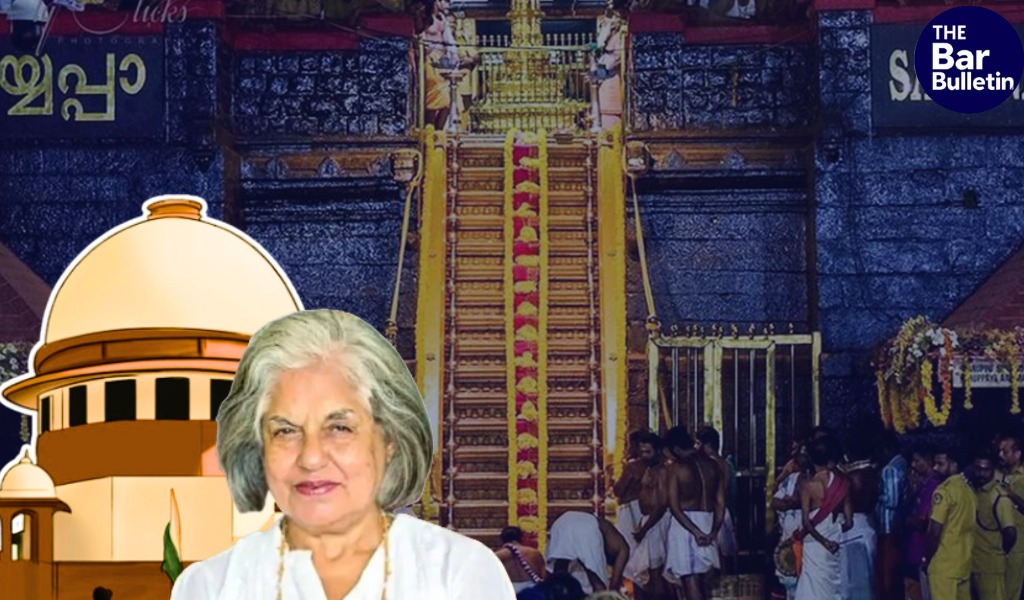
Senior advocate Indira Jaising, appearing before a 9-Judge Bench in the Sabarimala Reference, made a case that practices excluding women from places of worship violate the core guarantee of equality under the Constitution.
Opening her submissions, Ms Jaising framed the issue as one of constitutional interpretation rather than mere statutory reading. She confined her arguments specifically to the right to temple entry, stating that abstract questions must be grounded in concrete rights claims. She submitted that no religious practice, whether individual or denominational, can claim protection if it violates equality guarantees. As she put it, “this court will not recognise any practice which violates any of the provisions of Article 15, it is not entitled to recognition by a court of law.”
Denial of entry to women amounts to substantial deprivation
Referring to the Indian Young Lawyers Association v State of Kerala (Sabarimala) judgment, Ms Jaising emphasised that it remains in force as it is not stayed by the court till now and cannot be disregarded. She highlighted the lived consequences of exclusion, referring to women who entered the temple post-judgment and faced backlash, highlighting the gap between constitutional rights and ground realities.
She argued that the denial of entry to women between the ages of 10 and 50 amounts to “substantial deprivation” of rights under Article 25, submitting that it is the most productive years of a woman’s life. She argued that “any denial of equality is a substantial injury,” placing equality at the heart of religious freedom claims.
Ms Jaising also challenged the notion that courts should refrain from examining religious practices, calling such arguments a direct attack on judicial review. “Are we being told that religion is hands off from this court? My answer is no,” she asserted, adding that Indian courts have historically adjudicated religious questions, including through expert evidence.
Don’t throw away the essential religious practice test
Addressing the debate on essential religious practices, Sr. Adv Indira Jaising defended the doctrine as a necessary tool for harmonising competing rights. She cautioned against abandoning it in favour of vague standards such as bona fide belief, stating:
“The test of essential religious practice is to harmonise rights… The other side is telling you: throw away the essential practices test, throw away Devaru, and make everything and everyone a denomination. That is the answer to the question of how far to protect and how far not to protect a practice. Therefore, please do not throw out the essential practices test; if you do, the autonomy argument will prevail. At the same time, we must not ignore the civilisational and religious history of this land. Yes, the Constitution is a living, organic document, but let us not forget the background. The past shapes the present.”
Can a Practice Exclude a Constitutional Right?
Following her defence of the essential religious practices doctrine, Senior advocate Indira Jaising argued that Articles 25 and 26 must be harmonised rather than placed in hierarchy, as both ultimately stem from the same right to religion. She rejected the idea that denominational autonomy can override individual rights, emphasising that the State acts not on its own behalf but to protect fundamental rights in a parens patriae capacity. Temple entry laws, she submitted, are therefore instruments of equality, not intrusions into religion.
“The State is not claiming power on its own behalf; it acts on my behalf to protect my rights. Therefore, the only way forward is harmonisation. The real question before this Court is: what is to be protected and what is not? That cannot be decided by semantics or by reading Articles 25 and 26 in isolation. This is one indivisible Constitution, and the answer must come from its conscience. Ultimately, the question is one of inclusion and exclusion, can a practice exclude someone who has a right under the same Constitution?”
Temple Entry a Fundamental Right, Not Limited to ‘Devotees’
On the scope of religious freedom, she argued that while freedom of conscience predates the Constitution, it is structured and limited by it. She described the Constitution as a living document, capable of addressing new questions while remaining rooted in India’s civilisational context. Referring to Article 25(2)(b), she submitted that social reform includes reform within religion itself and cautioned that unchecked denominational autonomy would undermine this constitutional vision.
On temple entry, she submitted that the right to enter a place of worship is a fundamental right under Article 25(1), independent of denominational claims. While ritual practices may remain protected, exclusion from entry on grounds such as gender cannot be justified.
“The right to enter a temple, a place of worship, is a right guaranteed to me under Article 25(1) irrespective of any age group I belong to, my entry being a woman cannot be restricted. The limitation in law is Hindu, but in this case, they go further and say we allow others, but not women… What is the outcome? The outcome is I am excluded. I am excluded on both grounds, and I am claiming both rights.”
Responding to the question raised by Justice Ahsanuddin Amanullah, she clarified the view that only “devotees” can claim the right in not correct, highlighting that access to places of worship cannot be narrowly restricted by subjective standards of belief.
“I have not accepted the proposition that I can go there only if I am a believer… I need to go with reverence, I cannot go to create mischief, but I do not have to necessarily agree with all that is believed… How many of us go to temples without believing in that particular deity? We do.”
Custom Cannot Override Fundamental Rights
Continuing her submissions, Senior Advocate Indira Jaising argued that disputes within a religion over exclusionary practices are both possible and historically central to reform. Responding to the Bench’s query on whether such disputes can be adjudicated, she submitted that courts are competent to resolve them, particularly where competing claims arise over the existence and validity of customs and usage.
“If they say there is a custom that women cannot enter, and I say there is no such custom, I can approach the court that is exactly how religion has reformed…Any custom or usage which violates my fundamental rights will not get recognition by this court. If it has the force of law and violates rights, it is void, not voidable.”
She clarified that her claim was not for the creation of a new right, but for recognition of an existing constitutional guarantee. The central issue, she argued, was whether the Constitution permits exclusion of women from temples at all.
“I am not asking the court to create a right. I am saying the Constitution creates the right for me. Tell me whether the Constitution gives anybody the right to exclude a woman from a temple.”
The majoritarian view can’t override the individual constitutional freedoms
Responding to a question from the bench about majority sentiment, Ms Jaising firmly rejected the idea that the will of the majority can override individual constitutional freedoms.
“It is not a desire, it is a freedom under Article 25(1). If you trump my right with majority belief, you are destroying my fundamental right.”
She also dismissed the argument that exclusion could be justified by claims of “hurt” to religious sentiments, insisting that only legal injury, not subjective discomfort, is constitutionally relevant.
“You tell me what legal injury I cause… If you show me a legal injury, I will not go.
Constitutional Morality Over Public Morality and Majoritarian Views
Senior Advocate Indira Jaising emphasised that the Constitution is not static but a living, evolving instrument grounded in its core values of justice, liberty, equality, dignity, and fraternity. She argued that constitutional interpretation must respond to changing social realities and emerging forms of inequality.
“The Constitution has a moral conscience to realise liberty, equality, fraternity and dignity of the individual. In a society structured by wealth and power, the search for equality is a continuous one.”
She submitted that the Constitution is the highest normative authority (Grundnorm), to which all customs, traditions, and religious practices must yield. She strongly rejected the idea that courts should abstain from adjudicating religious disputes.
“There is no norm higher than the constitutional norm in this country… all else, including culture and religion, must yield to this norm.”
She further defended judicial review as essential to preserving constitutional morality:
“The moral conscience of the Constitution is redeemed by the judiciary through judicial review… you cannot leave it to the legislature to decide what is constitutional and what is unconstitutional.”
She cautioned against relying on vague notions of public morality, arguing instead for a structured understanding of constitutional morality rooted in the Preamble, Fundamental Rights, and Directive Principles.
“Constitutional morality narrows down the vagueness of the word morality… the public can be full of prejudices.”
She positioned the judiciary as a counter-majoritarian institution, tasked with protecting minorities against dominant social norms.
Courts’ Role in Adapting Law to Social Change (Living Tree Doctrine)
Referring to the “living tree” doctrine, she argued that the Constitution must grow with society and cannot be confined to the framers’ original intent.
“The Constitution of India is not a static text… it is a living document… giving effect to transformative aspirations in response to changing social realities.”
She reinforced that law must evolve with society, stressing: “Law without purpose has no result… the purpose of law is the evolution of a happy society.”
Real-World Consequences of Exclusion: Inequality, Gender Justice, and Exclusionary Practices
Ms Jaising grounded her arguments in ongoing legal controversies, illustrating how exclusionary religious or social practices raise constitutional concerns. She pointed to issues such as:
- Female genital mutilation
- Marital Rape
- Social boycott
- Gender-based exclusion in religious communities
- Discrimination against women in marriage and inheritance
“Are you going to give constitutional sanctity to such practices, or will you say no?”
She highlighted that gender justice lies at the forefront of contemporary constitutional adjudication, noting that many recent landmark cases revolve around equality and dignity.