


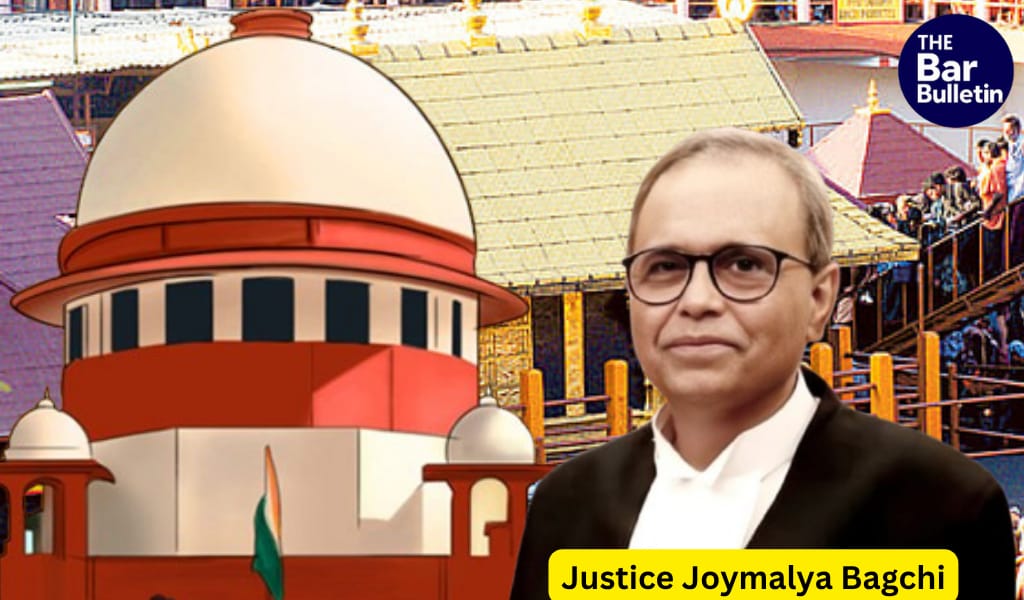

On the third day of hearings in the Sabarimala reference before the 9-judge Bench of the Supreme Court, Justice Joymalya Bagchi observed that the Court’s jurisdiction in matters of religion is not confined only to believers, noting that judicial intervention arises where there is a dispute regarding the existence or nature of a claimed religious practice.
The observation came during a broader exchange with Additional Solicitor General K.M. Nataraj on the nature of sampradaya (religious tradition), where ASG answered that there is “no rigid structure” and sampradayas evolve over time based on faith. Justice B. V. Nagarathna, however, emphasised that such traditions often carry elements of continuity and permanence, even within the diversity of Hindu religious practices.
Justice Bagchi raised a series of questions on whether changes in beliefs within a group, such as evolving practices or new philosophical ideas, would result in the formation of a new sampradaya. He contextualised this within the Hindu tradition, noting its history of “wave after wave” of philosophical evolution.
On the issue of judicial scrutiny, ASG Nataraj submitted that courts cannot scrutinise the correctness of a sampradaya from an external standpoint, as “these matters lie in the exclusive domain of denomination”.
Responding, Justice Bagchi clarified that courts do not determine religious practices in the abstract but step in when there is a conflict, such as when one group asserts a practice as part of a sampradaya and another disputes it.
He emphasised that under Section 9 of the Civil Procedure Code, any divergence or conflict necessarily invites adjudication, observing that such questions “require to be resolved through the process of adjudicatory mechanism” and cannot be kept outside the court’s domain. He illustrated that conflicts may arise even within a sampradaya over practices, such as modes of worship or observances, and reiterated that exclusion of courts is not tenable where rights are contested.
He further extended this to situations involving non-believers, noting that a person asserting a right of conscience may come into conflict with denominational practices, raising the question whether such an individual would be bound by the collective faith of the sampradaya. In response, ASG Nataraj argued that while individuals are free in matters of personal conscience, they cannot impose their choices on a denomination, arguing that a person cannot claim a right to alter established practices.
Concluding the submissions, he illustrated that in many temples, only vegetarian food is served, and a person cannot insist on being served non-vegetarian food on the basis of personal belief; similarly, in temples where liquor is offered as prasad, an individual cannot object to such practices or seek their alteration based on their own conscience.
Also Read
Read Day 1 Report- https://thebarbulletin.com/supreme-court-9-judge-bench-sabarimala-reference-live/
Read Day 2 Report- https://thebarbulletin.com/day-2-live-sc-9-judge-bench-hears-sabarimala-reference-case/