


loader image

LIVE: SC 9-Judge Bench Hears Sabarimala Reference Case

LIVE: SC 9-Judge Bench Hears Sabarimala Reference Case

The Supreme Court to begin hearing before a nine-judge Bench on reference arising from Sabarimala review pleas; The Court will examine scope of Articles 25 and 26, essential religious practices doctrine, and extent of judicial review in matters of faith.

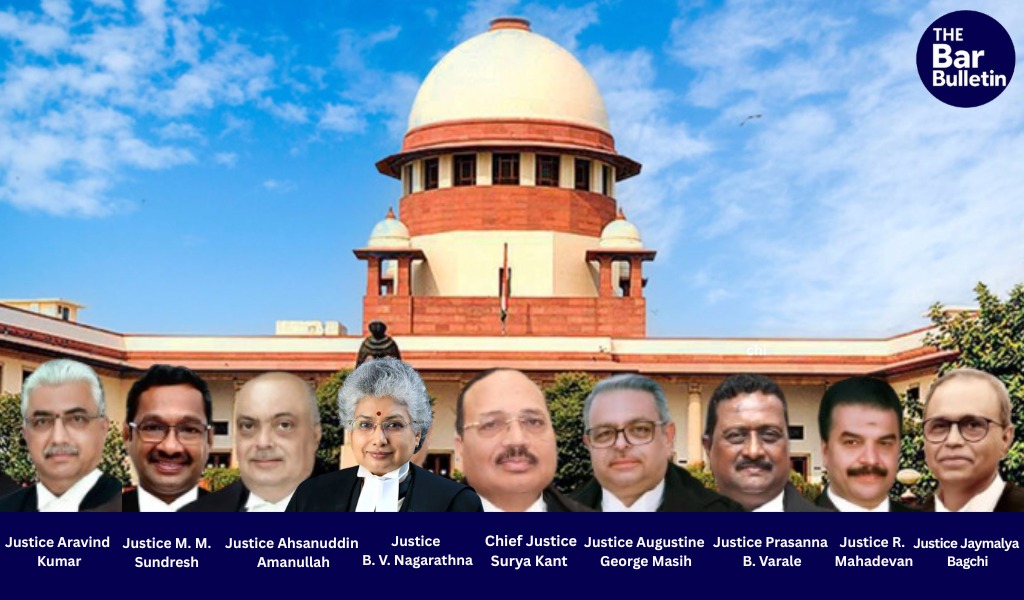
The nine-Judge Bench comprising the Chief Justice, Justice B. V. Nagarathna, Justice M. M. Sundresh, Justice Ahsanuddin Amanullah, Justice Aravind Kumar, Justice Augustine George Masih, Justice Prasanna B. Varale, Justice R. Mahadevan and Justice Joymalya Bagchi is presently considering the following seven broad constitutional questions:

  1. Whether a person not belonging to a religious denomination or religious group can question a practice of that religious denomination or religious group by filing a PIL?
  2. What is the scope and extent of judicial review with regard to a religious practice as referred to in Article 25 of the Constitution of India?
  3. What is the scope and extent of the word ‘morality’ under Articles 25 and 26 of the Constitution of India and whether it is meant to include Constitutional morality?
  4. What is the scope and ambit of right to freedom of religion under Article 25 of the Constitution of India?
  5. What is the inter-play between the rights of persons under Article 25 of the Constitution of India and rights of religious denomination under Article 26 of the Constitution of India?
  6. Whether the rights of a religious denomination under Article 26 of the Constitution of India are subject to other provisions of Part III of the Constitution of India apart from public order, morality and health?
  7. What is the meaning of expression “Sections of Hindus” occurring in Article 25 (2) (b) of the Constitution of India?

The Court has commenced the proceedings by reminding that the timeline prescribed in the order dated 16 February 2026 shall be strictly followed, whereby the hearings have been scheduled in a structured manner, with review petitioners to be heard from 7 to 9 April 2026, the opposing parties from 14 to 16 April 2026, rejoinders on 21 April 2026, and final submissions to be concluded by 22 April 2026.

Counsels argued on whether the present hearing pertains to a review of the Sabarimala judgment or is limited to answering the questions referred. Senior Advocate Indira Jaising sought clarification on it and stated that the Bench is required to decide only the referred questions, and that the issues would be addressed without concerning the earlier judgment, there being no mandamus or stay operating upon it. The Chief Justice observed that timelines had already been prescribed and it will go by it.


Before the nine-judge Constitution Bench of the Supreme Court of India, Solicitor General Tushar Mehta advanced a structured framework for interpreting Articles 25 and 26, urging the Court to delineate the scope of “religion”, “religious practices”, and “matters pertaining to religion” in light of India’s unique constitutional and social context. He submitted that earlier judgments had not fully considered key aspects such as Constituent Assembly debates and the extent of internal plurality within religions.

He submitted that the Court is essentially required to interpret three distinct but interrelated expressions “religion”, “religious practices”, and “matters pertaining to religion”, each of which carries a different constitutional meaning and scope of judicial review.

Emphasising that India is not only religiously plural but also marked by deep internal diversity within each faith, Solicitor General illustrated how Hinduism comprises multiple denominations, sects, and even non-theistic traditions, while Islam and Christianity too contain several doctrinally distinct sub-groups. He further pointed to Buddhism as an example of a religion that has evolved into multiple schools and traditions, with varying beliefs on concepts like salvation and practice, underscoring the difficulty in identifying any single, uniform “essential” practice.
Against this backdrop, he cautioned that the essential religious practices doctrine risks compelling courts to undertake theological determinations beyond their institutional competence. He emphasised that courts lack the expertise to interpret religious scriptures and doctrines, which often involve multiple commentaries and belief systems. Determining essentiality, he argued, would require courts to enter impermissible theological terrain and assess matters of faith that are inherently beyond judicial scrutiny

SG further submitted that Articles 25 and 26 must be interpreted in light of the Preamble, particularly the guarantee of liberty of thought, belief, faith, and worship. He urged that judicial review in matters of religion be confined to constitutional limitations public order, morality, health, and other fundamental rights rather than extending to adjudication of doctrinal correctness or essentiality of beliefs. In doing so, he cautioned against the uncritical adoption of foreign doctrines, stressing that India’s constitutional scheme on religious freedom is uniquely tailored to its pluralistic fabric.

During the hearing, Justice Jyomalya Bagchi posed a question to Solicitor General Tushar Mehta on whether courts can distinguish between an individual’s assertion of faith and the existence of that faith within a denomination, without entering into the substance of the belief itself.

Responding, SG Tushar Mehta submitted that while the existence of a belief within a religious denomination may be examined by courts using established legal tools, the validity, rationality, or scientific basis of that belief lies outside judicial scrutiny, as matters of faith may not conform to scientific temper or empirical verification. He highlighted that Article 25 protects faith even where it may not align with scientific reasoning, and courts cannot test religious beliefs on standards of rationality or scientific logic. He clarified a two-step approach: while courts may examine whether a belief is actually held by a denomination or section thereof, they cannot adjudicate upon the truth, validity, or essentiality of that belief

He further clarified that the Court may determine, as a matter of fact, whether a particular belief is genuinely held by a section or denomination, but not whether such belief is “essential” in a theological sense. According to him, if a practice appears irrational or socially undesirable, the appropriate remedy lies in legislative intervention under social reform, rather than judicial determination of essentiality.

He further stressed that even long-standing religious practices are subject to legislative intervention under Article 25(2)(b), which expressly empowers the State to enact laws for social welfare and reform, including regulating or prohibiting practices considered undesirable.

Mr Mehta also suggested that where disputes arise on whether a practice qualifies as religious at all, such questions are better suited for adjudication in civil suits, where parties can lead evidence and expert testimony. He cautioned against deciding such issues solely on affidavits in writ proceedings under Articles 32 or 226.

Mr Mehta rejected the view that Article 26 operates as a standalone right, submitting that Articles 25 and 26 must be read harmoniously with each other and with other fundamental rights, and cannot be treated as isolated or overriding provisions.

Emphasising that India is marked by both inter-religious and intra-religious plurality, he illustrated how Hinduism, Islam, Christianity, and Buddhism each comprise multiple denominations, sects, and doctrinal variations. This internal diversity, he argued, makes it constitutionally inappropriate to identify any singular or universally binding “essential” practice, reinforcing the need for judicial restraint in matters of faith.

During the hearing, Mr Mehta also took strong exception to the framing of the Sabarimala issue through the lens of patriarchy. He argued that Indian society has historically accorded women a position of respect and reverence, and cautioned against importing Western notions of gender inequality into the Indian constitutional context.

He further clarified that earlier constitutional and statutory interventions on temple entry were aimed at eliminating caste-based exclusion, and not gender-based distinctions. Taking objection to the 2018 Sabarimala judgment’s reference to “untouchability”, he submitted that Article 17 cannot be invoked in the context of menstruation.

Defending the Sabarimala practice, Mr Mehta characterised it as a sui generis denominational practice, stressing that Ayyappa temples across the country permit entry of women, with the restriction limited to one specific temple. He argued that not all religious practices can be tested on the touchstone of individual autonomy or dignity, and that certain practices such as dress codes or entry conditions in places of worship must be viewed as expressions of faith and denominational belief.

In his post-lunch submissions before the nine-judge Bench, Solicitor General Tushar Mehta placed significant reliance on the Court’s early Constitution Bench judgments, particularly Shirur Mutt and Venkataramana Devaru, to argue that the Constitution does not permit courts to determine the “essentiality” of religious practices. He submitted that these rulings recognise that matters of religion include not only doctrines but also rituals, observances, and modes of worship, and that it is primarily for the religious denomination itself to decide what constitutes its practices. Mehta contended that the later evolution of the essential religious practices doctrine represents a judicial departure from this position.

He further argued that Articles 25 and 26 must be harmoniously construed, emphasising that while denominations enjoy autonomy in matters of religion under Article 26(b), such rights are not absolute and may be subject to laws enacted for social reform under Article 25(2)(b). At the same time, he cautioned that this balance must be carefully maintained, and that courts must assess, on a case-by-case basis, whether giving precedence to one right would effectively nullify the other.

Referring to Devaru, Mr Mehta highlighted that denominational rights may yield to the right of temple entry in certain contexts, but not to the extent that the denomination’s core religious practices are extinguished. He stressed that the constitutional scheme requires a doctrine of harmonious construction, rather than hierarchy, between competing religious freedoms.

Additionally, he reiterated that judicial review in matters of religion must remain limited, and that courts cannot undertake theological inquiries into what is essential to a religion. According to him, such determinations lie within the domain of the faith itself, subject only to constitutional limitations such as public order, morality, health, and legislative reform.

The matter will be heard tomorrow.