


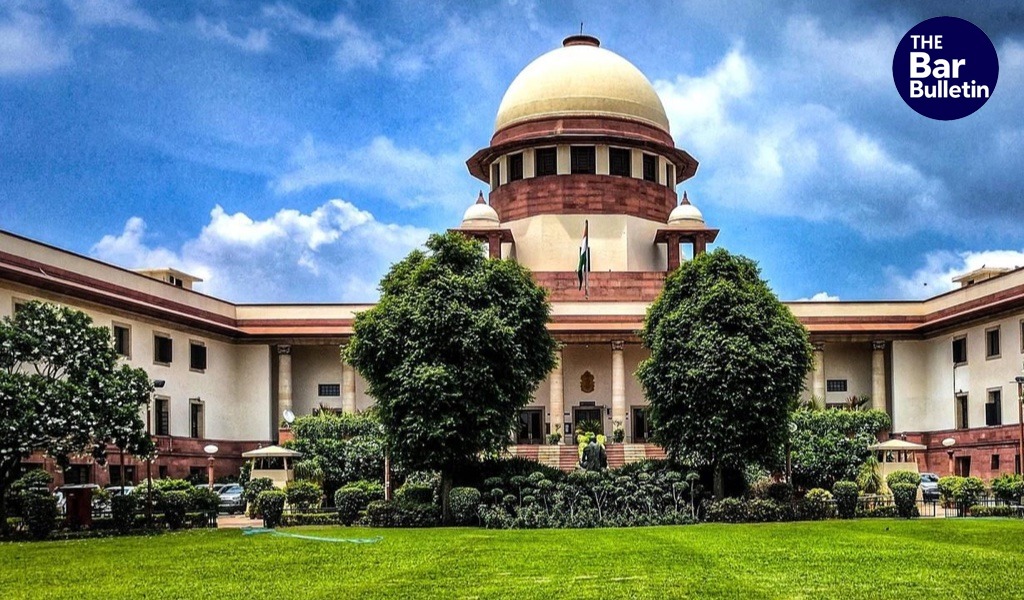

The Supreme Court has set aside the Delhi High Court’s decision quashing an FIR on the ground of limitation, holding that for the purposes of Section 468 of the CrPC, the relevant date is the date of initiation of criminal proceedings and not the date on which the Magistrate takes cognizance.
The case arose from an FIR registered in 2011 alleging offences under Sections 323 and 341 IPC following a physical altercation between the complainant and the accused outside a court complex, which also led to cross-FIRs. While the charge-sheet in the present FIR was filed after one year and 20 days, the trial court and revisional court declined to discharge the accused, noting that the delay was attributable to the investigating agency and should not benefit the accused. However, the Delhi High Court quashed the FIR, holding that cognizance was taken beyond the one-year limitation period prescribed under Section 468 CrPC. This led to the present appeal.
Allowing the appeal, the Bench of Justice Prashant Kumar Mishra and Justice N. V. Anjaria held that the High Court committed a patent error in applying the date of cognizance as the starting point for limitation. The Court referred to Sarah Mathew v. Institute of Cardio Vascular Diseases, (2014) 2 SCC 62, in which the constitutional Bench held that “the relevant date for the purpose of computing the period of limitation… is the date of filing of the complaint or the date of initiation of criminal proceedings,” which in cases based on police reports would be the date of lodging the FIR.
The Court referred to Bharat Damodar Kale and Another v. State of A.P., (2003) 8 SCC 559, which reasoned that taking cognizance is an act of the Magistrate, often subject to delays beyond the control of the complainant, and adopting such a date would unjustly prejudice a diligent litigant. It emphasised that the law of limitation cannot be interpreted in a manner that allows an accused to benefit from delays attributable to the court or the investigating agency.
The Court highlighted the binding nature of Constitution Bench precedents, cautioning against reopening settled legal principles through repeated arguments.
“It has to be asserted that the Constitution Bench judgment is a beckoning binding precedent and the courts are bound by it. There cannot be any room to travel beyond the four corners of the binding nature thereof by raising spacious argument that the particular aspect was missed or that the particular contentions was not canvassed. Such stock contentions cannot dilute the law laid down by the Constitution Bench and its unimpeachable precedential value.”
Accordingly, the Supreme Court restored the criminal proceedings and directed that the trial proceed expeditiously in accordance with law.
Appearances
Petitioner- Ms. Shivani Vij, AOR
Respondents- Mr. Rajkumar Bhaskar Thakare, A.S.G. Mr. Mukesh Kumar Maroria, AOR Mr. Rishikesh Haridas, Adv. Ms. Seema Bengani, Adv. Mr. Vevek Gurnani, Adv. Mr. Arkaj Kumar, Adv. Mr. Praveen Swarup, AOR
