


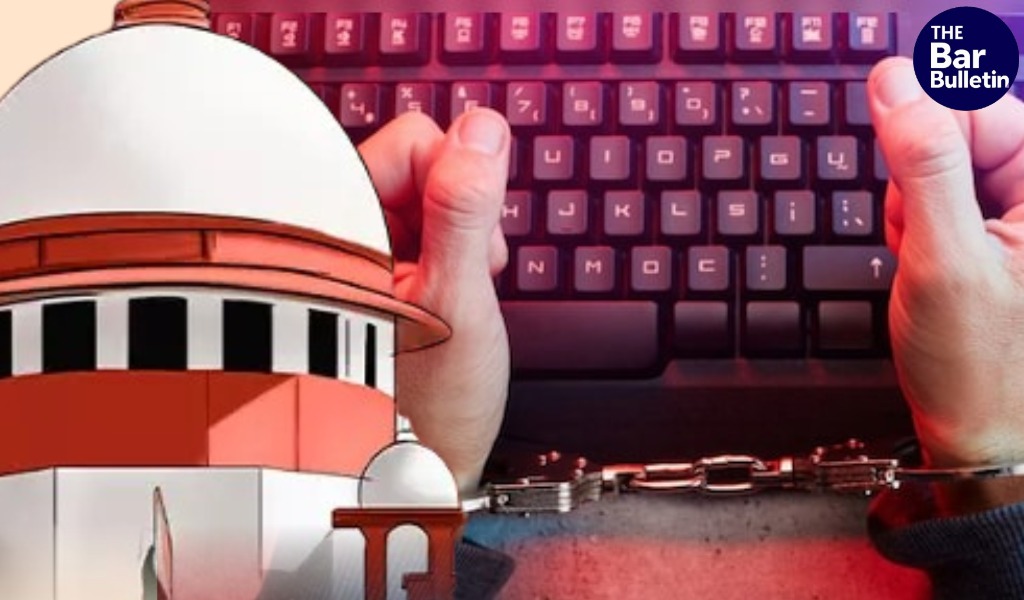

The Supreme Court today has expressed serious concern over the growing menace of “digital arrest” frauds and the systemic failures of telecom operators, banks and regulators in preventing large-scale financial crimes running into tens of thousands of crores.
Hearing the matter relating to victims of digital arrest scams involving forged documents, the Court directed the Department of Telecommunications (DoT) to notify rules within two weeks to curb the misuse of SIM cards and the routing of international calls as local calls through internet-based protocols. The Bench of Justice Surya Kant, Justice Joymalya Bagchi and Justice N.V. Anjaria noted that such measures cannot be delayed and must be implemented urgently.
The Court also took note of DoT’s implementation of a Centralised International Out-Roamer (CIOR) system in October 2024 to identify spoofed international calls, observing that regulatory steps must now translate into effective ground-level prevention.
The Ministry of Electronics and Information Technology (MeitY) was directed to develop and operationalise a complaint-reporting mechanism for digital fraud victims within four weeks. The Court underlined that the reporting framework must be victim-friendly and time-bound.
On the banking front, the Court expressed dissatisfaction with the Reserve Bank of India’s enforcement approach, observing that nominal penalties imposed on banks for regulatory violations are not commensurate with the losses suffered by victims. The Bench highlighted that while RBI has mandated AI-based fraud detection tools, implementation remains inconsistent, with several banks failing to deploy effective systems such as velocity checks for abnormal transactions.
The Court noted submissions that over ₹52,000 crore has allegedly been siphoned off through cyber-enabled frauds since 2021, stressing that banks act as trustees of public deposits and cannot prioritise commercial convenience over depositor safety.
It directed the RBI, Ministry of Home Affairs, Department of Revenue and MeitY to examine:
• suspension of suspicious transactions in accordance with law,
• strengthening reporting of suspicious accounts, and
• evolving a framework for victim compensation in digital arrest cases through a joint mechanism.
Calling for a “pragmatic and liberal approach” towards victims, the Court emphasised that voluntary transfers made under coercion or deception cannot be held against victims seeking redress.
The Bench directed that a fresh status report on compliance with all directions be filed and listed the matter for further hearing after four weeks.