
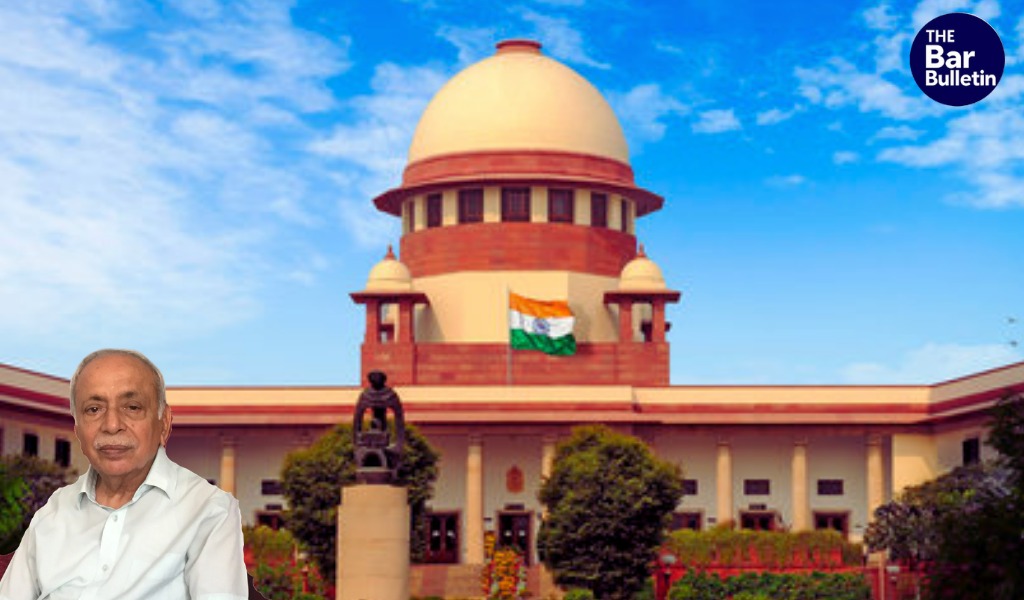

Former IAS officer and General Secretary of Lok Prahari, S.N. Shukla, appearing for Lok Prahari in person before the Supreme Court, argued that the Chief Election Commissioner and Other Election Commissioners Act, 2023 (“the Act”), amounted to a “fraud on the Constitution” as it enabled executive dominance over appointments to the Election Commission.
Challenging Sections 6, 7 and 8 of the Act, Shukla contended that the law violated Articles 14 and 324 by failing to ensure an independent, impartial and transparent appointment process. He argued that the selection committee, as presently constituted, had an “inherent incapacity” to make objective selections and urged the Court either to strike down the provisions or read them down by introducing a judicial safeguard involving the Chief Justice of India.
Opening his submissions, Mr Shukla told the Bench of Justice Dipankar Datta and Justice Satish Chandra Sharma that the challenge was not based merely on the Constitution Bench ruling in Anoop Baranwal v. Union of India, 2023 (6) SCC 1, but also on “proven legal infirmities” in the impugned provisions and appointments made under the Act, allegedly revealed through government records obtained under the RTI Act. He argued that the records showed serious procedural and constitutional defects in how the law was enacted and implemented.
He submitted that despite Dr. B.R. Ambedkar’s warning in the Constituent Assembly that Election Commissioners should not be “under the thumb of the Executive,” the 2023 law failed to address that concern precisely. Reading from his petition, Mr Shukla quoted Ambedkar’s statement that fixed tenure alone was meaningless if there were no constitutional safeguards against executive influence.
According to him, Sections 6 and 7 of the Act violated Articles 14 and 324 because they gave the executive a “free hand” over appointments. He argued that the law failed to preserve the four constitutional fundamentals of the Election Commission: impartiality, fearlessness, transparency and purity, which he said were recognised both by the framers of the Constitution and by the Supreme Court in Anoop Baranwal.
A major focus of his challenge was Section 6, which creates the Search Committee.
- Search Committee.—A Search Committee headed by the Minister of Law and Justice and comprising two other members not below the rank of Secretary to the Government of India, shall prepare a panel of five persons for consideration of the Selection Committee, for appointment as the Chief Election Commissioner and other Election Commissioners.
Mr Shukla argued that the original Bill had proposed the Cabinet Secretary as Chairperson of the Search Committee, but this was altered at the last minute during parliamentary debate to substitute a Union Minister. He contended that this amendment was moved without the mandatory approval of the Cabinet under the Government of India (Transaction of Business) Rules, 1961, making the process legally unsustainable.
He further claimed that the change was introduced “surreptitiously,” without any meaningful discussion in Parliament and without explanation as to why the Cabinet Secretary was replaced by a Minister or why the requirement of experience in election-related matters was removed.
Mr Shukla also accused the government of concealing critical reports and Law Commission recommendations from both the Cabinet and Parliament while securing approval for the legislation. He pointed the Court to Cabinet notes obtained through RTI proceedings and argued that these materials demonstrated suppression of relevant considerations.
Turning to Section 7 of the Act, Mr Shukla argued that the Selection Committee “as constituted has an inherent incapacity to select the best person through an objective assessment.” He contended that the structure of the committee made independent appointments impossible because executive members effectively dominated the process. Section 7 of the Act provides for:
7. Selection Committee.- (1) The Chief Election Commissioner and other Election Commissioners shall be appointed by the President on the recommendation of a Selection Committee consisting of-
(a) the Prime Minister-Chairperson;
(b) the Leader of Opposition in the House of the People-Member;
(c) a Union Cabinet Minister to be nominated by the Prime Minister-Member
He urged the Court either to strike down the provision or to “read it down” by introducing a judicial safeguard. According to his proposed formulation, if there was no unanimity within the Selection Committee, the matter should be referred to the Chief Justice of India for a final decision. He described this as the only way to preserve the constitutional independence of the Election Commission.
On Section 8 of the Act, which empowers the Selection Committee to determine its own procedure, Mr Shukla argued that the provision conferred “uncontrolled discretionary power” without any norms, safeguards or transparency requirements.
- Power of Selection Committee to regulate its own procedure.—
(1) The Selection Committee shall regulate its own procedure in a transparent manner for selecting the Chief Election Commissioner or other Election Commissioners.
(2) The Selection Committee may also consider any other person than those included in the panel by the Search Committee.
Relying on earlier Supreme Court precedent criticising vague procedural frameworks, he argued that the absence of guidelines rendered the provision unconstitutional because the committee’s functioning was left entirely unguided.
Referring to S. Krishnan v. State of Madras (1951 SCR 621), he argued that any legislation enacted with the purpose or effect of defeating constitutional guarantees could be invalidated as unconstitutional.
Throughout the hearing, the Court repeatedly steered Shukla back to the constitutional merits, while he insisted that the defects in the Act were not merely procedural but struck at the institutional independence of the Election Commission itself.