
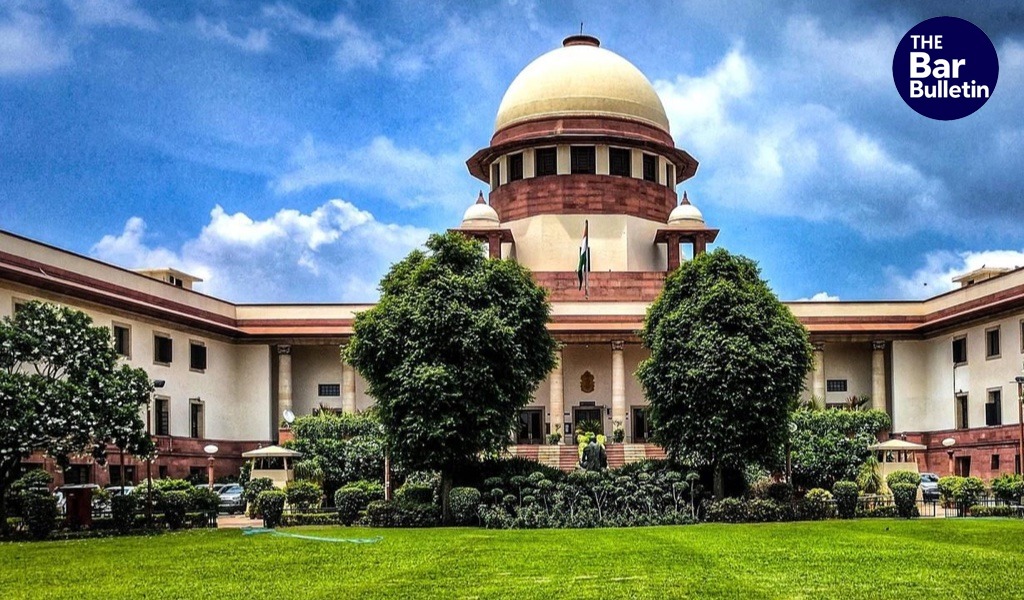

The Supreme Court has held that for determination of compensation under the National Highways Act, 1956, Sections 26 to 28 of the 2013 Land Acquisition Act apply, and the authority must determine market value strictly in accordance with Section 26(1). A sale exemplar under Section 26(1)(b) can be relied upon only if it relates to “similar type of land” and the “average sale price” must be derived using the statutory methodology in Explanations 1 to 4.
The Court explained that a single sale deed of a dissimilar category of land cannot lawfully be used for that purpose. Where the Ready Reckoner or stamp duty value under Section 26(1)(a) is the applicable higher valid criterion, that value must be adopted. An arbitral award ignoring these statutory requirements is vitiated by patent illegality and is liable to be set aside under Section 34(2A) of the Arbitration and Conciliation Act, 1996.
A Two-Judge Bench comprising Justice Sanjay Kumar and Justice K Vinod Chandran observed that in view of the Removal of Difficulties Order and the decision in NHAI v. P. Nagaraju alias Cheluvaiah [(2022) 15 SCC 1], the provisions of Sections 26 to 28 of the 2013 Act apply to determination of compensation under the National Highways Act. It extracted Section 26(1) and noted that the Collector must adopt the higher of the values under clauses (a), (b), and (c), with clause (a) referring to the market value specified for registration purposes under the Indian Stamp Act and clause (b) referring to the average sale price for similar type of land situated in the nearest village or vicinity, to be determined in accordance with Explanations 1 to 4.
Applying Section 26(1), the Bench held that the Arbitrator had demonstrably erred in relying on a single sale deed concerning a small residential plot in an adjoining village to determine compensation for land used for an industrial purpose. The Court held that the two lands were not of a “similar type” within Section 26(1)(b), and the statutory methodology under Explanations 1 to 4 did not permit reliance on a single sale deed to determine average sale price. The Bench also reiterated that Section 26(1) contemplates multiple sale deeds for reference and that singular deals may not provide adequate and reliable data.
The Bench further held that the arbitral award suffered from patent illegality under Section 34(2A) of the Arbitration Act because the Arbitrator had completely ignored the mandate of Section 26(1)(b) and the Explanations by adopting a single and dissimilar sale exemplar. Since the respondent itself had cited the Ready Reckoner rate of Rs. 2,020 per square meter applicable to lands on the highway in Zone 4, and Mouza Pardi (Rithi) fell within Zone 4, the Bench held that Section 26(1)(a) was the proper statutory basis. It therefore fixed compensation at Rs. 2,020 per square meter for the acquired 1,394 square meters, together with consequential statutory benefits, and directed that the Rs 50 lakhs already withdrawn be adjusted while disbursing the balance.
Briefly, the dispute concerns enhancement of compensation for land acquired for four-laning of National Highway No. 547-E under the National Highways Act, 1956. The respondent claimed ownership of 1,394 square meters of land in Survey No. 66, Mouza Pardi (Rithi), Tahsil-Saoner, Nagpur District. A notification under Section 3A(1) of the National Highways Act was issued and the competent authority under Section 3G(1), treated the land as fallow/agricultural dry crop land and awarded compensation at Rs. 161.63 per square meter based on three sale deeds relating to agricultural land in Mouza Pardi (Rithi).
The landowner challenged that determination before the Arbitrator under Section 3G(5) of the National Highways Act, contending that the land had wrongly been treated as agricultural land although it was being used for an industrial purpose. The respondent relied on documents showing such use, referred to the Ready Reckoner rate of Rs. 2,020 per square meter for similar lands abutting the highway, and also relied on a registered sale deed relating to a residential plot of 195.09 square meters in nearby Mouza Saoner showing a rate of Rs. 3,588 per square meter. By award, the Arbitrator accepted that the land was in non-agricultural use and awarded compensation at ₹3,588 per square meter by applying the rate from that sale deed.
NHAI and the Government of India challenged the arbitral award under Section 34 of the Arbitration and Conciliation Act, 1996. The District Judge set aside the award on the ground that the Arbitrator had acted contrary to Section 26 of the Right to Fair Compensation and Transparency in Land Acquisition, Rehabilitation and Resettlement Act, 2013. On appeal, the High Court restored the arbitral award, holding that the respondent’s land was being used for an industrial purpose, that the sale deed relied upon was genuine and related to land in a nearby village, and that the adopted rate was justified. The High Court also noted that the Ready Reckoner rate of Rs. 2,020 per square meter had not been considered by the Arbitrator.
Appearances:
Preetesh Kapur, Sr. Adv., Sumit Gupta, Adv. Jaikriti S. Jadeja, AOR, Akshay Kumar Tiwari, Adv., Tanya Shrotriya, Adv., for Appellant
Dhruv Mehta, Sr. Adv., Rajat Joseph, AOR, Yashraj Kinkhede, Adv., Shrirang B. Varma, Adv. Siddharth Dharmadhikari, Adv., Aaditya Aniruddha Pande, AOR, for Respondent
