
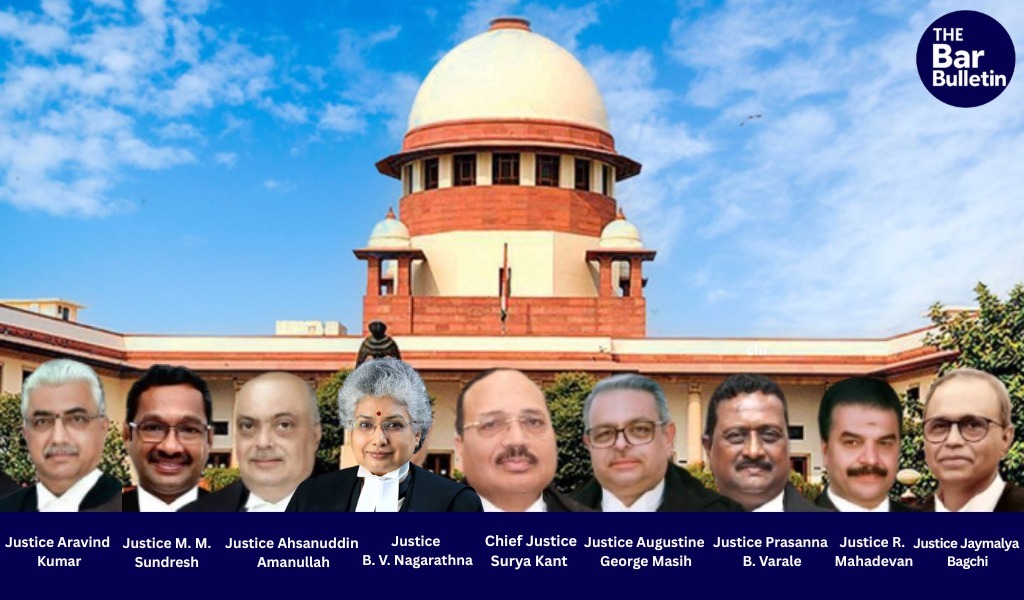

The Supreme Court on Thursday reserved its verdict in the Sabarimala reference matter after 16 days of marathon hearings before a nine-judge Constitution Bench. The Bench directed all parties to file their comprehensive written submissions by May 29.
The nine-Judge Bench comprising the Chief Justice, Justice B. V. Nagarathna, Justice M. M. Sundresh, Justice Ahsanuddin Amanullah, Justice Aravind Kumar, Justice Augustine George Masih, Justice Prasanna B. Varale, Justice R. Mahadevan and Justice Joymalya Bagchi is presently considering the following seven broad constitutional questions:
- Whether a person not belonging to a religious denomination or religious group can question a practice of that religious denomination or religious group by filing a PIL?
- What is the scope and extent of judicial review with regard to a religious practice as referred to in Article 25 of the Constitution of India?
- What is the scope and extent of the word ‘morality’ under Articles 25 and 26 of the Constitution of India and whether it is meant to include Constitutional morality?
- What is the scope and ambit of right to freedom of religion under Article 25 of the Constitution of India?
- What is the inter-play between the rights of persons under Article 25 of the Constitution of India and rights of religious denomination under Article 26 of the Constitution of India?
- Whether the rights of a religious denomination under Article 26 of the Constitution of India are subject to other provisions of Part III of the Constitution of India apart from public order, morality and health?
- What is the meaning of expression “Sections of Hindus” occurring in Article 25 (2) (b) of the Constitution of India?
The reference stems from the 2018 Constitution Bench judgment that allowed entry of women of all age groups into the Sabarimala temple. The present Bench is examining broader constitutional questions, including whether courts can determine “essential religious practices”, the balance between Articles 25 and 26 and equality rights, and the extent of State intervention in religious customs in the name of social reform.