


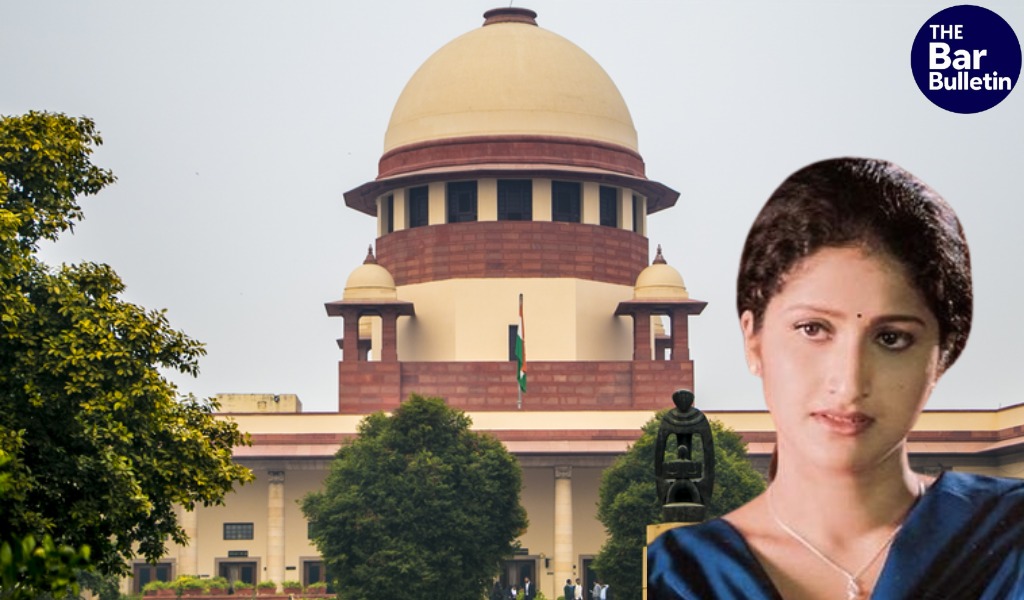

The Supreme Court has upheld the two-year sentence imposed on Gudipalli Sidharth Reddy in connection with the death of Telugu/Tamil actress Pratyusha in 2002, dismissing his challenge to the High Court judgment, which had convicted him for abetment to suicide under Section 306 of the IPC.
A Bench of Justice Manoj Mishra and Justice Manmohan affirmed the 2011 verdict of the High Court, which had reduced Reddy’s five-year jail term to two years and imposed a fine of ₹50,000, and ruled out the charge of murder and rape in the 2002 death of actress Pratyusha. “In light of the deceased’s own statement, hospital records, forensic reports and expert opinions, allegations of rape or murder are devoid of legal or factual foundation, the Court held.
The case arose from the death of Tamil/Telugu actress Pratyusha on 23 February 2002 after consuming pesticide (Nuvacron). Siddhartha Reddy, who was present with her, had also consumed poison but survived. The CBI charged him under Sections 306 (abetment of suicide) and 309 (attempt to suicide) IPC.
The trial court convicted him for abetment of suicide and sentenced him to five years’ imprisonment. In 2011, the High Court reduced the sentence to two years and imposed a fine. Reddy challenged the conviction before the Supreme Court.
While the Supreme Court ruled out murder by strangulation and rejected the rape charge, it affirmed that the death was caused by poisoning and examined the accused’s role through the prism of abetment. The chain of circumstances, including procurement of poison, credible witness testimony, rejection of accidental ingestion, and failure to explain incriminating facts, formed the basis of the Court’s ultimate determination on liability.
Not a Murder case
The Court ruled out the prosecution’s theory of murder by strangulation, holding that the allegation was not supported by the medical record. The Bench observed that the deceased was conscious at the time of admission to hospital, capable of responding and exhibiting motor reflexes, which would have been medically improbable in a case of manual strangulation. The absence of external injuries, including marks around the neck or signs of hemorrhage, further weakened the homicide narrative. The Court therefore conclusively rejected the theory that the death was caused by strangulation.
Instead, the Court held that overwhelming ocular and medical evidence established that the death was due to organophosphate poisoning. Doctors testified that the deceased had disclosed consumption of poison at the earliest point of medical examination.
No Rape case is made out
The allegation of rape against the appellant-accused was also found to be unsubstantiated. The Court noted that medical examination did not reveal injuries suggestive of forcible sexual assault, and the prosecution failed to establish lack of consent beyond reasonable doubt. It was observed that at such a belated stage, it was difficult to accept the theory that the cause of death was rape and strangulation when the initial medical records pointed clearly to poisoning. The shifting prosecution narrative was viewed with caution, particularly when it contradicted contemporaneous evidence.
The Court made strong observations regarding the postmortem report prepared by Dr. B. Muni Swamy, describing it as unprofessional and lacking scientific rigor. It found inconsistencies and unsupported conclusions in the report, observing that medical opinions in criminal trials must be objective and demonstrably supported by findings. The Court also cautioned against the consequences of premature and deliberate publication of case details, noting that such actions have the potential to distort public perception and prejudice fair adjudication.
Abatement of the Suicide case is made out
Relying on the testimony of a witness (shop-owner) that the accused came to the shop and asked for Nuvacron, it was inferred that the accused was likely aware of the toxicity of the said pesticide and had purchased it with the knowledge that ingesting the same would likely result in death. The Court found that the evidence this witness inspired confidence and was trustworthy.
The Bench drew an adverse inference against the appellant-accused in light of unexplained incriminating circumstances within his special knowledge. While reiterating that the burden of proof rests with the prosecution, the Court observed that failure to satisfactorily explain key circumstances can weigh against the accused. The defence theory of accidental consumption of poison was rejected as implausible, with the Court noting that the nature of the poison, the manner of procurement, and the surrounding conduct were inconsistent with an accidental ingestion narrative.
Significantly, the Court held that abetment was established through the purchase of Nuvacron, an organophosphate insecticide. The procurement of the poison prior to the incident formed a crucial circumstance pointing towards facilitation rather than mere passive presence.
The Bench also clarified that the precedent in Velladurai vs. State (2022) 17 SCC 523 was inapplicable to the present case, as the factual matrix materially differed, particularly in relation to active participation and procurement of the substance leading to death.
Addressing the argument of a mutual suicide pact, the Court clarified that a surviving partner in such a pact is not automatically absolved of criminal liability. Where evidence demonstrates active instigation or facilitation, legal culpability arises. The Court found that the accused’s conduct crossed the threshold from passive association to actionable abetment.
While rejecting the defence that the death was accidental, the Court upheld the conviction for abetment to suicide. The Bench directed that Reddy surrender within four weeks.
Appearances
Appellant- Mr. M Gireesh Kumar, Adv. Mr. Ankur S. Kulkarni, AOR Mr. Sanjay Singh, Adv. Mr. Tarun, Adv. Mr. G. N. Reddy, AOR Mr. P Venkat Reddy, Adv. Mr. P Srinivas Reddy, Adv. Mr. Sunni Muneer Basha, Adv.
Respondents- Mr. Arvind Kumar Sharma, AOR Mr. Vikramjit Banerjee, A.S.G. Mr. Nachiketa Joshi, Sr. Adv. Mr. Mukesh Kumar Maroria, AOR Mr. Sachin Sharma, Adv. Mr. Amit Sharma-b, Adv. Mr. Digvijay Dham, Adv. Mr. G. N. Reddy, AOR Mr. Prasanth Kumar Tyagi, Adv. Mr. Shreyas Kaushal, Adv.
