
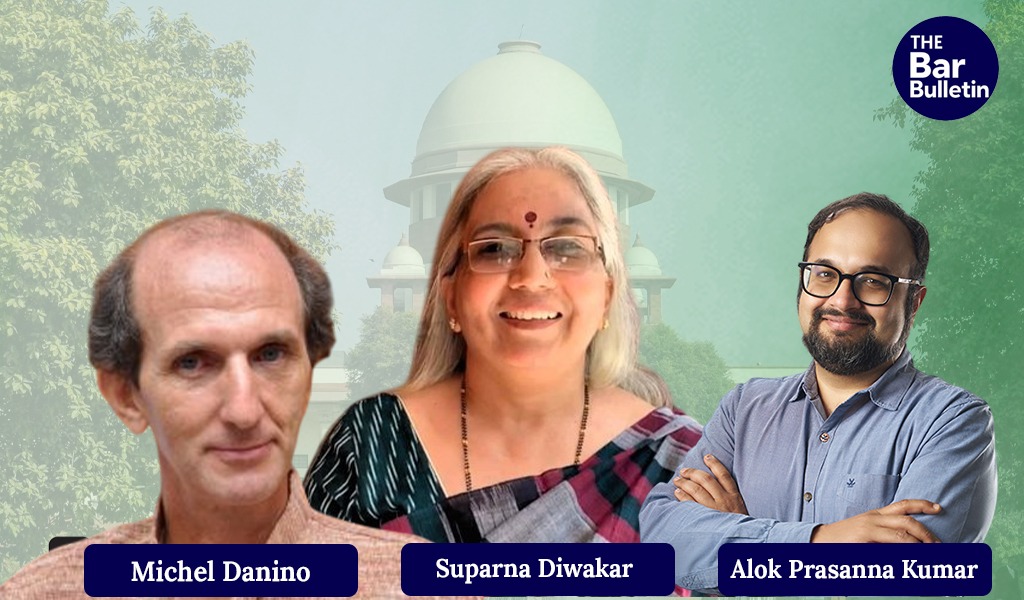

The Supreme Court on Friday substantially softened and modified portions of its earlier observations made in the NCERT textbook controversy, while clarifying that the Court’s concerns were directed at the contents of the textbook and not against the individual academics associated with its preparation.
The matter arose out of applications filed by authors of the NCERT Textbook of Class 8th- Profs Michel Danino, Alok Prasanna Kumar and Suparna Diwakar seeking modification of certain observations contained in the Supreme Court’s March 11, 2026, order concerning an NCERT Class 8 textbook chapter on the judiciary.
Also read- ‘This Was a Collective Process’: Supreme Court to Hear Authors’ Defence in NCERT Textbook Controversy https://thebarbulletin.com/supreme-court-ncert-textbook-controversy/
Solicitor General Tushar Mehta informed the Court that the Union Government had independently decided not to associate these three contributors with future textbook exercises. However, he clarified that the other prayers of the authors remain entirely within the court’s discretion.
The Solicitor General also brought another issue to the Court’s attention regarding certain cartoons contained in another NCERT textbook, which, according to him, may not be appropriate for impressionable students. The Court accordingly directed that the issue concerning the additional textbook material also be examined by the expert committee headed by former Supreme Court judge Justice Indu Malhotra. The Bench recorded:
“The said textbook also can be referred to the committee of Justice Indu Malhotra.”
______________________________________________________
Senior Advocate Shyam Divan, appearing for Michel Danino, urged the Court to reconsider paragraph 8 of the earlier order, arguing that the observations had caused severe reputational consequences for distinguished academics despite the order having been passed ex parte.
Addressing the Bench, he emphasised that the textbook drafting process was collaborative in nature and that there was no individual authorship or deliberate attempt to undermine the judiciary. Referring to the earlier observations attributing deliberate and knowing misrepresentation, he argued:
“When your Lordships make observations like this, it has massive impact across the country. Many states come running to show that we are good students… we are disenfranchising them immediately.”
He further cautioned the Court about the broader institutional consequences flowing from judicial observations:
“Because your Lordships are a court of record my Lords, this is for posterity. So, my problem is, if these paragraphs also, if one sentence can come that these observations are prima facie… it will help. Because as academics, my Lords, they have no protection.”
The Bench acknowledged these concerns and clarified that the attribution of mala fide intent would stand deleted from the earlier order. The Court observed:
“the conclusive opinion that there is an attribution of motive to your client is being deleted. We believe the observation that it was deliberate, knowing, misrepresentation to tarnish… we are deleting that portion.”
Justice Joymalya Bagchi further clarified that the Court’s concerns were directed at the contents of the textbook and not against the individual academics associated with it, observing, “Our comments are with the contents, not with the creators.” The Bench also accepted the explanation offered by the academics that there had been “zero intent” to malign or undermine the judiciary, stating, “that is the explanation we are accepting.”
However, while modifying portions of the earlier order, the Court highlighted that its concerns regarding the overall balance and presentation of the chapter continued to survive. The Bench remarked:
“We are not looking into positive or negative. We are seeing whether it’s a balanced side. And we felt it was not so.”
The Court specifically observed that the constitutional role of the judiciary had not been sufficiently highlighted in the chapter. At the same time, the Court clarified that discussions regarding institutional shortcomings, delays, or corruption could not automatically be treated as impermissible in educational discourse.
Senior Advocate Shyam Divan strongly defended the broader pedagogical approach adopted in the textbook and argued that educational material should not “whitewash” institutional challenges. He further pointed out that the chapter also extensively discussed judicial review, public interest litigation, environmental jurisprudence, and access to justice.
During the hearing, Senior Advocate Gopal Sankaranarayanan, appearing for Prof Alok Prasanna Kumar, submitted that the fallout from the Court’s earlier observations had already begun affecting careers and institutional affiliations. He informed the Court that certain state authorities had started distancing educational institutions from the concerned academics. Mr Sankaranarayanan submitted:
“These are academics of distinction. Their hard-earned effort and years of service will effectively suffer because perception matters unfortunately.”
Senior Advocate J Sai Deepak, appearing for Prof Suparna Diwakar, clarified that his client’s role in the textbook process had been limited and that she should not suffer professional consequences because of the controversy.
Senior Advocate J Sai Deepak submitted that the fallout from the Court’s earlier observations had extended far beyond the proceedings themselves, arguing that perceptions created by judicial remarks often produce serious professional consequences for academics. He pointed out that while the Court’s intention may have been limited, the manner in which the proceedings were reported had amplified the controversy.
In response, Justice Joymalya Bagchi remarked, “Do we have control over reporters?” The Bench thereafter expressed concern over sensational reporting surrounding judicial proceedings and observed that there was a need for “soberness and a degree of maturity” in responses to judicial orders rather than sensationalism. The Court further remarked that exchanges between judges and counsel in court should not be converted into dramatic public narratives divorced from the actual contents and context of judicial orders. Justice Bagchi observed:
“We would request you to create this climate as to its soberness and a degree of maturity in response to judicial proceedings and judicial orders, rather than sensationalism.”
Ultimately, while modifying the earlier observations and deleting portions attributing deliberate intent or mala fides to the academics, the Court left it open to the Union Government, State Governments, universities, and other authorities to independently decide future association with the concerned authors.
Appearances
Senior Adv Shyam Divan for Michel Danino
Senior Adv J Sai Deepak for Suparna Diwakar
Senior Adv Gopal Sankaranarayanan for Alok Prasanna Kumar