
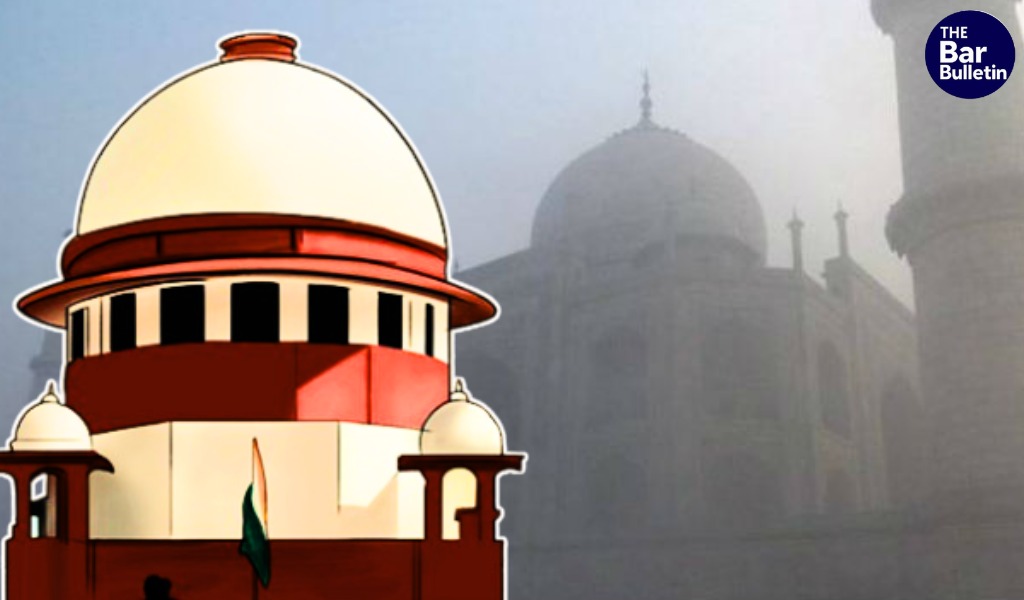

While emphasising over urban governance, and the State’s constitutional obligation to maintain ecological balance for present and future generations vis-à-vis industrial regulation of Taj Trapezium Zones, the Supreme Court has directed the Registry to register four new Suo Moto Writ Petitions (Civil) concerning: (a) Vision Document for the Taj Trapezium Zone; (b) Protection of Trees and Green Cover in the Taj Trapezium Zone; (c) Regulation of Industries in the Taj Trapezium Zone; and (d) Protection and Management of Water Bodies and Sewage in the Taj Trapezium Zone. At the same time, the Court directed that no new interlocutory applications or miscellaneous applications shall be entertained by the Registry in the instant petition or in the new suo motu cases until further orders.
The Amicus Curiae, in collaboration with counsel for the Union of India and the States of Uttar Pradesh and Rajasthan, was also directed to undertake a similar exercise to identify IAs that had become infructuous but had not yet been formally disposed of. All IAs where the Amicus and the respective AORs were ad idem that the same were infructuous were directed to be listed as miscellaneous applications before the Registrar Court for final disposal. Those IAs which the Amicus considered infructuous but which the respective AORs claimed remained pending were directed to be marked as “disputed” and listed before the Registrar Court for determining whether the matter required further consideration by the Supreme Court.
With respect to future writ petitions seeking permission to cut or relocate trees in the Taj Trapezium Zone, the Court directed that the Amicus shall prepare a tabulated chart containing, inter alia, the project proponent, details of the project, the number and types of trees to be cut or relocated, and the compensatory afforestation details, preferably by April 30, 2026.
A Three Judge Bench comprising Justice Surya Kant, Justice Joymalya Bagchi, and Justice Vipul M. Pancholi accepted that the present proceedings are emblematic of its environmental jurisdiction and of its resolve to give meaningful content to the right to a clean and healthy environment. It underscored that the evolution of this case reflected not only changing factual concerns but also the deepening of constitutional environmental jurisprudence over time.
The Bench expressly acknowledged that development and environmental protection are not opposing claims to be mechanically balanced, but constitutional values that must be reconciled through the discipline of sustainable development and inter-generational equity. It also reiterated that the precautionary principle and the polluter pays principle had been given operative content through its prior jurisprudence.
The writ petition, though originally confined to preservation of the Taj Mahal from air pollution, had over decades become a vehicle for a broad range of issues raised through numerous interlocutory applications, thereby losing procedural coherence and focus in its original form, noticed the Bench, while accepting the Amicus’s position that pending issues should not be transferred to the jurisdictional High Court(s). It took note of the fact that the Taj Trapezium spans different States, giving rise to jurisdictional complications, and that the pre-existing orders of the Supreme Court would make it difficult for the High Court(s) to adopt a dynamic approach if the issues were transferred.
The Bench clarified that closure of the instant petition does not efface the binding character of the orders and directions issued by it from time to time. The Bench also considered it necessary to lay down additional guidelines for petitions seeking permission to cut or relocate trees in the Taj Trapezium Zone, thereby indicating that while the original petition was being formally closed, substantive environmental supervision and procedural scrutiny in relation to the zone would continue under the renewed framework.
Briefly, the instant petition arose originally as a plea for preservation of the Taj Mahal, but over time expanded into a continuing environmental cause concerning heritage conservation and the State’s constitutional obligation to maintain ecological balance. At its inception, the petition was prompted by the visible deterioration of the Taj Mahal, including yellowing and blackening of its white marble, apparently attributable to air pollution in and around Agra. M.C. Mehta then approached the Court contending that a monument of unparalleled national and international significance ought not to be left vulnerable to unchecked emissions and administrative inaction.
In the forty-two years since the institution of the petition, both the factual matrix and the constitutional response had substantially evolved. Through a consistent line of decisions, the Court had given operative content to the precautionary principle and the polluter pays principle, while emphasising sustainable development and inter-generational equity, and had employed the device of continuing mandamus to secure effective enforcement of fundamental rights in relation to environmental wrongs.
Later, by order dated Feb 23, 2026, the Court had indicated that it would be appropriate to bring the writ petition to a formal close while ensuring that all live and subsisting concerns were carried forward in a more structured manner. The Amicus Curiae, Liz Matthew, Senior Advocate, accordingly placed a brief note on record indicating steps to facilitate this transition. She suggested, first, that the proceedings in the instant writ may be converted into a newer suo motu case structure with categorisation of pending interlocutory applications, and secondly, that the pending issues ought not to be transferred to the jurisdictional High Court(s), inter alia because the Taj Trapezium falls across State borders and because the long history of the issues before the Supreme Court would make it procedurally difficult for the High Court(s) to modify previous orders of this Court.
Appearances:
AOR Atishi Dipankar, for the Petitioner
A.S.G Aishwarya Bhati, Senior Advocates Ruchi Kohli, Liz Mathew, Aparna Bhat, AORs Ankur Prakash, Gurmeet Singh Makker, Sudeep Kumar, Badri Prasad Singh, Lakshmi Raman Singh, Ajit Sharma, M/S. Lawyer S Knit & Co, Rachana Joshi Issar, E. C. Agrawala, Dr. Mrs. Vipin Gupta, Prashant Kumar, Rajiv Tyagi, Rahul Tyagi, Ajay K. Agrawal, Shiv Prakash Pandey, Sudhir Kulshreshtha, P. K. Manohar, Pradeep Misra, P. Parmeswaran, P. Narasimhan, M/s. Manoj Swarup And Co., Mridula Ray Bharadwaj, M/s. Meharia & Company, Saurabh Mishra, Ankit Goel, Anurag Kishore, Rachit Mittal, Chitranshul A. Sinha, Nishit Agrawal, Rashmi Singh, Mukesh Kumar Maroria, Aakashi Lodha, Zoheb Hossain, Shishir Deshpande, Ishit Saharia, Gurmeet Singh Makker, Arvind Gupta, Shantanu Bansal, Savita Singh, Jogy Scaria, Guntur Pramod Kumar, Rajeev Kumar Dubey, Amrish Kumar, Adarsh Tripathi, Sunny Choudhary, Siddhartha Chowdhury, Saurabh Mishra, Shreekant Neelappa Terdal, Saurabh Yadav, Vishal Arun Mishra, Ankur Prakash, Ashutosh Dubey, Vivek Narayan Sharma, Gaurav Goel, Kamlendra Mishra, Kailash Parsad Pandey, Udita Singh, M/S. Gsl Chambers, M/S. M. V. Kini & Associates, Arjun Nanda, Arvind Kumar Sharma, Anupam Kishore Sinha, Gaurav Goel, Rajkumari Banju, Kailash Prashad Pandey, Shantanu Krishna, Dr. Rajeev Sharma, Saksham Maheshwari, Pushkar Sharma, Sumeer Sodhi, Vivek Gupta, Abhinav Agrawal, Seshatalpa Sai Bandaru, Praveen Swarup, Pranaya Kumar Mohapatra, Mayuri Raghuvanshi, Abhijit Banerjee, Abhishek Chaudhary, Syed Abdul Haseeb, Anshul Gupta, Satya Kam Sharma, Shraddha Deshmukh, Nischal Kumar Neeraj, Shubham Upadhyay, N. L. Ganapathi, Anju Thomas, Gaurav Dhingra, along with Advocates Kishan Chand Jain, Ashwini Kumar, Rajesh Kumar, Daleep Dhyani, Anupam Misra, Dr. Sumant Bharadwaj, Dr. Vedant Bharadwaj, Vikas Parashar, Ankit Kumar Chaudhary, Amrita Behera, D.m. sharma, Shrimay Mishra, Abhinav Pandey, Anup Kumar, Parish Mishra, Tanvi Aggarwal, Kanishk Raj, Srishti Agrawaal, Abhishek Sinha, Shivansh Bansal, Bharat Malhotra, Shivika Mehra, Rajeshwari Shankar, Sarthak Karol, Jagdish Chandra Solanki, Astha Singh, Shivika Mehra, Sarthak Karol, T.s Sabarish, Chitvan Singhal, Padmesh Mishra, Shrimay Mishra, Abhinav Pandey, Rajshri Dubey, Abhishek Chauhan, H.B. Dubey, Amit P. Shahi, Amit Kumar, Sona Khan, Sumant Akram Khan, Rajendra Anbhule, Anjan Datta, Rishabh Bhardwaj, Omkar Hemant, Nishtha Jindal, Virag Gupta, Akash Singh, Mahima Bhardwaj Kaluch, Dinesh Sharma, Manisha Rore, Rajeev Kumar Dubey, Ashiwan Mishra, Aditi Mishra, Sarthak Karol, Santosh Ramdurg, Yogesh Vats, Sarthak Chaturvedi, Pradeep Kumar Tiwari, M. Abhijnan, Sahitya Srivastava, Apoorv Jha, Raghav Sharma, Vartik Raj Srivastava, Varun Varma, Hitesh Kumar Sharma, Amit Kumar Chawla, Akhileshwar Jha, Mahi Pal Singh, Manisha Chawla, Shreya Jha, Niharika Dwivedi, Swati Vishan, Rashmi Prava Mohanty, Charanjeet Sidhu, Sandeep Singh Dingra, Saurabh Kumar Solanki, Anupam Kumar, Jogender Kumar, Sanjeev Kumar, Manoj Kumar, Desh Pal Singh, Prince Raj, Kamlesh Kumar Pandey, Raghavendra Pratap Singh, Honey Sharma, Bagat Ram, Vaishnavi Srivashtava, Shikher Deep Aggarwal, Karishma Maria, Prashant Sharma, Viresh Kumar Bhawra, Rajneesh Tingal, Suresh Chand, Kapil Sharma, Manish Arora, Akshit Chauhan, Amarjeet Prakash, Nagma Bee, Sahil Malik, Vinod Kumar, Vikrant Bhardwaj, Anirudh Kaushik, Ankit Verma, Govind Gupta, Sanjeev Kumar Choudhary, Shradha Choudhary, Vivek Pathak, Rohit Swarup, Devesh Maurya, Sheetal Kandpal, R.d. Maurya, Saurabh Rohilla, Kirti Dua, Aditya Tainguriya, Virender Kumar, Raj Rani, Garima Kumar, Shalen Bhardwaj, Reema Roy, Neelima Bagoria, Amod Kumar Mishra, Chandan Kumar Mandal, Deependra Kumar Pathak, Vishal Mudgal, Lakshmi, Smerity Rani, Sabika Ahmad, Shafiq Khan, Anjani Suri, Amit Kumar, Akash Maurya, P. Ravi Kiran, V.S Patel, Banisha Verma, Jyotika, and Anukriti Bajpai, for the Respondents
