


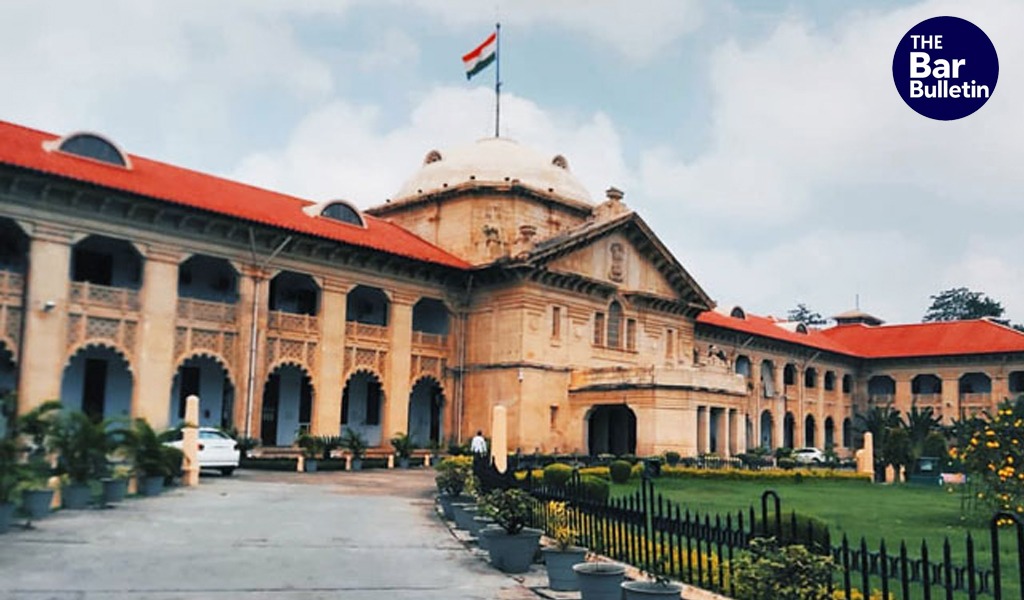

The Allahabad High Court (Lucknow Bench) has clarified that an order of suspension, subject to inquiry, may not be equated to be an order of blacklisting, and under the scope of judicial review, the Court cannot substitute its view with the technical expertise of the Technical Evaluation Committee, and it is not open to the court to independently evaluate the technical bids as an appellate authority.
The High Court explained that the rejection of a technical bid based on a bonafide assumption and doubts regarding product quality due to non-performance in another tender is not arbitrary or malafide, and the constitutional court will not interfere unless the thresholds of mala fides, intention to favour someone, bias, arbitrariness, irrationality, or perversity are met.
Accordingly, the Court held that the rejection of the technical bid of the petitioner (Vertel Digital Pvt Ltd) and their subsequent representation in the present tender for the procurement of various wireless equipments for the Uttar Pradesh Police department, by the State government, cannot be faulted with. However, the Court cautioned the State of U.P. not to treat the suspension order of the Government of Maharashtra dated January 13, 2026 as a blacklisting order in future tenders, and the petitioner shall be at liberty to participate in the same, in accordance with law.
The Division Bench comprising Justice Shekhar B. Saraf and Justice Abdhesh Kumar Chaudhary observed that the Bid Document merely mentions the word ‘blacklisting’ for the cancellation of a bid, and the word ‘suspension order’ is conspicuously absent. The Bench held that any suspension order by itself may not amount to an order of blacklisting, as normally the process of blacklisting has the principles of natural justice ingrained in it, which were not followed before the passing of the suspension order by the Government of Maharashtra.
The Bench noted that an order of suspension that is subject to inquiry does not amount to a blacklisting order, keeping in mind that any blacklisting order carries grave and serious consequences and has at times been termed the civil death of an entity.
The Bench went on to observe that the action of the respondent-State in rejecting the technical bid was based on a bonafide assumption that the suspension order amounted to a blacklisting order and cannot be treated as an arbitrary order or having been passed with any malafide intention. It noted that the equipment being procured is meant for police functioning, which is a significant module for maintaining law and order, and thus the quality of the equipment and after-supply service maintenance standard cannot be tweaked or compromised.
The Bench emphasized that the scope of judicial review in matters relating to tender is minimal, and the threshold of malafide intention, arbitrariness, irrationality, or perversity must be met before the constitutional court interferes with the decision-making process. Referring to Tata Motors Ltd. vs. Brihan Mumbai Electric Supply & Transport Undertaking (BEST) [(2023) 19 SCC 1], the Bench noted that it does not sit as a Court of Appeal and must give ‘fair play in the joints’ to the government in matters of contract.
Lastly, the Bench concluded that setting at naught the entire tender process at the stage when the contract is well underway would not be in public interest and would cause loss to the public exchequer. Further, it noted that under the scope of judicial review, the High Court could not ordinarily question the judgment of the expert consultant on the issue of technical qualifications when the consultant takes into consideration various factors including the basis of non-performance of the bidder.
Briefly, the petitioner participated in a tender for the procurement of various wireless equipment for the Uttar Pradesh Police department, wherein the last date for submission of the bid was Jan 02, 2026 and the date of opening of the technical bid was extended to Jan 15, 2026. On Jan 13, 2026, the Home Department, State of Maharashtra issued a suspension order against the petitioner with immediate effect, pending an enquiry, on the ground that the quality of similar equipment supplied to Maharashtra Police units was found to be substandard and the response during the warranty period was unsatisfactory.
Consequently, the Technical Evaluation Committee of the respondent-State disqualified the petitioner’s technical bid vide an order dated Jan 23, 2026, citing the Maharashtra suspension order. The petitioner’s subsequent representation was also rejected on the grounds that allowing the petitioner to participate would not be appropriate for maintaining a level playing field and that doubts regarding product quality would adversely affect the transparency and fairness of the procurement.
The petitioner then filed a petition before the Bombay High Court, which refused to pass any interim order. The petitioner subsequently filed a Special Leave Petition before the Supreme Court, which was disposed of on Feb 09, 2026 with a clarification that the observations made in the suspension order will be confined to the present tender and will not have a bearing on other tenders issued by other States. In the interregnum, the tendering process of the respondent-State concluded with the declaration of M/s Mobile Communications (India) Pvt Ltd. as the Lowest bidder (L-1) on Jan 30, 2026. The petitioner therefore filed the present writ, wherein a coordinate bench passed an interim order on Feb 24, 2026 restraining the State from entering into a contract with the L-1 bidder.
Appearances:
Advocate Mudit Agarwal, for the Petitioners
Advocate Akshat Kumar, for the Respondents
