
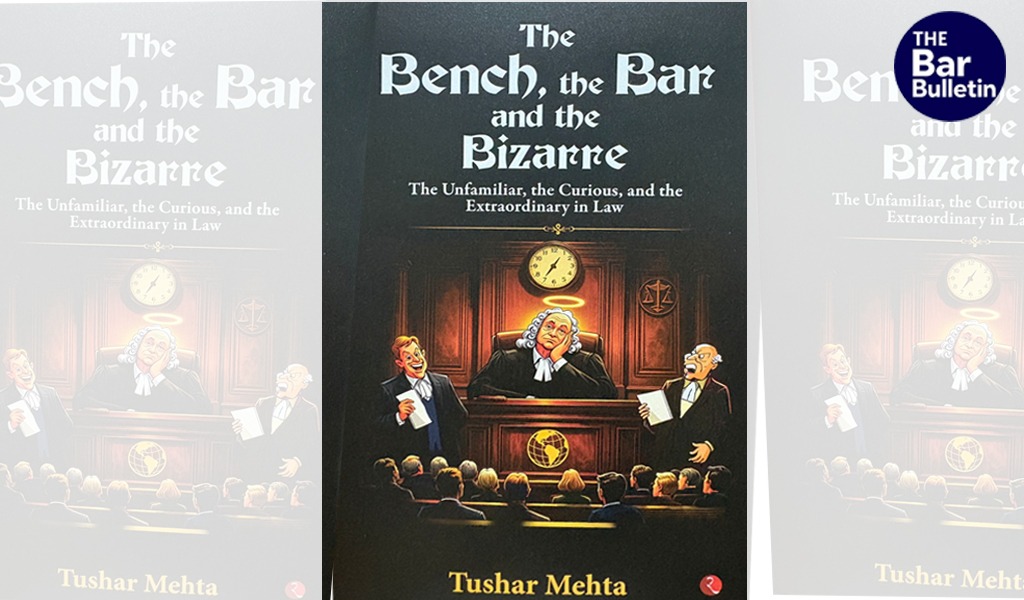

Some legal books explain the law. Some recount landmark cases. A rare few pull back the curtain on the culture, personalities, absurdities, and unspoken truths that animate the justice system. The Bench, the Bar, and the Bizarre by Solicitor General Tushar Mehta appears to belong firmly in that last category.
Beginning with the strikingly titled opening chapter, “The Divinity Virus: Bullies on the Bench,” Mr Mehta makes it immediately clear that this is not a conventional legal text. He opens not with dry doctrine, but with a provocative examination of judicial temperament, power, and the peculiar reverence that often surrounds those who sit on the bench. The “Divinity Virus,” as he terms it, is his description of the phenomenon where authority, ritual, and institutional insulation can occasionally produce a sense of infallibility among judges. He begins the narrative with the remark that, in litigation practice, judges are sometimes afflicted with an “incurable ailment” he calls ‘black robe-itis’, a sharp, witty phrase that encapsulates how authority can occasionally harden into self-importance.
What makes this chapter particularly compelling is not merely the criticism it advances, but the manner in which it is delivered. Mr Mehta writes with the confidence of an insider who has spent years navigating courtrooms at the highest level. His prose is sharp, witty, and unapologetically candid.
Descriptions of lawyers learning the delicate art of apologising to judges, advocates choosing strategic silence over correction, and courtroom hierarchies sustained by unwritten etiquette are rendered with both satire and startling realism. It is writing that entertains while provoking serious introspection.
Crucially, the critique does not rest on abstraction. The book is fortified with examples of judicial misconduct, courtroom bullying, disciplinary proceedings, and reversals where judicial behaviour itself became the subject of scrutiny. These episodes transform what could have been a rhetorical essay into a serious commentary on power and accountability.
The later chapters titled “The Tiny Tyrant,” “Judicial Rebels,” “Law Beyond the Living,” and “Artificially Intelligent, Legally Embarrassed” suggest a work that is as curious about the culture surrounding law as it is about law itself. The thematic range hints at a book that understands an important truth: the justice system is not merely built on judgments and statutes, but also on personalities, rituals, habits and humour.
That is perhaps the book’s greatest strength. It appears to treat law not as a sterile intellectual discipline, but as a profoundly human institution capable of brilliance and vanity in equal measure.
Mr Mehta writes not like an academic observer standing outside the system, but like someone who has spent years within it, watching its finest moments and its stranger ones unfold in real time. That insider vantage lends authenticity. At the same time, the accessible prose ensures that the book does not become inaccessible to readers outside the legal profession.
Legal writing often suffers from excessive solemnity. The Bench, the Bar, and the Bizarre seems refreshingly uninterested in that tradition. It brings wit without sacrificing seriousness, criticism without abandoning respect, and storytelling without losing intellectual substance.
In a profession that too often takes itself with unwavering seriousness, Mr Mehta’s work appears to offer something rare: reflection with personality.