
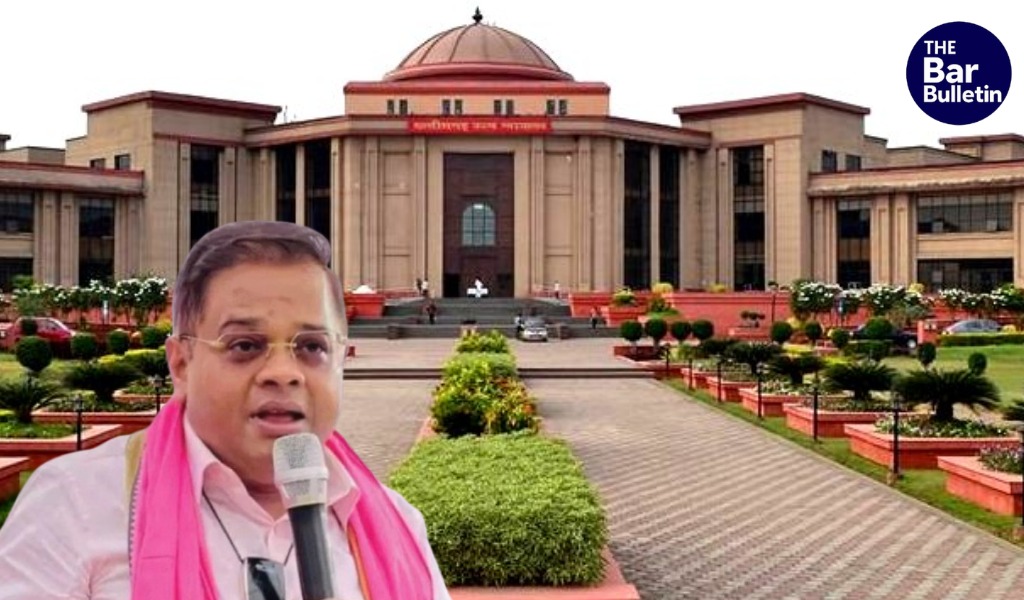

The High Court of Chhattisgarh at Bilaspur Bench has asserted that an artificial distinction cannot be drawn in favour of a particular accused when all are charged with participation in a common offence. Where the prosecution case rests on the same set of evidence against all accused, it would be impermissible to acquit one accused while convicting the others on that very evidence, unless a strong and compelling case for acquittal is independently made out in favour of such accused.
Accordingly, the High Court quashed the Trial Court’s 2007 judgment acquitting Amit Jogi, son of former Chief Minister Ajit Jogi, in the 2003 murder case of NCP leader Ramavatar Jaggi, holding it as ‘palpably illegal, wrong, perverse and contrary to the evidence on record’. The Court also sentenced Amit Jogi, and directed him to surrender before the court within three weeks.
The Division Bench comprising the Chief Justice Ramesh Sinha and Justice Arvind Kumar Verma observed that the appellate Court has ample power under Section 386 of the CrPC to re-appreciate the evidence and material available on record, as well as to review the findings recorded by the trial Court. If the view taken by the trial Court is found to be palpably illegal, wrong, perverse, contrary to the evidence on record, and lacking any reasonable basis, the appellate Court is fully empowered to interfere with an order of acquittal.
The Bench observed that conspiracy under Section 120-B of the IPC is hatched in private or in secrecy, and it is rarely possible to establish a conspiracy by direct evidence; usually, the existence of the conspiracy and its objects have to be inferred from the circumstances and the conduct of the accused. The evidence of witnesses established that meetings were convened at Hotel Green Park, CM’s House, and Batra House at the instance of Amit Jogi with the object of sabotaging the NCP rally.
The Trial Court relied upon one set of evidence to hold the 28 co-accused guilty, but the same set of evidence available against Amit Jogi was disbelieved on flimsy grounds and presumptions without any foundation. Thus, the Trial Court’s finding that the co-accused acted independently to please Amit Jogi, without his knowledge, and in a manner not contemplated by him, is unsustainable, as the evidence indicates that the plan to eliminate the NCP office bearers originated from Amit Jogi himself, added the Bench.
The Bench emphasised that when the prosecution case against all the accused persons is founded upon a common, cogent, and interlinked body of evidence, such evidence must be assessed uniformly, unless there exist clear and discernible grounds for differentiation. If no distinguishing feature, such as absence from the scene, lack of participation, credible alibi, or material contradictions in testimony vis-à-vis the main accused is brought on record, the grant of acquittal to him alone would amount to a perverse finding and misappreciation of evidence.
The orchestration of such a sophisticated and high-level organized crime, particularly one involving imposters, pre-planned execution, and apparent compromise of the State Police machinery, could not have been possible without the active involvement, guidance, and protection of a person wielding considerable influence and authority. The material on record points towards Amit Jogi not merely as a passive or incidental beneficiary, but as the principal architect and driving force behind the conspiracy. Consequently, the judgment passed by the Trial Judge acquitting Amit Jogi is palpably illegal, wrong, perverse, and contrary to the evidence available on record.
Briefly, Ram Avtar Jaggi @ Taru Jaggi, a leader of the Nationalist Congress Party (NCP), was shot on June 04, 2003 while travelling in his car. A FIR was initially lodged at Raipur Police Station under Sections 447 and 307 of the IPC at the instance of V.K. Pandey, the Station House Officer, and the injured subsequently succumbed to his injuries in the hospital. A second FIR was also registered for the same incident under Section 302 IPC at the instance of the complainant-Satish Jaggi, son of the deceased.
During the initial investigation conducted by the State Police, five accused persons were arrested, and a charge-sheet was filed against them in Sessions Trial, alleging that they had murdered the deceased with the motive of robbery. Subsequently, the matter was handed over to the Central Bureau of Investigation (CBI), which filed a supplementary charge-sheet against 31 accused persons, including the five already charge-sheeted. The CBI alleged that the deceased was murdered for political reasons as he was organizing a major NCP rally in Raipur, which was perceived as a political threat to the then Chief Minister, Ajit Jogi, and his son Amit Jogi.
The CBI further alleged that the five accused persons in Sessions Trial were imposters falsely implicated by the real perpetrators with the assistance of certain police officials who conducted a sham investigation. The Trial Court however, acquitted accused Amit Jogi @ Amit Aishwarya Jogi, but convicted and sentenced the remaining accused persons under various sections including 302, 120-B, 427, 193, and 218 of the IPC. The CBI preferred an acquittal appeal challenging the acquittal of Amit Jogi, while the complainant filed revision petitions challenging the acquittal and seeking enhancement of the sentences awarded to the convicts.
Appearances:
Advocates Shri Singh, Raj Bahadur Singh and Arunima Nair, for the Applicant/ Complainant
Deputy Advocate General, Dr. Sourabh Kumar Pandey, for the State
Advocate Vikas Walia, for the Respondent/ Accused
