
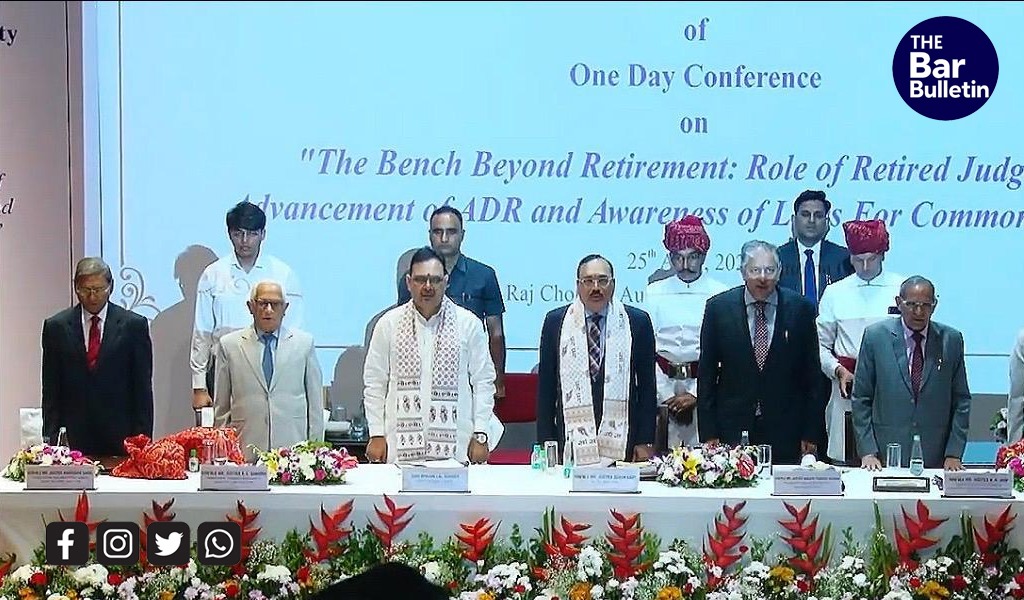

At the National Conference titled “The Bench Beyond Retirement: The Role of Retired Judges in Advancement of ADR and Awareness of Laws for Common Masses”, held at Jaipur on April 25, 2026, the Chief Justice of India, Justice Surya Kant, delivered a keynote address emphasising the continued relevance and responsibility of retired judges in strengthening access to justice. The event was organised by the Association of Retired Judges of the Supreme Court & High Courts of India in collaboration with the Rajasthan State Legal Services Authority. Justice Narendra Kumar Jain is the President of the Association.
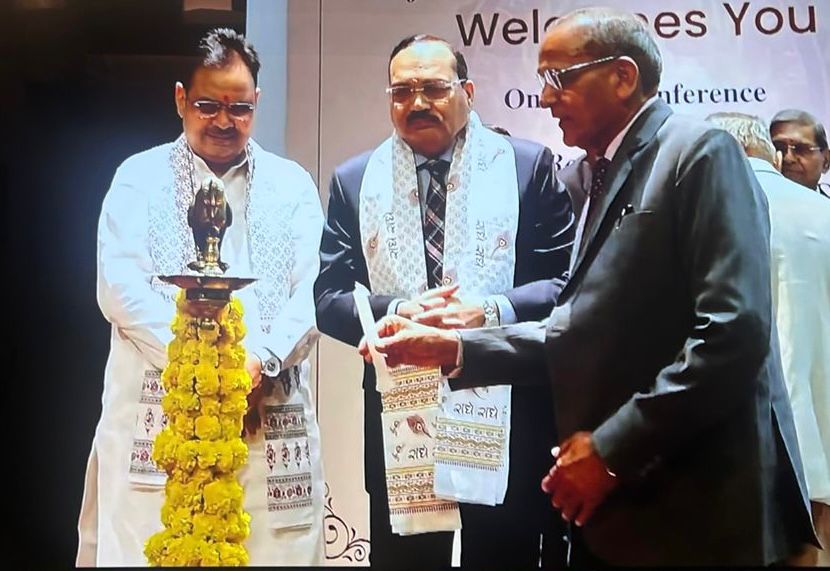
Speaking at the one-day Conference, CJI highlighted the significance of post-retirement judicial contribution, the CJI remarked:
“When a judge retires, we arrange a function. We garland them, we present a shawl, and we speak warmly of decades of distinguished service. Then, we quietly assume that the show will go on as usual even without them…However that critical assumption is, in my view, among our most wasteful traditions. For the robe may be retired. The judge never is. It is a truth universally known that once a judge, is always a judge.”
Time and again, the Chief Justice has questioned the use of the word “alternative” in ADR. Reiterating his stance, he once again observed:
“The word ‘alternative’ carries with it an unintended hierarchy… 1.let us retire that word along with the misconception it carries. Mediation, Lok Adalats, Arbitration, Conciliation: these are not the back door to justice. For millions of Indians, they are the only door…These avenues are not a supplement to the justice system. They are, at their finest, justice itself.”
The address identified four key areas where retired judges can significantly contribute:
- As mediators and arbitrators
- As legal educators for the public
- As pre-litigation counsellors
- As mentors and institution builders
Emphasising the need for systemic reform, the CJI called for a structured framework to formally engage retired judges, including the creation of a national registry and institutionalised participation with accountability.
“I am calling for a formal framework: a structured National Registry of Former Judges… and institutionalised participation, with dignity, support, and accountability.”
Reflecting on the transition after retirement, he observed that the sense of loss many judges feel is not due to the end of purpose, but the absence of a platform to continue contributing.
Concluding on a reflective note, the CJI likened retired judges to reservoirs of public wisdom, deep in experience and capable of guiding society in times of need.
“Our eminent former judges are much like those stepwells of public wisdom… deep in experience, tested by time, and nurturing in moments of need… a wise Republic does not merely admire such reservoirs from a distance. It revers them and preserves them for posterity. It draws strength from them, and ensures that they continue to sustain the community, especially when the times demand it the most.”