
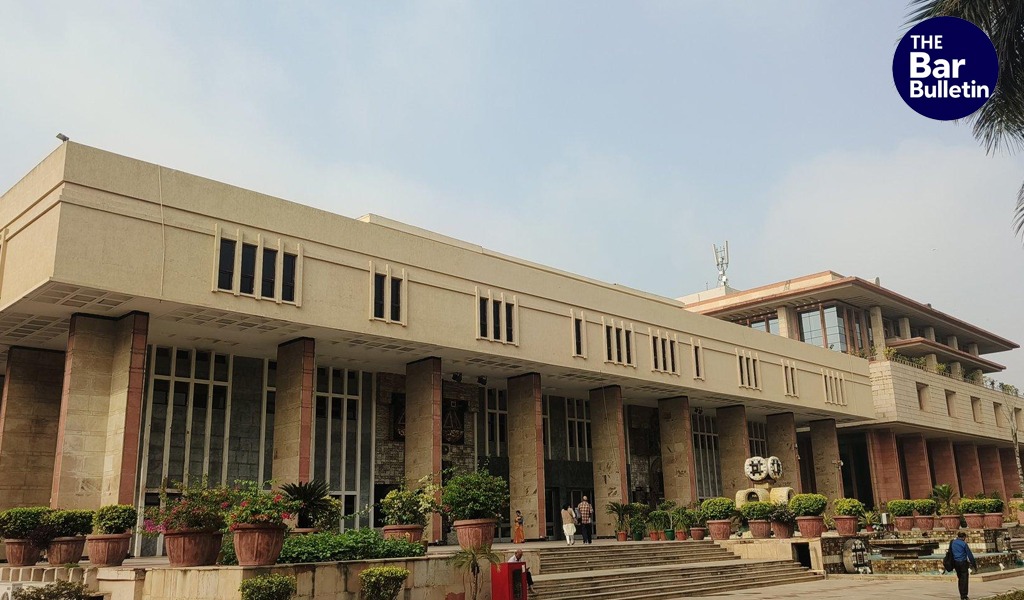

The Delhi High Court has held that false statements made by a candidate about their own educational qualifications in election affidavits do not amount to “corrupt practice” under Section 123(4) of the Representation of the People Act, 1951.
The case arose from an election petition filed by the BJP MPYogender Chandolia challenging the 2020 election win of Aam Aadmi Party MLA Vishesh Ravi from the Karol Bagh Assembly constituency. The petitioner alleged that the returned candidate had furnished false information regarding his educational qualifications in Form 26, thereby misleading voters.
A Division Bench comprising Justice Dinesh Mehta and Justice Vinod Kumar clarified that Section 123(4) applies only to false statements made about other candidates with the intent to harm their electoral prospects, not to self-declarations, even if incorrect. The Court emphasised that election law requires strict interpretation and cannot be expanded through purposive reasoning.
25. The allegations levelled by the petitioner, even if assumed to be correct are to the effect that the respondent no.1 has made false assertions about his educational qualification so as to influence the election in his favour, whereas sub-section (4) clearly provides that such allegation should be made to prejudice the prospects of that candidate’s election i.e. election of the opposite candidate, qua whom false assertion has been made/published.
26. Firstly, by no stretch of imagination, a candidate can/would level allegation against himself, that too with a view to prejudice his own prospects. The use of expression “in relation to personal character or conduct of any candidate” so also, the expression “reasonably calculated to prejudice the prospects” and expression „that candidate’s election” leaves no room for doubt that the assertion made by the petitioner, even if taken to be at its face value, cannot be brought within the sweep and scope of subsection (4).
Relying on recent Supreme Court precedent, the Court further noted that inaccuracies relating to educational qualifications are not of such substantial character as to invalidate an election or constitute a corrupt practice.
Since fresh Assembly elections had already been held in 2025, the Court concluded that the petition had become infructuous. It ruled that even if the allegations were proven, they would not meet the legal threshold for setting aside the election or disqualifying the candidate.
“According to us, even if the case is tried and the allegations are found to be correct, then also, the Respondent no.1 cannot be held guilty of corrupt practice in light of the pleadings made. Since the term of the Assembly is over and fresh elections have been held in the year 2025, the election petition is liable to be declared infructuous.”
