
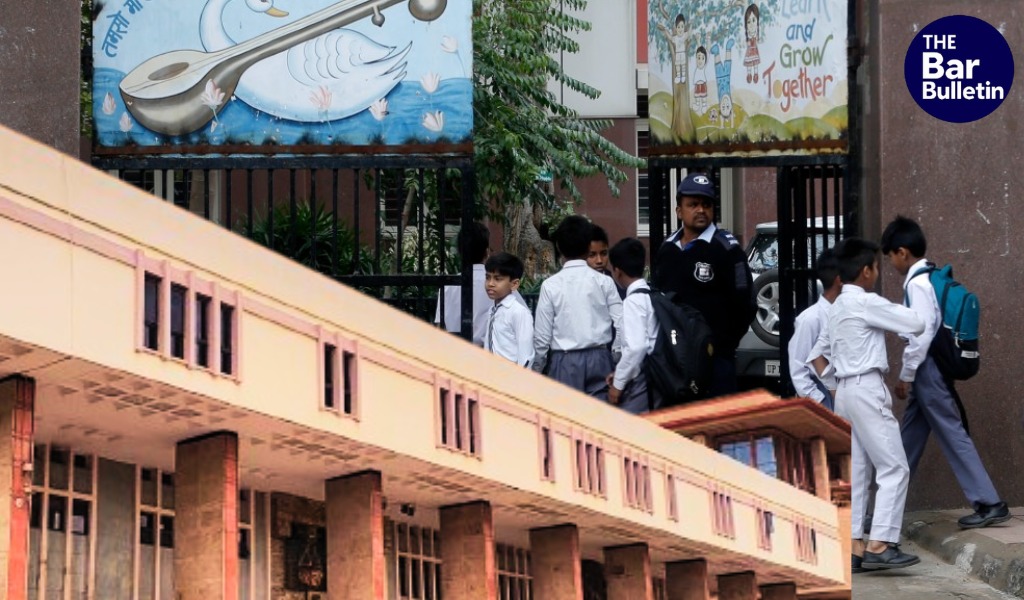

In a batch of petitions filed by 137 private unaided schools before the Delhi High Court to contend that their proposals for increasing fees from time to time were arbitrarily and unlawfully rejected by the Department of Education (DoE), impinging on their right to run private, unaided, and recognized schools with requisite financial autonomy, a Single Judge Bench of Justice Anup Jairam Bhambhani quashed all impugned orders by the DoE while holding that no prior permission is required by a private, unaided, recognised school to increase its fee at the commencement of the academic session.
Based on the suggested points of determination, the Court, by an order dated 13-09-2023, framed certain points of determination. The schools collectively asserted that, as private, unaided institutions, they possessed an explicit fundamental right under Article 19(1)(g) of the Constitution to maintain financial and administrative autonomy, which inherently included the liberty to fix and update reasonable fee structures. They argued that under Rule 177 of the Delhi School Education Rules, school fees must first cover employee salaries, and any remaining funds should be safely allocated to capital expansion and statutory reserves, rendering the DoE’s practice of absorbing these restricted safety buffers into general operational calculations completely illegal. They emphasized that inordinate administrative delays by the DoE in issuing rejection orders created massive complications, as schools could not practically recover increased fees from families on a retrospective basis.
It was submitted that although the rationale for maintaining a Contingency Reserve Fund was to provide a buffer or reserve for unforeseen exigencies that the school may face, the DoE had ignored this provision and had added the said reserve to the ‘fund available’ with the school. The schools also contended that a ‘land-clause’ was merely a contractual condition inserted by the land-owning agency when allotting land to a school, and that it was only a contractual requirement imposed by a third party, requiring the school to obtain prior approval from the DoE before increasing fees.
Conversely, the DoE contended that institutional autonomy must be balanced with strict financial discipline to prevent the exploitation of parents through unauthorized levies and disguised capitation fees. It was argued that concessional land allotments carried an unyielding public-interest obligation, thereby providing the State with heightened regulatory authority to monitor school accounts in accordance with Generally Accepted Accounting Principles (GAAP). The DoE insisted that long-term infrastructure expansion costs, vehicular capital assets, or societal loan repayments must be borne entirely by the school’s sponsoring trust or society, rather than passed on to the student fee structure.
The DoE implemented a layered scrutiny framework consisting of special audits by empanelled chartered accountants, secondary expert reviews by a Project Management Unit operated by M/s. Ernst & Young LLP, and final evaluations by an internal departmental accounts committee. During the pendency of these proceedings, the Delhi Legislative Assembly enacted the Delhi School Education (Transparency in Fixation and Regulation of Fees) Act, 2025. However, upon re-hearing the matter, all contesting parties conceded that this new statute applies prospectively and has no bearing on the previous orders under challenge.
The Court stated that almost all contentions raised by the parties had been substantially decided by the Supreme Court as well as various benches of this Court in several judgments. It was said that the actions of DoE under challenge were clearly flawed and a misunderstanding of the law, along with all the court rulings. It was said that the DoE must keep in mind that it is permissible for a school to hold surplus funds, which may, at a later stage, be used to set up another school or educational institution under the management of the same society.
It was mentioned that in multiple cases, the principle of fiscal autonomy for private, unaided, recognized schools had been upheld, holding that the scope for interference by the DoE as a regulator was limited. The decisions also stated that, regarding the fixation of the fee, the scope of interference was restricted only to cases of profiteering or commercialization by a school. The Court clarified that the DoE could intervene only if a private, unaided, recognized school was found to be indulging in profiteering, and not merely because the school had surplus funds or wished to increase its fees. It was reiterated that the law does not require a private, unaided, recognized school to seek any prior approval to increase its fee, except when a school proposes to increase its fee during an ongoing academic session.
Further, the Court held that the DoE’s understanding of how funds available in a school are to be calculated was flawed, since the DoE had included certain heads of funds that could not be added to the funds available. It was held that DoE’s interpretation regarding the manner in which a school was to utilize its funds was not only contrary to Income Tax provisions, but also Rule 176 of the DSE Rules.
Regarding the ‘land clause’, the Court agreed with the Division Bench’s decision that unaided schools that had been allotted land by the governmental agencies were bound to comply with the terms of the allotment letter, and that such schools could not increase their tuition fee without prior approval from DoE. The Court stated that, as an agency tasked with implementing the provisions of the DSE Act, the DoE could not overlook those provisions and begin implementing the land clause. It was said that if non-compliance with the land clause is noticed by the DoE, information must be given to the land owning agency, and it must be left to that agency to take appropriate steps.
The Court held that by embedding a land clause in the allotment letter, the land owning agency cannot confer any additional powers upon the DoE to enforce an obligation against a school in excess of the provisions of Section 17(3) of the DSE Act, meaning thereby that breach of the land clause could not result in consequences for the school by the DoE. Further, the Court stated that a private, unaided, recognized school must maintain its accounts on the ‘accrual system’ of accounting as per the IT Act and the ICAI Guidance Note. It was held that the impugned directions by the DoE were contrary to provisions of the IT Act and the ICAI Guidance Note.
The Court held that there is no provision which bars a private school from paying its employees, including teachers, staff, and contractual employees, at rates higher than government school employees. It was stated that any action of the DoE that did not allow a school to pay higher remuneration to its employees was impermissible.
Thus, the Court quashed and set aside all orders passed by the DoE to the extent that they had rejected the fee-hike proposals by schools at the commencement of an academic session. The proposals pending before the DoE were also closed for being based on a misconceived notion that prior approval was required.
The Court noted that if the pending fee-hike proposals are allowed to be implemented after a lapse of several years, as in the present case, it would impose an unacceptable burden on parents/students, who would have to pay arrears of fees for the past several years. As an equitable option, the Court directed that the fee increases last proposed by schools in their fee statements filed with the DoE apply only from the next academic session. The schools were directed not to demand or recover any arrears of fees or other charges retrospectively for the past academic sessions. Hence, the petition was disposed of.
Appearances:
For Petitioners – Mr. J.P. Sengh (Sr. Adv), Ms. Diya Kapur (Sr. Adv), Mr. H.L. Tiku, (Sr. Adv), Mr. Puneet Mittal (Sr. Adv), Mr. Kamal Gupta, Mrs. Tripti Gupta, Mr. Sparsh Aggarwal, Mr. Siddharth Arora, Mr. Pranav Rishi, Mr. Gaurav Mishra, Ms. Sukriti Kamra, Mr. Rishabh Sharma, Mr. Raghav Kumar, Ms. Ambica Sood, Ms. Yashmeet Kaur, Mr. Hitesh Wadhwa, Mr. Rahul, Ms. Sakshi Mendiratta, Mr. Pramod Gupta and Ms. Yogita, Mr. Anushu, Mr. Khagesh B. Jha, Ms. Jyoti Shokeen, Mr. Ankit Mann, Mr. Divjyot Singh, Mr. Nipun Diwvedi, Mr. Prashant Kumar, Mr. Arjun Garg, Ms. Gauri Puri, Ms. Apoorva Pandey, Ms. Soumya Singh, Mr. Hriman Dhaka, Mr. Pranav Gadi, Mr. Krishna Gaur, Ms. Pavi Maheshwari and Ms. Shivani, Mr. Nitin Bhardwaj, Mr. Saurabh Chadda, Mr. Rohit Bhagat, Ms. Aprajita, Mr. Anurag Lakhotia, Mr. Udit Dwivedi, Mr. Vibhor Kush
For Respondents – Mr. Chetan Sharma (ASG), Mr. Puneet Mittal, (Sr. Adv), Mr. Sameer Vashisht (SC, GNCTD), Mr. Amit Gupta, Mr. Dhruv Rohtagi, Mr. Abhinav Sharma, Mr. Chandrika Sachdev, Mr. Dhruv Kumar, Ms. Avni Singh (Panel Counsel, GNCTD), Mr. Gaurav, Mr. Tushar Sannu, Mr. Sourav Verma, Mr. Kamal Gupta, Mr. Sparsh Aggarwal, Ms. Shobhana Takiar (SC), Mr. Kuljeet Singh, Mr. Prateek Dhir, Mr. Rupendra Pratap Singh, Ms. Shikha Sharma Bagga, Mr. Aranya Moulick, Ms. Namya Rishi, Mr. Anubhav Gupta (Panel Counsel), Ms. Manika Tripathy (Standing Counsel, DDA), Mr. Ashutosh Kaushik
