
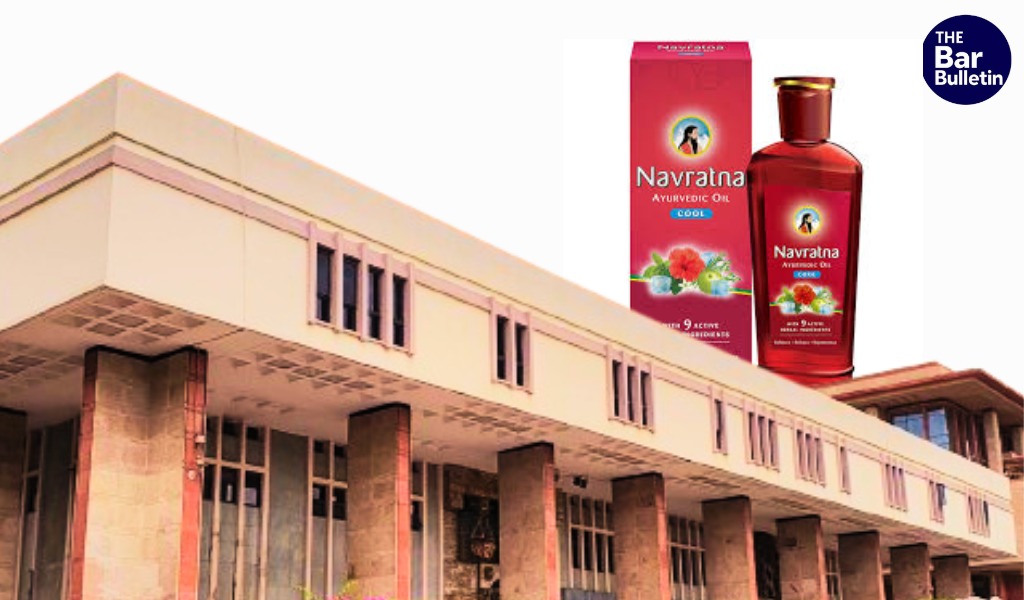

The Delhi High Court has asserted that in an action confined to passing off based on trade dress, the court must assess the overall visual impression and get-up of the competing products from the standpoint of a consumer of average intelligence and imperfect recollection, and not by dissecting individual features or relying only on dissimilarities. Even where individual elements such as colour, flowers, herbs, descriptive expressions or packaging motifs may not by themselves be monopolised, their combination, arrangement and presentation may nevertheless constitute a protectable trade dress for purposes of passing off if the overall get-up has acquired goodwill and the defendant’s adoption is deceptively similar so as to cause confusion and likelihood of damage.
The Court further laid down that, at the interim stage, the plaintiff in a passing off action is not required to conclusively prove its case as at trial; prima facie material such as sales figures, market share, advertising expenditure and product history may suffice to establish goodwill and justify injunctive relief, with formal proof left to trial. The Court also held that the presence of a prominent or even well-known house mark does not necessarily neutralise deceptive similarity in trade dress, especially in relation to low-cost consumer goods where purchasing attention is limited and the overall get-up remains likely to mislead.
The High Court also held that an appellate court hearing an appeal from an interlocutory injunction will not reassess the material to substitute its own view merely because another view is possible; interference is warranted only where the discretion of the court of first instance has been exercised arbitrarily, capriciously, perversely, or in disregard of settled principles governing interim injunctions. Since the Single Judge had applied the correct principles and the respondent had shown a prima facie case, likelihood of confusion, balance of convenience and risk of harm, the injunction was rightly sustained.
The Division Bench comprising Justice V. Kameswar Rao and Justice Manmeet Pritam Singh Arora observed that in a passing off action, the issue had to be examined on the basis of similarities in the get-up and packaging and whether the defendant’s get-up was similar enough to deceive, notwithstanding other differences. The Bench found that Emami had shown sufficient prima facie material of goodwill and prior user, including its market share, turnover, and the chartered accountant’s certificate recording product sales; it also held that the shift to the current label from 2016 did not appear so stark as to require independent proof of goodwill divorced from the earlier get-up.
The Bench further observed that Dabur had not given any bona fide explanation for changing its own trade dress over time and adopting the impugned get-up in 2023, and therefore the possibility of Dabur’s goods being passed off as Emami’s goods could not be ruled out. On the plea that the common elements were descriptive or common to trade, the Bench held prima facie that overall appearance, and not individual attributes in isolation, was determinative in a passing off action.
The Bench agreed with the Single Judge that the appellant had attempted to imitate the essential features of Emami’s trade dress and that the overall get-up at the point of sale created an impression of imitation likely to confuse a consumer of average intelligence and imperfect recollection. The Bench also held that the presence of the house mark “DABUR” did not, in the facts of this case, dispel confusion, particularly because the goods were low-cost consumer goods and the overlapping features in the trade dress remained significant.
The Division Bench ultimately held that Emami had, at least prima facie, satisfied the triple test for passing off and had also made out a case for grant of injunction. It further held that the Single Judge had properly exercised discretion, and under the principle in Wander Ltd., an appellate court would not interfere unless the discretion was arbitrary, capricious, perverse or contrary to settled law; no such infirmity was found here. Accordingly, the interim injunction was upheld.
Briefly, the dispute arises from an appeal filed by Dabur India Limited against the order passed by the Single Judge, whereby Dabur was restrained from selling its product “Cool King Thanda Tael” in a trade dress or any similar trade dress resembling Emami’s “Navratna Oil”. Emami had restricted its interim case to passing off alone, and had given up its claims pertaining to bottle design, copyright infringement, trademark infringement and disparagement; it also noted that Emami did not claim monopoly over the colour red as such.
Emami contended had launched Navratna Oil in January 1989, had used the product continuously and uninterruptedly since then, and had built substantial goodwill in the cooling oil segment, including a claimed market share of 66% as of 2022. Emami relied on multiple trademark registrations, design registrations for its bottles, copyright registrations in its labels, long-standing advertising and publicity, and rising turnover figures, including sales of Navratna Ayurvedic Oil (red packaging) aggregating to about Rs. 4,927 crores for the financial years 2009-10 to 2024-25.
Emami alleged that Dabur launched a similar cooling oil product in 2023 and had adopted a visually, structurally and phonetically similar presentation, including the marks “THANDA TAEL”, “COOL KING”, “COOL OIL”, “COOL KING THANDA TAEL” and “NAYA DABUR COOL KING THANDA TAEL”, so as to create an impression of association with Emami’s product.
Dabur’s principal objections were that this was only a passing off case and not an infringement action; that the trinity test of goodwill, misrepresentation and likelihood of damage had not been satisfied; that Emami had not proved goodwill in the current trade dress; that the relied-upon elements were common or descriptive in the red cooling oil market; that third-party use, especially by Himtaj and others, negated exclusivity; and that Dabur’s prominent house mark “DABUR”, being a well-known mark, was sufficient to distinguish its product.
Appearances:
Sandeep Sethi, Sr. Advocate with Kripa Pandit, R. Jawahar Lal, Anirudh Bakhru, Prabhu Tandon, Christopher Thomas, Meghna Kumar, Krisna Gambhir, Shreya Sethi and Aayomi Sharma, Advocates, for Appellants
Abhimanyu Bhandari, Sr. Advocate with Roohe Hina Dua, Harshit Khanduja, Shrutika Garg and Piyush Jain, Advocates, for Respondents
