
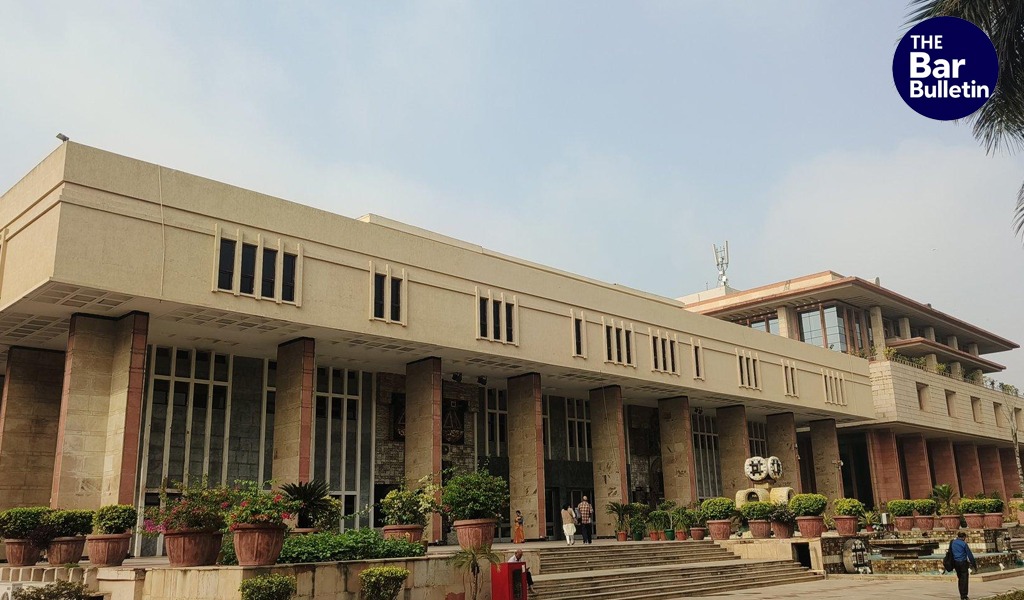

The Delhi High Court has clarified that, for purposes of reassessment proceedings after the death of an assessee, the relevant expression under Section 159 of the Income-tax Act, is “legal representative” and not “legal heir”. This expression must be understood in the wider sense assigned by Section 2(11) of the Code of Civil Procedure, 1908, and may include a person who, by conduct, represents or intermeddles with the estate of the deceased, even if such person is not a Class I heir under succession law.
However, where reassessment is initiated by invoking the extended limitation period, approval must be obtained from the authority specified in Section 151(ii), namely the PCCIT; approval by the PCIT is incompetent and renders the reassessment notice liable to be quashed, added the Court.
The Division Bench comprising Justice Dinesh Mehta and Justice Amit Mahajan rejected the petitioner’s contention that service of notice on Vijender Pal Jain was fundamentally void. The Bench drew a distinction between the expressions “legal heir” and “legal representative”, observing that these are legally distinct expressions operating in different statutory domains. It noted that Section 159 of the Income-tax Act uses the expression “legal representative” and not “legal heir”, and that by virtue of Section 2(29) of the Act, “legal representative” bears the meaning assigned in Section 2(11) of the Code of Civil Procedure, 1908.
The Bench reproduced and relied upon the statutory definition, emphasizing that it is inclusive and wide, and is not confined to persons who inherit the estate. The test, according to the Bench, is not inheritance but representation vis-à-vis the estate of the deceased. Applying that principle, the Bench held that Vijender Pal Jain, though not a Class I heir under the Hindu Succession Act, had by his conduct become a legal representative, having expressly responded to the notice in that capacity. Accordingly, the Bench held that notice served upon him did not suffer from infirmity merely because he was not a “legal heir”.
The Bench found that since the respondents had invoked the extended period of limitation, the approval ought to have been obtained from the Principal Chief Commissioner of Income Tax (PCCIT) under Section 151(ii) of the Income-tax Act, and not from the PCIT. The respondent’s counsel was unable to satisfy the Court as to how approval granted by the PCIT could be treated as valid in those circumstances. The Bench therefore held that the approval suffered from lack of competence under the statute.
Consequently, although the Court rejected the challenge based on service of notice upon the father of the deceased assessee, it allowed the petition on the ground of defective statutory approval. The impugned notice was quashed for want of proper approval.
Briefly, the petitioner challenged the reassessment proceedings initiated by notice under Section 148 and the order under Section 148A(d) of the Income-tax Act, on two grounds: first, that the notice had been issued against a deceased assessee, Rishi Raman Jain, who had died on March 20, 2018; and second, that the approval for reassessment had been granted by the Principal Commissioner of Income Tax (PCIT) instead of the competent authority required under Section 151 where the extended period of limitation had been invoked. During the reassessment proceedings, Vijender Pal Jain had himself filed a reply in the capacity of legal representative of the deceased assessee, and petition was also filed by him in that representative capacity.
Appearances:
Pankaj Kumar Saxena, Keshav Dwivedi, Divyanshee Singh and Ashish Kumar Singh, Advs., for Petitioner
Shlok Chandra, Sr. Std. Counsel with Naincy Jain, Madhavi Shukla, Jr. SCs and Udit Dad, Adv., for Respondent
