
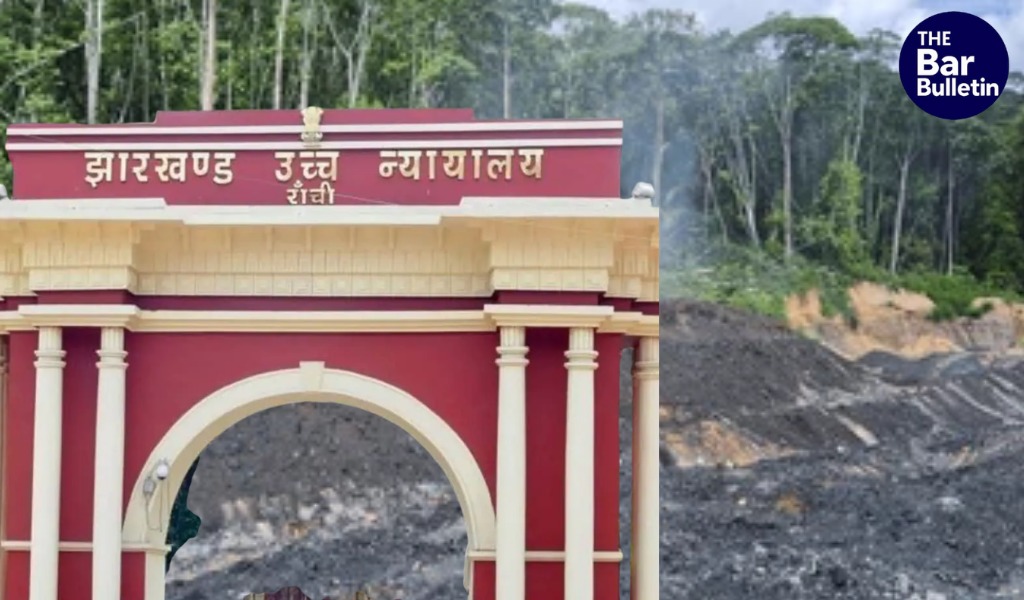
The Jharkhand High Court has issued a sweeping set of directions to curb illegal mining and environmentally non-compliant stone crusher operations in Hazaribagh district, observing that rampant illegal quarrying had devastated the ecological balance of the region and posed a direct threat to human life and the environment.
A Division Bench comprising Chief Justice M.S. Sonak and Justice Rajesh Shankar passed the order in a Public Interest Litigation concerning illegal stone mining and crusher units operating around the Siwane River in the Ichak region of Hazaribagh.
The Court directed that no mining activity or operation of stone crusher units shall continue in the affected areas until a comprehensive verification of statutory permissions and environmental compliances is completed by the District Level Task Force (DLTF).
Describing the environmental degradation in strong terms, the Court observed that the “gardens are being replaced by craters” and noted that abandoned mining pits had become “death traps” for local residents and children.
The Bench held that illegal mining in the region stood established from the material on record, including an independent report submitted by the Secretary of the District Legal Services Authority (DLSA), Hazaribagh. According to the Court, the activities had caused damage to cultivable land, disrupted the ecological balance of the Siwane River, and endangered human life.
The Court further held that the District Administration, Mining Department, Police authorities, and the Jharkhand State Pollution Control Board had failed to discharge their statutory obligations effectively. It observed that sporadic FIRs without meaningful prosecution or confiscation proceedings reflected systemic enforcement failure.
Criticising the authorities, the Bench remarked that such large-scale unauthorised quarrying operations involving heavy machinery and transportation could not continue without the knowledge of officials responsible for preventing them.
“These pernicious activities cannot be carried out in complete secrecy… The law-enforcement agencies are content with paper assurances, shifting blame, and avoiding enforcement,” the Court observed.
The Court also noted that despite the availability of sophisticated technological tools such as satellite imagery, geo-tagging, GIS mapping, GPS-based vehicle tracking systems, and the Jharkhand Integrated Mines and Mineral Management System (JIMMS), authorities had failed to stem illegal mining activities.
Invoking the “Polluter Pays” principle and the doctrine of sustainable development, the Bench directed the Jharkhand State Pollution Control Board to assess and impose environmental compensation on non-compliant and unauthorised mining and crusher units within twelve weeks.
Among the key directions issued by the Court were:
• suspension of mining and stone crusher operations pending compliance verification;
• monthly meetings of the District Level Task Force;
• review of all environmental clearances, mining permissions, and pollution consents;
• establishment of a technology-driven surveillance regime with CCTV monitoring and GPS tracking;
• creation of a public grievance mechanism and dedicated helpline;
• initiation of proceedings under the Mines and Minerals (Development and Regulation) Act, 1957;
• criminal prosecution against non-compliant units under environmental laws;
• recovery proceedings for illegally extracted minerals; and
• reclamation and securing of abandoned mining pits.
The Court reiterated that no mining or stone crushing activity could take place within a one-kilometre buffer zone of the Hazaribagh Wildlife Sanctuary. It also reaffirmed earlier directions restricting grant of pollution control consents within 500 metres of forests for mining activities and 400 metres for stone crushers.
The Bench emphasised that the right to a clean and pollution-free environment forms part of Article 21 of the Constitution and relied upon several Supreme Court precedents concerning environmental protection, sustainable development, and illegal mining.
Appearances:
For the Petitioner: Mr Vijay Narayan Singh, Advocate
For the State: Mr Gaurav Raj, A.C. to A.A.G.-II
For Resp. Nos.5-7: Mr Prabhash Kumar, Advocate
Mr Manish Sharma, Advocate
