
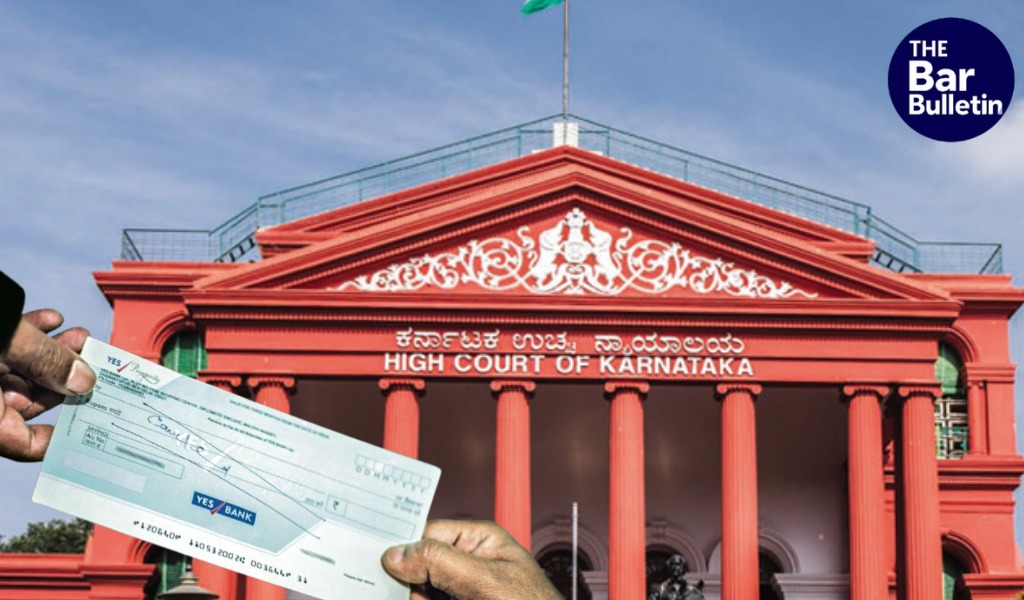

The Karnataka High Court at Bengaluru Bench has asserted that, after adoption of the electronic clearance system (ECS), a cheque return memo or bank endorsement need not bear seal or signature to be acted upon under Sections 138 and 146 of the Negotiable Instruments Act, 1881, and absence of seal or signature on such memo does not invalidate the prosecution. Neither Section 138 nor Section 146 prescribes any particular form of cheque return memo, and if the accused disputes the endorsement, the burden lies on him to disprove it by appropriate evidence.
The Court held that once the accused admits execution of the cheque, the presumptions under Sections 118 and 139 of the Negotiable Instruments Act arise, and the accused must rebut them by sufficient evidence. In revisional jurisdiction, the High Court will not interfere with concurrent findings of fact unless perversity or jurisdictional error is shown. Since the accused failed to rebut the presumption and no perversity was found in the findings of the courts below, the revision petition was dismissed.
A Single Judge Bench of Justice V Srishananda noted that there was no dispute that the cheque belonged to the accused and that the signature on the cheque was his. It further noted that bank endorsement contained the cheque number, sort code, ISN, branch code, bank name, inward details, date of presentation, amount of cheque, and the reason for dishonour. On that basis, the Bench rejected the contention that criminal prosecution could not lie merely because the bank memo did not contain seal or signature.
The Bench observed that with the introduction of the electronic clearance system (ECS), seal and signature on the cheque return memo were not mandatory, and absence of such seal or signature, official mark could not be a ground to reject the complaint. The Bench also observed that if the accused genuinely disputed, he could have summoned his banker to establish that sufficient funds were available or that the cheque was never presented. Instead, the accused admitted in cross-examination the endorsement issued in respect of dishonour.
The Bench Court further observed that once execution of the cheque is admitted, the presumptions under Sections 118 and 139 of the Negotiable Instruments Act arise in favour of the complainant. The complainant had discharged the initial burden, as the cheque belonged to the accused, the signature was not in dispute, and the transaction between the parties stood established. In revisional jurisdiction, the High Court would not re-analyse and re-interpret the evidence in the absence of perversity in concurrent factual findings.
Briefly, the complaint case was that the complainant and the accused were acquainted for several years, and the accused sought financial assistance of Rs. 3 lakhs, agreeing to repay the same within two months with interest at 16% per annum.
The complainant alleged that he advanced Rs. 3 lakhs in cash on Oct 24, 2014, which was acknowledged by the accused. Upon failure to repay, the accused issued post-dated cheque for the same amount, drawn on State Bank of India. On presentation, the cheque was dishonoured with the endorsement “funds insufficient”. A legal notice was issued, but the accused did not comply, resulting in the filing of the complaint.
The Trial Court convicted the accused and sentenced him to pay a fine of Rs. 4 lakhs, with Rs. 3.95 lakhs payable to the complainant as compensation. The First Appellate Court dismissed the appeal and confirmed the conviction and sentence. Hence, the revision petitioner/ accused challenged the concurrent judgments of the Trial Court and the First Appellate Court convicting him for the offence under Section 138 of the Negotiable Instruments Act, 1881.
Appearances:
Advocate Rishi Pal Singh Varma, for the Petitioner
Advocate Chandrashekar P Patil, for the Respondent
