
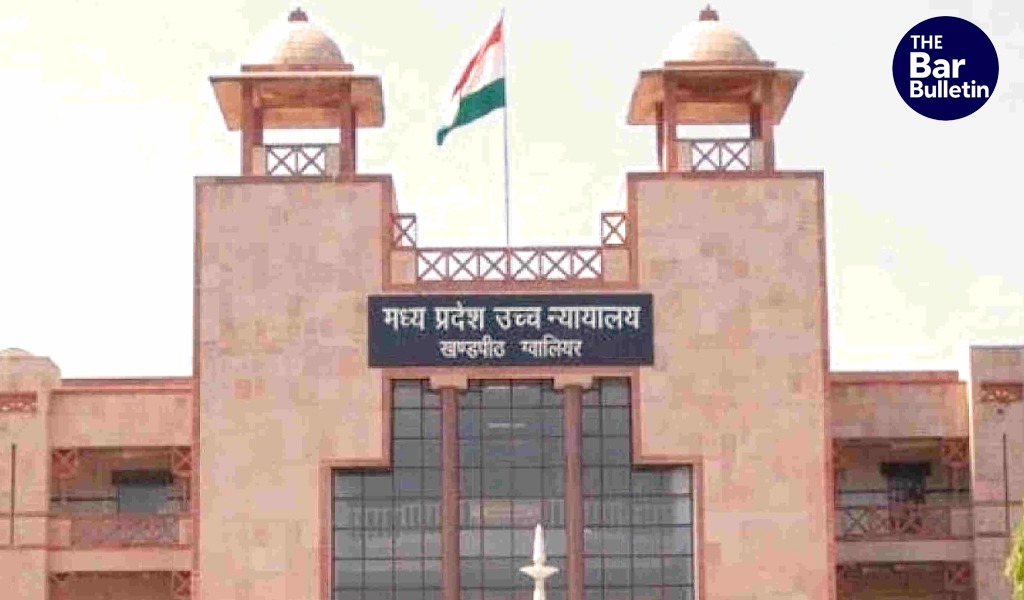

The Gwalior Bench of the Madhya Pradesh High Court has held that where acquisition proceedings were challenged by some landowners and relief was granted only to those petitioners, such quashing does not automatically enure to the benefit of other landowners who did not challenge the acquisition at the relevant time, if the earlier order is in personam and not in rem.
The Court further held that a writ petition challenging land acquisition is liable to be dismissed on the ground of delay and laches when filed long after issuance of notifications, passing of award, acceptance of compensation, and taking of possession, and no fresh cause of action arises merely because of later clarification orders in earlier litigation.
It was also held that once the landowners have accepted compensation and possession has been taken, and the acquiring body has altered its position by developing the land for the public purpose for which it was acquired, the challenge is barred by estoppel and acquiescence.
A Single Judge Bench of Justice Amit Sethi framed two core issues: whether the benefit of the order dated March 31, 1995 in M.P. No. 1198 of 1989 could be extended to the present petitioners, or whether the petitions were liable to be dismissed on delay and laches; and whether the petitions were barred by estoppel and acquiescence.
The Bench held that the earlier order dated March 31, 1995 was not an order in rem. Relying on the clarification issued by the Division Bench in R.P. No. 443 of 2012, the Bench observed that the benefit of quashing was confined only to those petitioners who had approached the Court at the relevant time, and therefore the earlier relief was in personam.
The Bench observed that the present petitioners had remained inactive despite the acquisition proceedings attaining finality, and that belated challenge after the award and after acceptance of compensation could not be entertained. It found that even the civil suit filed by one set of petitioners in 2009 was much too late and did not cure the delay.
On estoppel and acquiescence, the Bench observed that the petitioners had admittedly accepted compensation and that possession had also been taken. In these circumstances, and particularly when the respondents had materially altered their position by constructing multiple permanent structures and making the Mandi functional, the doctrine of estoppel and acquiescence squarely applied.
The Bench also rejected the argument that the land was still vacant or in the petitioners’ possession. It accepted the respondents’ material showing construction and substantial use of the land, and held that mere indication of some vacant portion in Google imagery could not justify interference at that stage.
Briefly, the petitions challenged the land acquisition notifications issued under Sections 4 and 6 of the Land Acquisition Act, 1894 for acquisition of lands in village Kiratpura, Bhind and Mangatpura for establishment of Krishi Upaj Mandi, Bhind, and also sought return of possession on the ground that the land was allegedly lying vacant and no construction had taken place.
A prior attempt to acquire land for the same purpose had been initiated in 1985 under Section 17(1) of the Act of 1894, but those proceedings were later dropped by the Collector on April 29, 1988. Thereafter, a fresh resolution dated Oct 27, 1988 was passed, followed by a notification under Section 4 dated Feb 17, 1989 invoking urgency and a notification under Section 6 dated Aug 04, 1989. Some landowners had earlier challenged the 1989 acquisition in M.P. No. 1198 of 1989, and during pendency of that matter the award dated Feb 14, 1991 was passed. On March 31, 1995, this Court allowed that petition and quashed the Section 4 notification.
In the present matters, the petitioners approached the Court only in 2013 and 2014, where they had accepted compensation under the award, and these petitions were filed nearly 22 years after the award and about 25 years after the impugned notifications. The respondents opposed and relied on possession proceedings and subsequent development of the land, including declaration of the acquired land as “Market Yard” under Section 5 of the Krishi Upaj Mandi Adhiniyam, 1972, and asserted that permanent structures had been constructed and the Mandi was functional.
Appearances:
Advocates Prashant Sharma and Somyadeep Dwividi, for the Petitioners
Advocates Shiraz Quraishi and S.P. Jain, for the Respondents
