
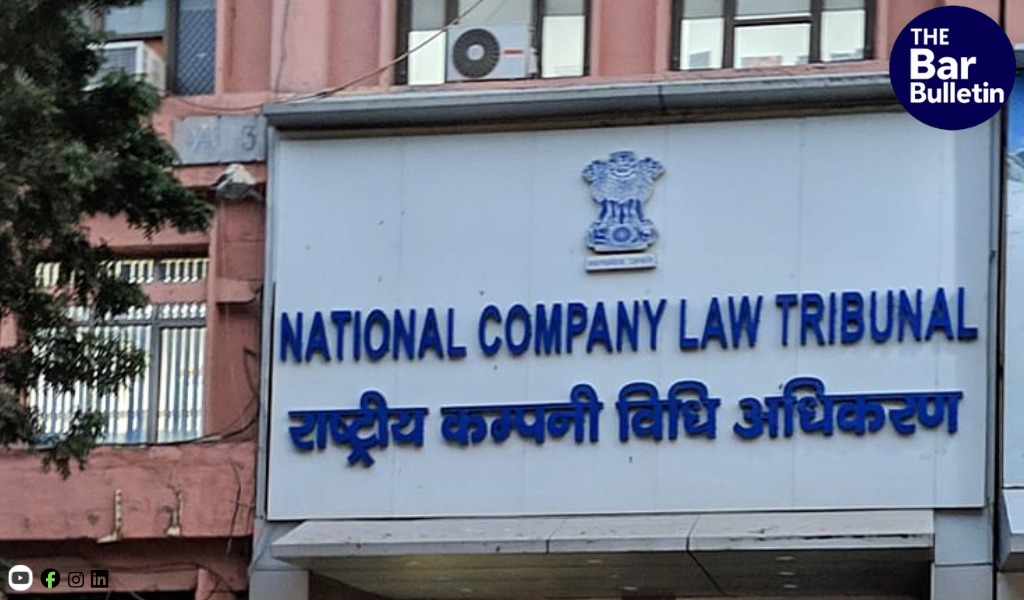

The National Company Law Appellate Tribunal (NCLT) Mumbai Bench has clarified that for admission of a Section 7 IBC application, the Adjudicating Authority is required to determine whether there exists a financial debt and whether a default has occurred. The Court held that disputes raised by the Corporate Debtor, including MSME-related objections, alleged irregularity in NPA classification, pending arbitration, or other inter se disputes, do not defeat admission once debt and default are established.
The Tribunal also held that a dispute as to the precise date of default is not material where, even on the Corporate Debtor’s own case, the application remains within limitation. Further, a defect in the supporting affidavit of the application was treated as a curable defect, not fatal to maintainability once cured pursuant to the Tribunal’s direction.
The Tribunal explained that the debt owed by the Corporate Debtor fell within the definition of “financial debt” under Section 5(8), that the default exceeded the threshold under Section 4, and that the conditions necessary to trigger CIRP were fulfilled. Accordingly, the Section 7 application was admitted, moratorium under Section 14 was declared, and RSDS Advisory & Restructuring LLP was appointed as IRP.
The Division Bench comprising Nilesh Sharma (Judicial Member) and Sameer Kakar (Technical Member) observed that it was an admitted and undisputed position that the Applicant sanctioned Rs. 18 crores to the Corporate Debtor under the sanction letter dated 10.04.2023, that the loan agreement dated 29.04.2023 was executed, and that the account statement reflected disbursement of Rs. 18 crores on 29.04.2023. It also noted that the facility was secured by a mortgage deed dated 18.04.2023.
The Tribunal reproduced the repayment clauses of the loan agreement and noted that the loan, though approved as a demand loan, was permitted to be repaid in monthly instalments as a concession, and that if an amount equal to three instalments was not paid, the creditor could demand recovery of the entire outstanding amount with interest and expenses.
On default, the Tribunal observed that the moratorium expired on 29.04.2024 and that the Corporate Debtor failed to pay the first three instalments. In terms of the loan agreement, this entitled the Applicant to recall the entire loan. The Tribunal also recorded that demand notices dated 27.06.2024 and 19.09.2024 were issued and remained unpaid.
On the objection regarding the date of default, the Tribunal rejected the contention as inconsequential. It held that even if the Corporate Debtor’s interpretation were accepted and the instalments were treated as due on the 10th of the following month, the application would still be within the three-year limitation period. The Tribunal stated that the objection did not have the effect of rendering the application time-barred and was therefore rejected.
On the MSME defence, the Tribunal held that while MSME status was not disputed, the reliefs under the MSMED Act and related RBI frameworks cannot override the operation of the Code. The Tribunal expressly observed that for admission under Section 7, the relevant date is the date of default and not the date of NPA, and that even procedural non-compliance in NPA classification would not negate the right to approach the Adjudicating Authority once default is established.
On the argument that the petition was a counterblast and on disputes relating to pledged goods/arbitration, the Tribunal held that proceedings under Section 7 are summary in nature, and the Adjudicating Authority is only required to ascertain the existence of financial debt and default. Inter se disputes and pendency of arbitration were held to be irrelevant for admission of the application.
The Tribunal noted that the Applicant had placed on record the NeSL record of default in Form D, showing the status as “Deemed to be Authenticated”, total outstanding of Rs. 22.77 Crores, and date of default as 31.07.2024. It also found that the application filed on 30.07.2025 was within limitation. Accordingly, the Tribunal found that the proposed IRP did not have a valid AFA as on the date of the order.
Briefly, the Financial Creditor filed the Section 7 application on 30.07.2025 through its authorised representative for initiation of CIRP against the Corporate Debtor. The Applicant stated that it had sanctioned a loan facility and sought admission on account of default in repayment. The Applicant relied, inter alia, on the loan sanction letter dated 10.04.2023, mortgage deed dated 18.04.2023, loan agreement dated 29.04.2023, certificate of registration of charge, CERSAI search report, demand notices dated 27.06.2024 and 19.09.2024, loan account statement, and record of default with the information utility.
According to the Application, the total amount claimed to be in default was Rs. 24.26 Crores as on 06.05.2025. The unpaid financial debt arose from a loan sanctioned under the sanction letter dated 10.04.2023. To secure the repayment, a mortgage deed dated 18.04.2023 was executed over personal immovable properties of guarantors, including Vikram Virsen Kadam, Surekha Vikram Kadam and Rachna Sangram Kadam. A loan agreement dated 29.04.2023 was executed. Under it, the Applicant sanctioned a loan of Rs. 18 crores carrying 15% interest for a tenure of 120 months.
The Applicant’s case was that the moratorium expired on 29.04.2024, the first instalment fell due on 30.04.2024, and the Corporate Debtor failed to pay instalments due on 30.04.2024, 31.05.2024 and 30.06.2024. On that basis, the Applicant treated 31.07.2024 as the date of default. The account was later classified as NPA on 30.11.2024.
The Corporate Debtor objected on several grounds: alleged discrepancy in the date of default, alleged defect in affidavit/notarisation, MSME protection and alleged non-compliance with the revival/restructuring framework, and the plea that the petition was a counterblast to disputes relating to pledged goods and pending arbitration proceedings.
Appearances:
Adv. Aishwarya Darda, for Financial Creditor
Adv. Omkar Deosthale a/w Adv. Daya i/b Adv. Indrajeet Hingawe, for Corporate Debtor
