
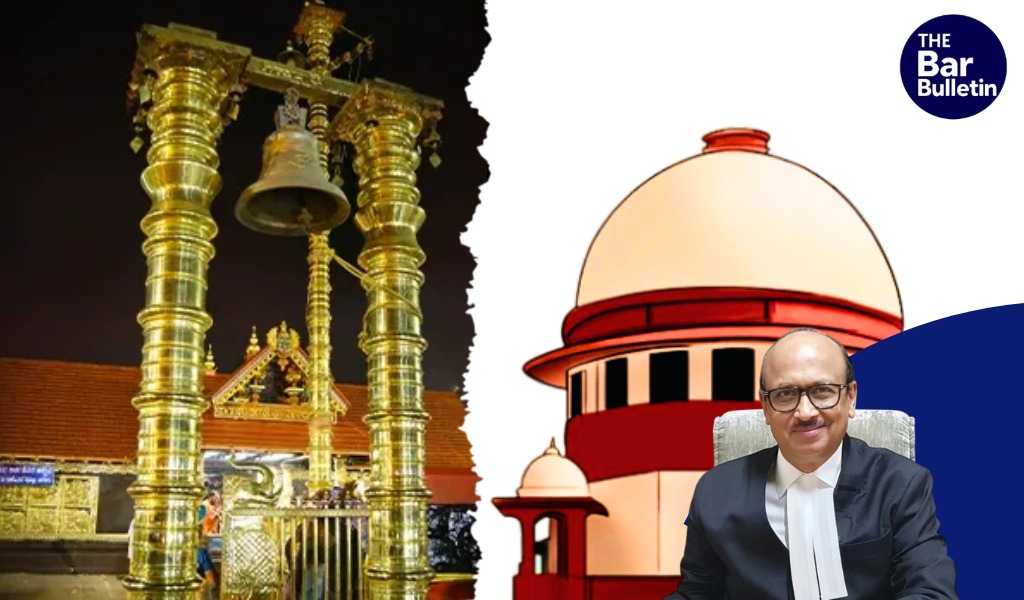

The Supreme Court’s nine-judge Bench on Tuesday heard oral submissions by Senior Advocate Vijay Hansaria in the Sabarimala reference. He argued that constitutional morality and social reform must prevail over exclusionary religious practices.
Appearing for three women who unsuccessfully attempted to enter the Sabarimala Temple, Hansaria contended that Article 26 rights of religious denominations are not absolute and remain subject to Article 25(2), which empowers the State to enact social reform legislation.
“Opposing a social reform is an immoral act… If there is a social reform legislation by the State under Article 25(2)(b), that will prevail and cannot be struck down on grounds of violation of religious practice.”
Hansaria argued that Article 26 does not contain a “notwithstanding” clause unlike several other constitutional provisions, and therefore cannot claim supremacy over equality and reform-oriented provisions. Referring to Constituent Assembly debates, he said member Durgabai Deshmukh had advocated a broader interpretation of temple-entry protections to include all classes and citizens, including women.
Addressing the issue of morality, Hansaria submitted that the term used in Articles 25 and 26 must be understood as “constitutional morality” rooted in equality and dignity. Referring to menstruation-related exclusion, he argued that social taboos cannot justify the denial of worship rights to women devotees.
“If women enter the temple, it does not physically hurt anyone. It does not stop the temple from functioning. By saying women cannot enter, it sends a loud message that women are impure and lesser humans than men.”
He further argued that exclusion of women from places of worship on the basis of menstruation or other biological factors is constitutionally impermissible and contrary to constitutional morality:
“Any custom that excludes women based on biological factors is jurisprudentially unsound, as it contradicts the primary moral code of the land, namely the Constitution. In a secular democracy, the State and the courts cannot enforce religious purity norms if they violate the civil rights of a large group of people. While a religious denomination may view menstruation through the lens of impurity or theological morality, the law must view it through the lens of biological reality and secular jurisprudence. Jurisprudence demands that any legal restriction must have a rational nexus with a legitimate state objective.
Excluding women to preserve the ‘calibate character’ of a deity is a theological argument, not a legal one, and therefore cannot override the fundamental right to worship. Morality is a matter of subjective interpretation, and there is no reason to exclude constitutional morality from the meaning of the term ‘morality,’ nor to restrict the principles of constitutional morality only to administrative functioning.”
He argued that the exclusion of women of menstruating age from the Sabarimala Temple was rooted in social stigma surrounding menstruation. “Consider me as a 10-year-old girl” visiting the temple with her family after observing the required vratam and carrying faith in the deity since birth, only to be denied entry upon reaching a certain age.
Justice B. V. Nagarathna, however, observed that they can go to all other Ayappa temples and said perceptions of taboo differ depending on individual belief and conscience. Justice M. M. Sundresh also noted that similar restrictions do not exist in most other temples.
The Chief Justice remarked that courts would be “extremely reluctant” to pronounce upon such issues in the absence of legislative intervention, observing that if elected representatives considered an issue to require social reform, courts may take note of it. However, the Bench appreciated Mr Hansaria’s argument based on categorisation of constitutional provisions and non-obstante clauses as a “new point” raised during the hearing.
Mr Hansaria further submitted that exclusionary practices must satisfy the “twin test” under Article 14 and argued that opposing social reform itself would amount to an immoral act under constitutional principles.