
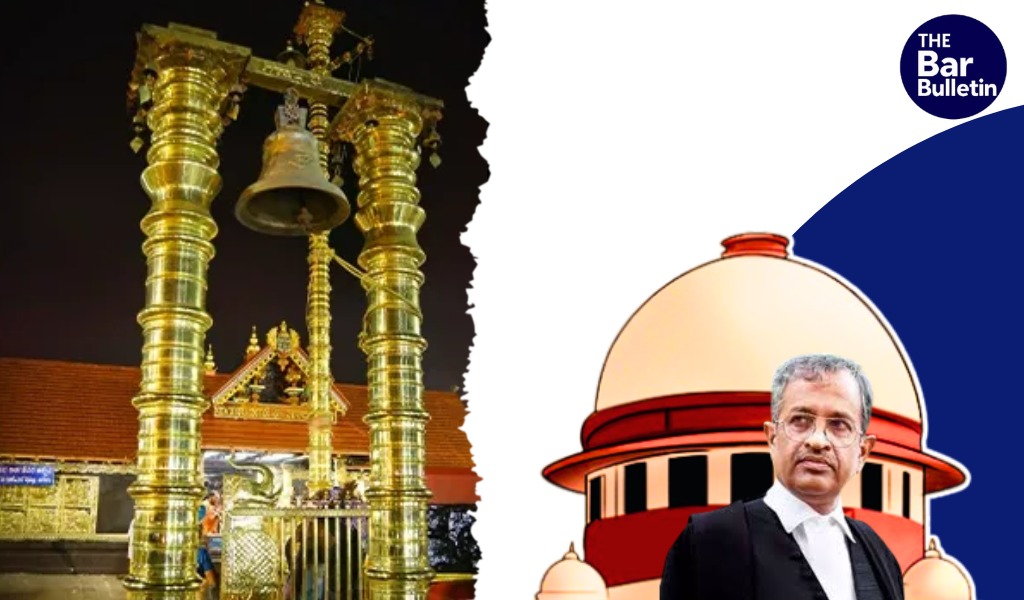

Senior Advocate Sanjay Hegde on Tuesday presented an expansive constitutional defence of social reform and rationalism before the Supreme Court’s nine-judge Bench hearing the Sabarimala reference, arguing that constitutional morality and equality must prevail over exclusionary religious customs.
Appearing for the Maharashtra Andhashraddha Nirmoolan Samiti, Mr Hegde began by situating the case within India’s long history of caste exclusion and temple-entry movements. Referring to the assassinations of rationalist thinkers including Narendra Dabholkar, Govind Pansare, M.M. Kalburgi and Gauri Lankesh, He submitted that “there are several accretions to religion, or which claim a religious descent, which have been exploited and which would in no way receive the protective cover of religion.”
Describing the constitutional vision behind Articles 25 and 26, Mr Hegde argued that the framers consciously adopted a model of “constitutional incrementalism” in a deeply divided society recovering from Partition violence and social discrimination.
“We are a deeply religious, ritualistic country. We are a country that suffered a partition because we could not accommodate certain religious identities. We are also a country whose Constitution was written not only in the backdrop of a struggle against imperialism but also a social struggle among ourselves.”
Tracing the history of reform movements from the Vaikom Satyagraha to Dr. B. R. Ambedkar’s temple-entry agitations, Mr Hegde emphasised that women from oppressed communities had historically led struggles for equal access to places of worship. He argued that the Constitution must therefore be interpreted as a transformative document aimed at dismantling social barriers rather than preserving orthodoxy.
He laid a proposition that freedom of conscience under Article 25 belongs to the individual and not merely to organised denominations. Interpreting the text of Article 25, he argued that the Constitution deliberately omitted any reference to a fixed or birth-based religion.
“The Constitution protects belief absolutely. It cannot prescribe what a person may think or in whom he may have faith. The Constitution protects practice conditionally. Practice is subject to public order, morality and health… Article 13 supplies the bridge between religion and constitutional discipline. A custom that fails the filter does not become protected by being old.”
Mr Hegde further submitted that denominational rights under Article 26 cannot create a superior right to discriminate against worshippers. According to him, collective religious rights are derivative of individual rights and remain subject to constitutional limitations.
“Any reading that produces the result that a community’s right to discriminate is greater than the State’s power to forbid discrimination is an absurdity. The Constitution gives no warrant for so strange a proposition.”
Drawing from religious traditions associated with Udupi Sri Krishna Temple and the Jagannath Temple, Hegde argued that exclusion was a human imposition rather than a divine command.
“The moral I derived from that is that God does not discriminate, man does.”
The Bench engaged actively with Hegde’s submissions. Justice Ahsanuddin Amanullah questioned Hegde’s interpretation of Article 25 by suggesting that the freedom to profess, practice and propagate religion could not mean changing religions throughout the day, as it would lead to “absurdity.” Justice B. V. Nagarathna observed that believers often display deep devotion irrespective of exclusionary practices, to which Hegde responded that “the Lord does not turn away any believer.”
Concluding his submissions, Hegde argued that the Constitution itself embeds rationalist values through provisions such as Article 51A(h), which imposes a duty to develop scientific temper and reformist thinking. He urged the Court to ensure that customs enforced with the force of law remain subordinate to constitutional guarantees of equality, dignity and non-discrimination.
He also urged the Court not to view the constitutional questions solely through the prism of the Sabarimala Temple dispute. The Chief Justice Surya Kant responded, “Don’t be under the heavy burden of Sabarimala,” prompting Mr Hegde to suggest that the matter instead be titled “In Re Articles 25 and 26.”