
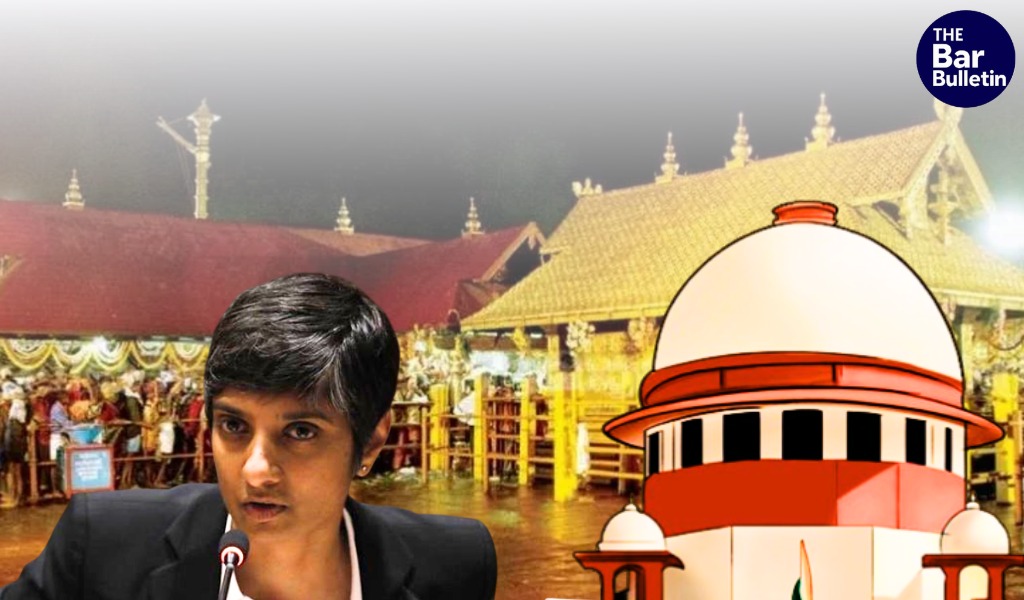

Senior Advocate Menaka Guruswamy on Tuesday advanced the oral argument before the Supreme Court’s nine-judge Bench hearing the Sabarimala reference, contending that the Indian Constitution consciously envisages reform within religion and particularly within Hinduism. She argued that Articles 25 and 26 cannot be interpreted as granting absolute protection to exclusionary practices, especially where such practices conflict with constitutional guarantees of equality and dignity.
Exclusion Comes in Many Forms
Opening her submissions, Ms Guruswamy reflected on her early days at the Bar and recalled entering Supreme Court courtrooms as a young lawyer only to find that there was “not one woman” represented in the portraits lining the walls. She remarked that “Exclusion comes in many forms, in many ways, including at the highest temple of justice.” Ms Guruswamy further expressed hope that Justice B.V. Nagarathna would become India’s first woman Chief Justice and referenced former US Supreme Court judge Ruth Bader Ginsburg’s famous remark that “when all nine are women” would be enough representation on a nine-judge bench.
Following this, in a lighter exchange on the future of women’s representation in the judiciary, Justice BV Nagarathna remarked that “we don’t want to see them in portraits, we want them to be alive.”
The Constitution Envisages the Reform of Hinduism
Mr Guruswamy argued that the Indian constitutional framework differs fundamentally from Western models of religious freedom because it permits and even encourages reform within religion.
“The state is not only religiously agnostic, but it also does more. It reforms. We are, in that sense, a classical Indian welfare state. It is unique to us. Indian constitutionalism is unique not because we have freedom of speech and expression, but because it wades into ways of life.”
She submitted that the Constitution was framed in the backdrop of caste oppression, temple-entry movements and Partition-era violence, and therefore intentionally embedded transformative provisions such as Articles 15, 17 and 25(2)(b). According to her, Hinduism itself had historically accommodated reform with confidence rather than fragility.
“We must be confident of this old religion, our faith, to also say that it has some practices that needed to be reformed out. And that is the confidence with which we must wear our faith.”
She added: “The Constitution envisages the reform of Hinduism and Hinduism has confidently accommodated such reform.”
Referring to Dr. B. R. Ambedkar’s experiences of caste discrimination, including his exclusion from the Jagannath Temple in 1945, Ms Guruswamy argued that constitutional reform cannot be divorced from lived histories of exclusion. She stressed that the framers of the Constitution deliberately chose a limited and conditional model of religious freedom rather than an unrestricted one.
“This is a truncated right. It is not a free, unfettered right. Unlike Germany, unlike the United States, this is a truncated right because it is subject to public order, morality and health and the other provisions of Part III.”
Manage the Religious Affairs, Not Control Them
On the wording of Article 26, she argued that the Constitution deliberately grants religious denominations only the right to “manage” affairs in matters of religion, and not to “control” them absolutely.
“The word ‘manage’ is not a matter of chance. It is a matter of explicit intention. Because the word used is manage, not control. If Article 26(b) had said ‘control’, then we would be in a zone of power beyond this Court. But the framers consciously used the word ‘manage’.”
Ms Guruswamy also argued that Article 25(2)(b), which empowers the State to throw open Hindu religious institutions of a public character to all classes and sections of Hindus, must prevail where denominational claims conflict with individual rights of worshippers.
“The right of entry into a public temple is a subject of Article 25 and cannot be made subject to Article 26(b). When a right has already been specifically granted to the State under Article 25(2)(b), there is no conflict created merely by using the word ‘manage’ in Article 26.”
She reiterated that denominational rights under Article 26 do not extend to denying women entry into public temples and relied on Constituent Assembly debates to argue that the framers consciously intended temple-entry reforms to prevail over exclusionary religious practices.
Civilisations are Enhanced When There is Social Reform
The Bench engaged extensively with her interpretation. Justice B. V. Nagarathna observed that the right under Article 26 was intended to protect denominational practices and management of institutions, while also cautioning that constitutional adjudication should not “upset civilisation.” Ms Guruswamy responded that the framers themselves believed reform strengthened rather than destabilised civilisation.
“The framers were confident that by reforming faith and reforming religion they were not upsetting a civilisational balance. Sometimes civilisations are enhanced when there is social reform.”
Throughout her submissions, Guruswamy repeatedly invoked the framers’ understanding that constitutional morality and social reform were inseparable from religious freedom in India. Citing Constituent Assembly debates, she argued that the “exceptions and qualifications” under Article 25 were “as important as the right it confers,” and the Constitution consciously prioritised freedom of conscience and equality over exclusionary custom.
Provision Restricting Women’s Entry into Temples is Unconstitutional
She also challenged Rule 3 of the Kerala Hindu Places of Public Worship Rules, arguing that the provision restricting women’s entry into temples is unconstitutional and fails the test of proportionality.
She argued that the rule places women alongside categories such as “persons of unsound mind” and “professional beggars,” describing the classification as stigmatising. She further contended that the restrictions resemble historically exclusionary practices that the Constitution sought to dismantle through Article 15(2), which prohibits discrimination in access to public spaces.
“The problem with codification is this. This is perhaps the situation in 1963. We are now assessing it in 2026..the constitutional values must guide the interpretation of codified religious rules.
Referring to Article 51A, counsel also highlighted the constitutional duty to “renounce practices derogatory to the dignity of women.”