
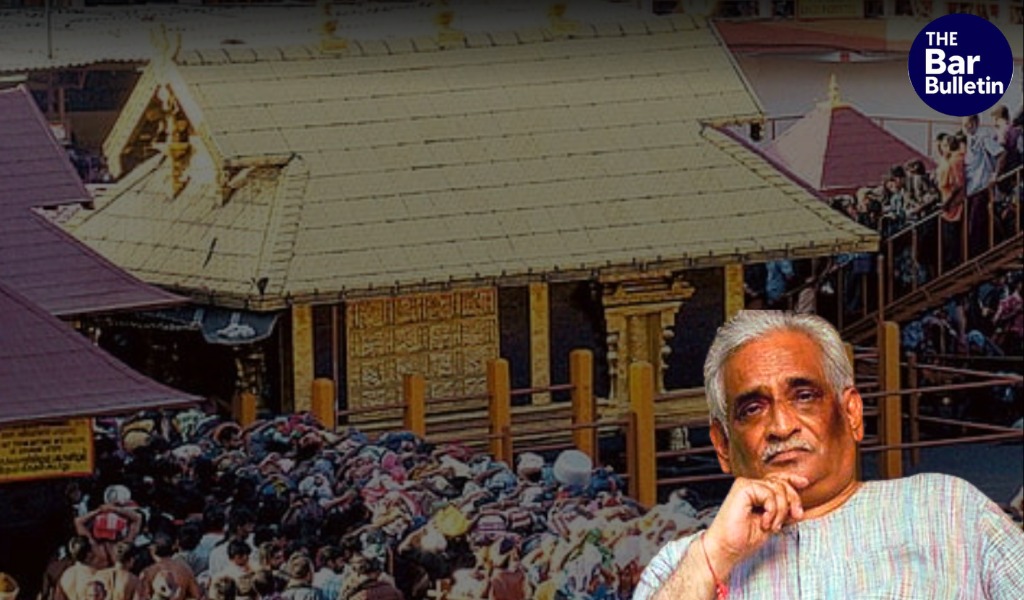
Senior Advocate Rajeev Dhavan, appearing in the Sabarimala review proceedings before the Supreme Court, argued that the adjudication of religious freedom under Articles 25 and 26 cannot be left to a “case-by-case” determination, urging the Court to lay down clear and consistent constitutional principles.
Opening his submissions, Sr Adv Dhavan referred to the framework outlined earlier by the Chief Justice on the scope of judicial discretion, ranging from broad to narrow and even no discretion, and submitted that such an approach must culminate in principled adjudication rather than ad hoc determinations.
He highlighted a series of questions raised by the Bench including by Justices B.V. Nagarathna, Ahsanuddin Amanullah, Sudhanshu Dhulia, and others on critical issues such as the status of the Essential Religious Practices doctrine, the role of custom in defining religion, and whether externally manifested beliefs, including those perceived as superstitious, are subject to judicial review.
Addressing the Court’s broader role, Sr Adv Dhavan emphasised that the present reference is not confined to Hindu practices or the Sabarimala temple alone, but concerns the constitutional framework governing all religions, beliefs, and matters of conscience. He described the Indian Constitution as one designed for a “civilisation state”marked by unparalleled diversity and argued that this plural character must guide the interpretation of religious freedoms.
Relying on the eleven-judge bench decision in T.M.A. Pai Foundation, Sr Adv Dhavan submitted that the Constitution recognises and preserves diversity across religions, communities, and belief systems, and that any interpretation of Articles 25 and 26 must reflect this foundational commitment.
He also flagged the importance of the relationship between Articles 25 and 26, questioning whether the latter is merely a subset of the former or confers independent institutional rights. In this context, he cautioned against reducing denominational rights to a mere aggregation of individual rights.
Referring to queries raised by the Bench, Sr Adv Dhavan underscored that issues such as freedom of conscience, choice of place of worship, and the extent of judicial intervention in religious matters require a coherent doctrinal framework. He submitted that where a place of worship holds unique religious significance, the argument that devotees can simply go elsewhere is untenable.
Setting the tone for his arguments, Dhavan outlined that his submissions would focus on foundational constitutional questions, including the nature of India’s secularism, the scope of religious freedom, and the need to balance reform with respect for diverse traditions.