
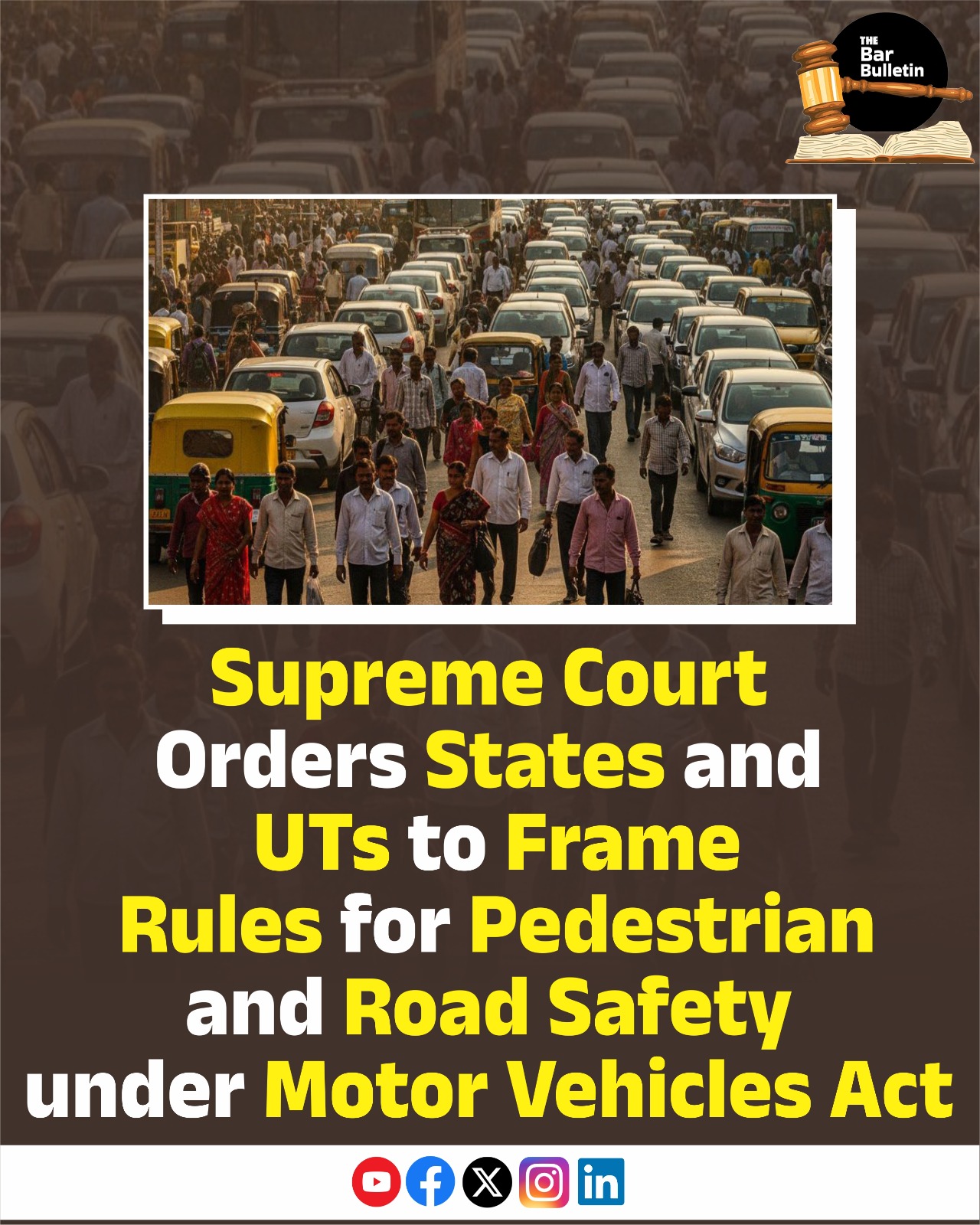
The Supreme Court Bench of Justices J.B. Pardiwala and K.V. Viswanathan issued a series of wide-ranging directions to strengthen pedestrian safety, helmet enforcement, lane discipline, and vehicle lighting norms, calling the rising number of road accident deaths “a national emergency.”
Acting on a public interest petition filed by orthopaedic surgeon Dr S. Rajaseekaran, the Court cited official data from the Road Accidents in India 2023 report, which recorded 1,72,890 deaths, including 35,221 pedestrians and over 54,000 two-wheeler riders who were not wearing helmets. The Court observed that pedestrian deaths had increased by more than 90% since 2016 and emphasised that safe, encroachment-free footpaths and well-designed crossings were a judicially recognized right integral to Article 21 of the Constitution.
The Bench directed the NHAI, municipal authorities, and State Governments in 50 major cities to:
Audit all footpaths and crossings, prioritizing accident-prone and high-footfall zones (markets, hospitals, schools, and transit hubs).
Implement Indian Roads Congress (IRC) 103-2022 Guidelines on pedestrian infrastructure, with provisions for tactile paving, lighting, bollards, and CCTV-equipped subways/FOBs.
Establish online grievance redressal systems for reporting encroachments or unsafe conditions.
Frame rules under Sections 138(1A) and 210-D of the Motor Vehicles Act within six months to regulate pedestrian access and road-design standards.
The Court also mandated:
Strict enforcement of helmet laws through e-monitoring and licence suspensions.
Crackdown on wrong-lane driving and unsafe overtaking, using automated cameras and graded fines.
Ban on dazzling LED headlights, unauthorized red-blue strobes, and hooters on private vehicles, coupled with nationwide awareness drives.
Describing footpaths as “vital public property” and safe walking as a constitutional entitlement, the Court will monitor compliance every seven months. The Bench recorded its appreciation for amicus curiae Mr Gaurav Agrawal, who has assisted the Court on the matter since 2015.
