
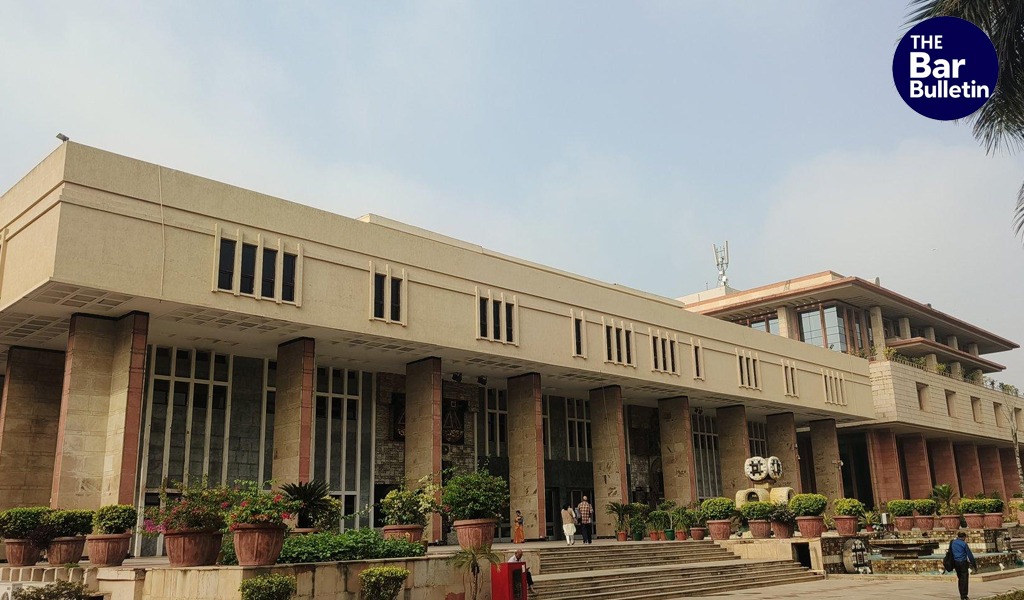

The Delhi High Court has held that where an arbitration clause states that the place of arbitration shall always be at Delhi, and the separate exclusive jurisdiction clause in favour of another court is expressly made subject to the arbitration clause, Delhi is to be treated as the juridical seat of arbitration, and the Delhi High Court has jurisdiction under Section 11 of the Arbitration and Conciliation Act, 1996. In the absence of contrary indicia, designation of the place of arbitration anchors supervisory jurisdiction in the courts of that seat.
The Court further held that at the Section 11 stage, the Court is concerned only with the prima facie existence of an arbitration agreement. Where the existence of the arbitration clause is not disputed, and indeed has been invoked by both parties, objections relating to alleged non-execution of the agreement, forgery on another page, prior civil proceedings, or unpursued insolvency threats do not defeat reference to arbitration at this threshold stage.
The Court also found that the earlier civil suit at Indore had already been withdrawn and that mere prior institution of a civil suit was not a bar to invoking arbitration, particularly where the suit stood withdrawn. It further found that the second suit at Rewa was based on a distinct cause of action, namely alleged interference in the petitioner’s business activities after termination of the Dealership Agreement, whereas the present proceedings concerned monetary claims arising from alleged breaches of the Dealership Agreement.
The Court has reaffirmed that the scope of inquiry under Section 11 is confined to the prima facie existence of an arbitration agreement. Once the arbitration clause is not in dispute, particularly where it has been invoked by both sides, objections concerning alleged non-execution, forgery on another page, prior civil proceedings, or unpursued insolvency threats do not defeat constitution of the arbitral tribunal at the referral stage.
Also Read Delhi High Court Quashes FIR and PMLA Proceedings Against NewsClick and Prabir Purkayastha
A Single Judge Bench of Justice Mini Pushkarna first examined the objection on territorial jurisdiction by analysing Clause 34 of the Dealership Agreement. It noted that the clause provided for amicable settlement first, failing which disputes would be finally settled by a panel of three arbitrators, one appointed by each party and the third jointly by the two nominee arbitrators; the language of arbitration would be English; the place of arbitration would always be at Delhi; the agreement would be governed by Indian law; and, subject to Clause 34.1, Courts at Indore would have exclusive jurisdiction.
The Bench observed that the plain reading of Clause 34 made the intention of the parties clear that the place of arbitration shall always be Delhi. Referring to Section 20 of the Arbitration Act, the Bench reiterated that where the agreement designates a place or venue of arbitration and there is no contrary indicia, that place is to be treated as the juridical seat, and the courts at the seat have supervisory jurisdiction over the arbitral process.
Applying that principle, the Bench held that Clause 34.1 constituted the arbitration agreement, while Clause 34.2 governed disputes other than those covered by Clause 34.1. Since Clause 34.2 was expressly made “subject to Clause 34.1”, there was no doubt or confusion that Delhi was intended to be the place as well as the seat of arbitration. Therefore, the fact that the agreement was entered into in Gurugram or performed in Indore did not affect the jurisdiction of the Delhi High Court for purposes of the Section 11 petition.
On the objection that the Dealership Agreement was an unexecuted document, the Bench found no merit because the respondents had themselves invoked Clause 34 in their reply to the notice invoking arbitration. On the forgery allegation regarding page 4 of the agreement, the Bench observed that the allegation related only to page 4 and not to page 21 containing Clause 34, and the signatures on the page containing the arbitration clause had not been disputed. The Bench therefore held that at the Section 11 stage, where the inquiry is confined to prima facie existence of the arbitration agreement, such allegations could not be gone into.
Also Read CBSE Evaluation Row Reaches Delhi HC, No Immediate Relief for Students: Matter Listed for 6th July
The Bench also rejected the plea of waiver based on civil suits. It held that the Indore suit had already been withdrawn with liberty to file afresh and that mere earlier filing of a civil suit would not bar invocation of arbitration, especially where the suit stood withdrawn. As to the Rewa suit, the Bench noted that it arose from respondent no. 2’s interference with the petitioner’s business activities after termination of the Dealership Agreement and sought injunctive relief, whereas the present reference concerned monetary claims arising from non-compliances under the Dealership Agreement. The causes of action were therefore distinct.
With respect to the respondents’ Section 8 IBC demand notice, the Bench noted that despite issuance of the notice on 17 October 2025, nothing had been placed on record to show initiation of formal IBC proceedings. It further observed that the respondents had themselves invoked the arbitration clause in relation to recovery of the same operational debt of Rs. 40.66 crores, which weakened their objection.
Briefly, the petition was filed under Sections 11(5) and 11(6) of the Arbitration and Conciliation Act, 1996 seeking appointment of a nominee arbitrator on behalf of the respondents or, alternatively, a sole arbitrator, in relation to disputes arising out of a Dealership Agreement dated 18 March 2021 between VE Commercial Vehicles Limited and Singh Enterprises. The parties had been in dealership since 2006 in relation to supply of Eicher Pro Trucks/Buses, spare parts and related services in Rewa, Madhya Pradesh, and the last renewal under the Dealership Agreement was for 4 years and 3 months up to 30 June 2025.
The petitioner alleged continuous non-compliance and deterioration in performance by the respondents, including failure to make timely deliveries of vehicles, deploy manpower at the dealership, and infuse required working capital. A notice dated 22 April 2024 communicated the petitioner’s intention to terminate the Dealership Agreement, followed by a Termination-cum-Demand Notice dated 11 May 2024 terminating the agreement under Clause 26 and demanding Rs. 1.41 crores. The respondents replied on 26 June 2024, and thereafter the petitioner invoked Clause 34 of the Dealership Agreement by notice dated 05 August 2025 under Section 21 of the Arbitration Act.
The respondents, by reply dated 05 September 2025, refused consent to the petitioner’s proposed nominee arbitrator, counter-invoked the arbitration clause, and raised monetary claims of Rs. 40.66 crores. In resisting the petition, they contended, inter alia, that the Dealership Agreement filed with the petition was unsigned by the petitioner and therefore unenforceable, that Clause 31 required execution by an authorised signatory of the petitioner, that there was forgery regarding the term on page 4, that criminal complaint had been lodged with the EOW, that prior civil suits amounted to waiver of arbitration, that Courts at Indore alone had jurisdiction, and that serious fraud allegations were not arbitrable.
