
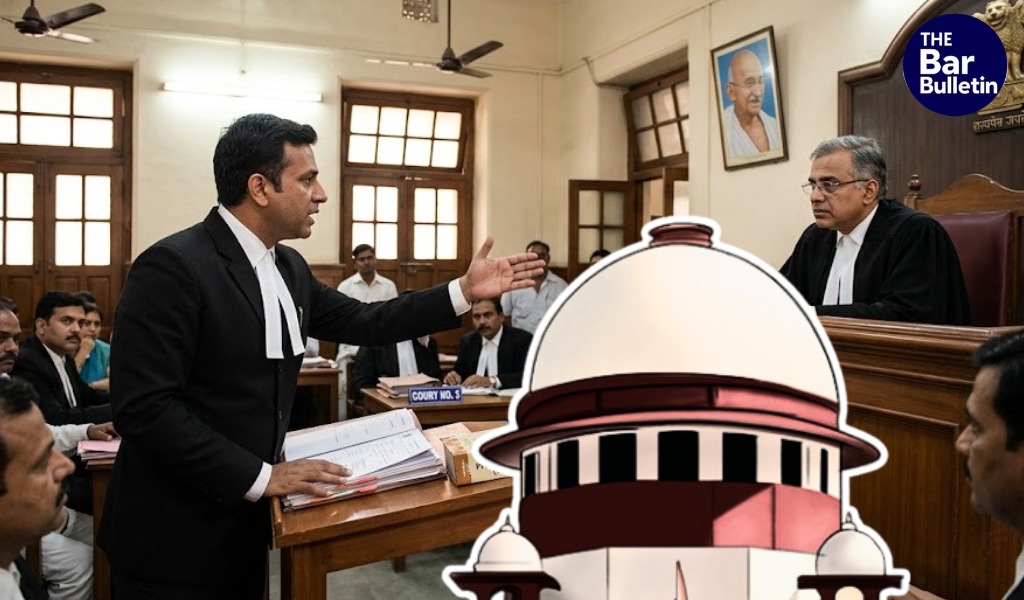

The Supreme Court on Monday closed proceedings arising out of the widely circulated video of an exchange between a judge of the High Court of Andhra Pradesh and a young lawyer during court proceedings, while emphasising that members of the judiciary “ought to exhibit patience, compassion and a spirit of encouragement particularly towards young entrants to the legal profession.”
The matter came before the Court following communications from the Supreme Court Bar Association and the Bar Council of India concerning media reports alleging that a young advocate had been directed to be taken into judicial custody for 24 hours after a disagreement with a High Court judge during proceedings on May 6, 2026.
The matter stemmed from a disagreement over the applicability of a judicial precedent. According to the report, the situation escalated after the judge formed an impression that the young lawyer had deliberately struck his file against the podium, whereas the advocate submitted that the file had accidentally slipped from his hands. The video circulated on Social media received mixed reactions and outrage, following which, the Supreme Court took suo motu cognisance.
After seeking a report from the Chief Justice of the Andhra Pradesh High Court, the Bench of Chief Justice Surya Kant and Justice Joymalya Bagchi noted that the incident had since been amicably resolved and that the young counsel had expressed willingness to continue his professional duties without apprehension. It also recorded that no formal complaint had been lodged by the advocate or any bar body.
“We are thus of the view that the incident in question does not warrant any further action at our end,” the Bench observed.
At the same time, the Court used the occasion to make broader observations on judicial temperament, professional ethics and institutional responsibility toward young lawyers entering the profession.
“Members of the judiciary at all levels ought to exhibit patience, compassion and a spirit of encouragement particularly towards young entrants to the legal profession.
The Bench further observed that while it is the duty of senior members of the Bar to inculcate discipline, ethics and professional commitment among young advocates,
“The present juncture thus precipitates that young law graduates come from a wide variety of backgrounds. Our encouragement is to join the bar, especially at the level of trial and district courts who has to imbibe the foundational principles of legal practise. While it is certainly the solemn duty of the senior members of the court to inculcate in young advocates ethical values, discipline, professional commitment and a habit of continuous learning, the responsibilities does not rest with the bar alone.”
The Court also called upon the Bar Council of India and State Bar Councils to conduct structured orientation programmes for new entrants into the legal profession and encouraged closer collaboration between the Bench and the Bar in fostering professional development.
The Bench also suggested that High Courts consider constituting institutional grievance redressal mechanisms involving representatives of Bar Associations and Bar Councils to amicably resolve disputes between members of the Bench and the Bar.
Expressing concern over circulation of decontextualised courtroom clips on social media, the Bench cautioned that selective dissemination of video snippets “has the potential to cause unwarranted tribulations to institutions as well as to the administration.” The Court said the media must act with a heightened sense of responsibility and report legal proceedings in a manner that is fair, balanced and conducive to the larger public interest.
“We also consider it necessary to make an unequivocal observation that the media has a vital role to play in this regard. The dissemination of decontextualised video clips without presenting the full background in which certain expressions may have been made has the potential to cause unwarranted tribulations to the institutions as well as to the administration. We therefore expect that the media will also play a very core role with a heightened sense of responsibility and discharge their obligations in a manner that is fair, balanced and conducive to the larger public interest.”
Praising the role of responsible legal journalism, the CJI observed:
“The rest of the media, particularly our legal correspondents, reporters and even those who are at very high-level editors, they are very responsible. The quality of the reporting, the amount of publicity in which they are entering to provide what’s happening in the system and the amount of public awareness about their rights, their responsibilities.”
Senior advocate Vikas Singh agreed: “The media which is permanently placed here, they really know how the system functions.”
