
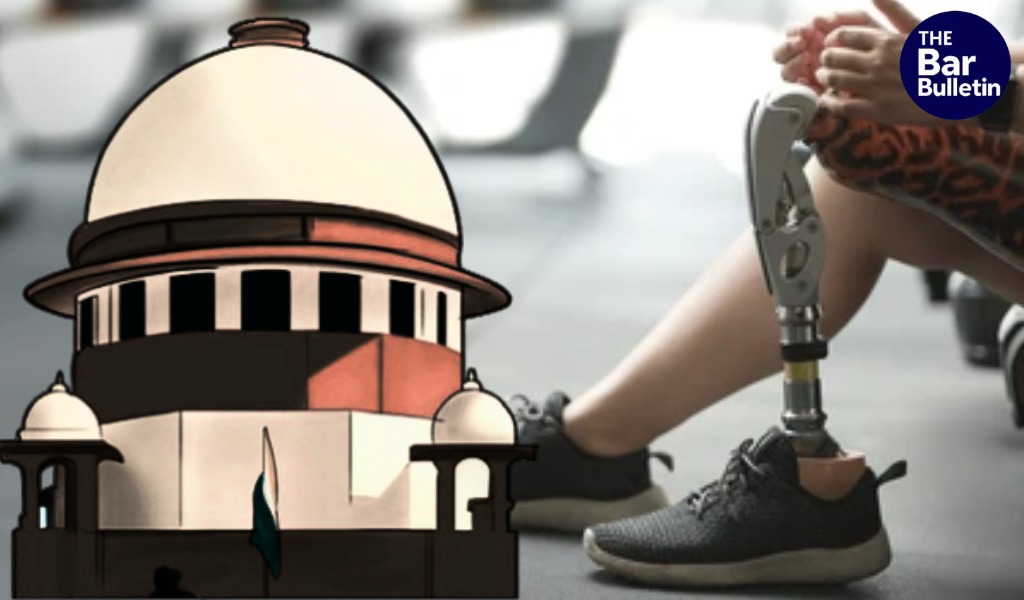

The Supreme Court of India has laid down important principles governing compensation for prosthetic limbs in motor accident cases, while enhancing compensation to ₹36.2 lakh.
The Bench of Justice K. V. Viswanathan and Justice J.B. Pardiwala emphasised that compensation must adhere to the principle of restitutio in integrum, aiming to restore the claimant, as far as possible, to their original condition.
Dealing with a case where the appellant’s right leg was amputated following a road accident, the Court noted that prosthetic limbs are essential and personal to the dignity and functionality of an amputee. It held that compensation must account not only for the initial cost but also periodic replacement and maintenance over the claimant’s lifetime.
The Court assumed a standard life expectancy of 70 years and recognised a five-year replacement cycle for prosthetic limbs. Applying this, it awarded compensation for seven prosthetic limbs at ₹3 lakh each (?21 lakh), along with ₹5 lakh towards maintenance costs.
Rejecting reliance on government-notified rates as “abysmally low,” the Court held that claimants are entitled to reasonable costs based on actual needs and are not bound to opt for cheaper alternatives. The Court also directed that future claims under this head must be supported by quotations from multiple service providers to enable accurate assessment.
On facts, the Court enhanced compensation under various heads, including loss of future income taking monthly income at ₹6,000 and functional disability at 100% and awarded additional amounts towards litigation costs. The total compensation was fixed at ₹36,20,350, over and above the amount awarded by the High Court.
Appearances:
For the Appellant: Anuj Bhandari, Advocate
For the Respondent No. 1 (Haryana Roadways): Akshay Amritanshu, Advocate
For the Respondent No. 2 (Insurance Company): Vishnu Mehra, Senior Advocate
