
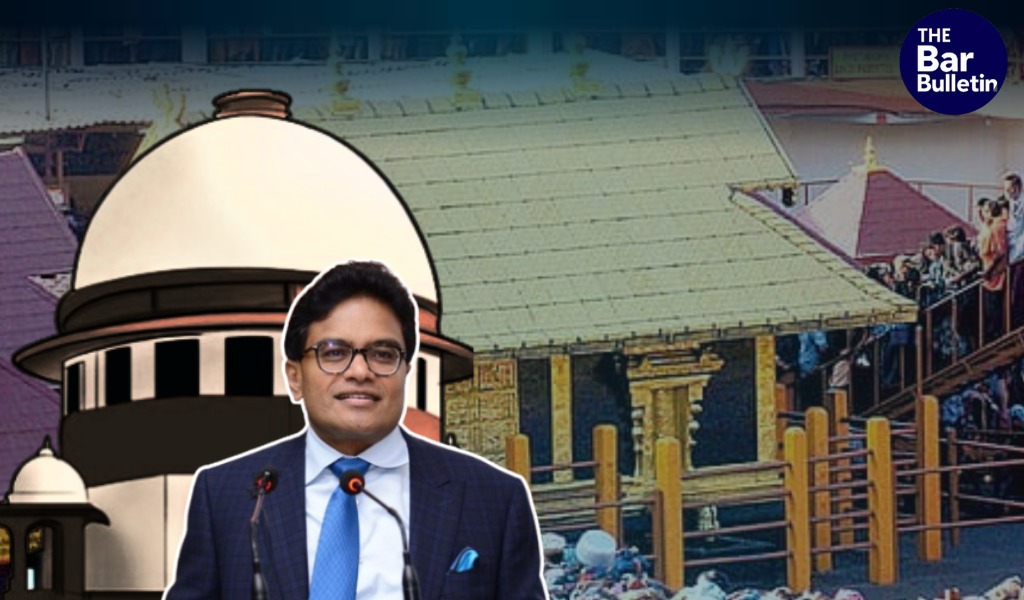

Senior Advocate Krishnan Venugopal, appearing for Jain organisations, before the 9-Judge Bench in Sabarimala Reference, told the Supreme Court that increasing state interference in religious affairs risks undermining institutional autonomy across faiths. He submitted: “we are concerned for all religions about increasing instances of state intervention… whether through legislative or judicial intervention.”
Mr Venugopal argued that a secular state should not control religious institutions, stating, “A secular state ought not to be administering temples and controlling temple management, staffing and financial decisions…in order to give religion its rightful place in the affairs of the country, one should allow religions to conduct their own affairs. Interference should be permitted on very narrow grounds, which is the specific grounds mentioned in Article 25 (1) and 26 (1).”
Critiquing the broader approach to reform, Mr Venugopal contended that “state intervention is not necessarily the panacea for all ills in a religion… reforms should ideally emerge internally.
Proposing a structured framework for assessing state action under Article 25, Mr Venugopal outlined that the State must first demonstrate that a regulated activity is “economic, financial, political or other secular” in nature, and only then justify intervention.
Raising concerns about state control of temples, Mr Venugopal pointed to past instances where government involvement allegedly led to mismanagement of religious assets. He maintained that “the state ought not to be running temples,” because such involvement can interfere with religious functions and traditions.
He opposed the acquisition of Jain religious sites, stating that such locations are “believed for millennia to be divine and sacred sites of worship and they should not be subject to state takeover except in the most exceptional circumstances.” On the regulation of religious funds, he relied on precedent to submit that donations must be used strictly for intended religious purposes.
On the essential religious practices doctrine, Venugopal submitted that the test has “no textual foundation whatsoever” in Article 25(2)(a). Referring to the provision, he pointed out that it only allows the State to regulate “economic, financial, political or secular activities associated with religious practice,” and emphasised that the word “essential” does not find mention in the text.
He argued that constitutional protections under Articles 25 and 26 must be carefully balanced, stressing that denominational rights ensure the survival and coherence of religious communities. Referring to precedent, he submitted that a denomination is defined by “a common faith, common belief and a belief in common creed, doctrines and dogma,” and communities have the right to preserve these essentials.
Mr Venugopal cautioned against challenges to religious practices by non-believers, stating that allowing such interventions could undermine the internal discipline necessary for a denomination’s continuity. At the same time, he clarified that the state retains powers to intervene in extreme cases affecting public order, morality or health, including practices that may violate criminal law.
On untouchability, he emphasised that the constitutional prohibition under Article 17 applies uniformly, including to religious denominations, asserting that no group can claim protection for practices that violate this guarantee.
Concluding, he urged the Court to recognise Articles 25 and 26 as part of the Constitution’s basic structure, underscoring that religious freedom, dignity, and liberty of belief form foundational principles that must remain insulated from excessive state interference.