
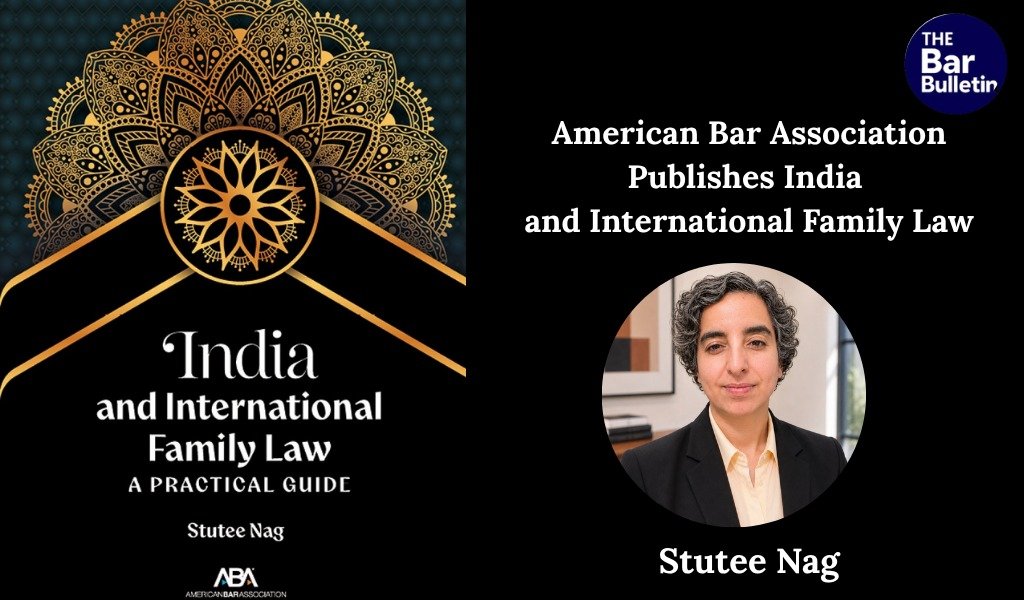

The American Bar Association has published India and International Family Law: A Practical Guide, authored by Stutee Nag, an attorney licensed in New York, New Jersey, and India.
The book provides judges, attorneys, mediators, and family law professionals with a practical guide to cross-border family law disputes involving India and the United States. It addresses issues including international child custody, parental child abduction, divorce, jurisdictional conflicts, immigration consequences, and the recognition and enforcement of foreign orders. Drawing upon Indian and U.S. law, international conventions, case law, and practical experience, the book offers guidance on the legal and procedural complexities that arise when family disputes span both jurisdictions.
The book has been endorsed by Hon. Judith J. Gische (Ret.), former Justice of the Appellate Division of the Supreme Court of the State of New York, who writes: “Although she calls her work ‘A Practical Guide,’ make no mistake this resource is so much more than that.” Justice Gische describes it as “an important resource for attorneys” and “must read for attorneys who want to practice international family law involving the United States and India.”
The book has also received endorsements from distinguished international family law practitioners. Michael J. Stangarone, Esq., a leading Canadian international family law attorney, describes it as “a timely and much-needed contribution to the growing field of international family law” that “will be an indispensable resource for judges, lawyers, mediators, and other professionals seeking clear, thoughtful, and practical guidance” and “a valuable reference for both experienced practitioners and those new to international family law.”
Lawrence J. Katz, Esq., a highly respected U.S. international family law attorney, highlights Nag’s “unique experience in both Indian and American legal systems,” noting that she “explains complex legal issues in a clear and accessible manner.” He concludes that practitioners confronting questions of “jurisdiction, international child custody, parental child abduction, or the recognition of foreign orders” will find the book “an invaluable resource.”