
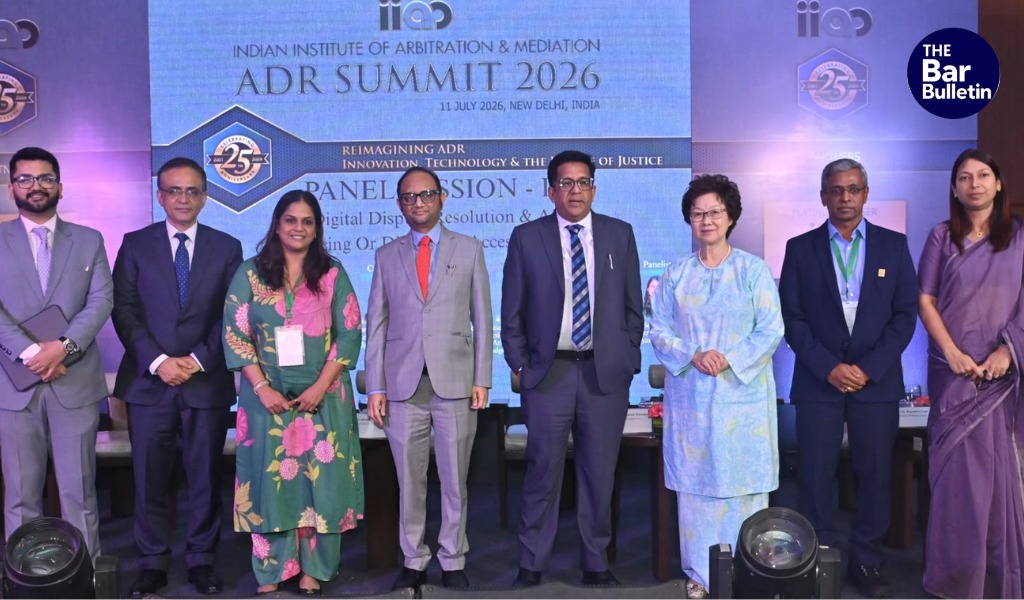
Artificial Intelligence (AI) is poised to transform dispute resolution by making legal processes faster, more efficient and accessible. However, technology must remain an aid—not a substitute—for human judgment, judicial discretion and due process. This was the key takeaway from Panel Session No. 3, titled “Digital Dispute Resolution & AI: Enhancing or Disrupting Access to Justice?”, held at the IIAM ADR Summit 2026, organised by the Indian Institute of Arbitration & Mediation (IIAM) at Shangri-La Eros, New Delhi.
The session was chaired by Hon’ble Mr.Justice A. Muhamed Mustaque, Chief Justice of the Sikkim High Court, with Hon’ble Mr. Justice Advait M. Sethna of the Bombay High Court serving as Co-Chair. The discussion was moderated by Mr. Zafar Khurshid, Senior Partner at TKC Partners LLP and an arbitration practitioner. The panel featured Hon’ble Ms. Justice Dato’ Mary Lim Thiam Suan, President of the AIAC Court of Arbitration and former Judge of the Federal Court of Malaysia; Mr. Dhirendra Negi, Partner at JSA Advocates & Solicitors; Ms. Seema Singh, General Counsel, Nayara Energy; Ms. Bindu Janardhanan, Partner at Squire Patton Boggs, Singapore; and Mr. Rajendra Lade, Chief General Manager (Legal), Hindustan Petroleum Corporation Limited (HPCL).
Opening the discussion, moderator Zafar Khurshid framed the debate around one of the defining questions confronting the legal profession today whether AI is truly enhancing access to justice or gradually disrupting the very foundations of adjudication. Steering the conversation through practical and policy concerns, he invited the panellists to examine the role of AI in arbitral award drafting, digital evidence, cross-border disputes, sanctions regimes and institutional safeguards necessary for responsible adoption of emerging technologies.
Justice Advait M. Sethna observed that artificial intelligence has immense potential to improve efficiency within courts and arbitral proceedings by assisting with legal research, document management and administrative functions. However, he cautioned against allowing technology to replace judicial reasoning. According to him, adjudication is fundamentally a human exercise requiring application of mind, appreciation of facts and accountability functions that cannot be delegated to machines. AI may support decision-makers, but the ultimate responsibility for dispensing justice must remain with judges and arbitrators.
Building upon that theme, Justice Dato’ Mary Lim Thiam Suan shared Malaysia’s experience with AI in criminal sentencing, explaining that AI had been introduced to minimise inconsistencies in sentencing and promote greater uniformity in judicial outcomes. She noted that technology had demonstrated its value in assisting the justice system without replacing judicial discretion. In the arbitration context, she explained that AI can significantly improve institutional efficiency, including assisting arbitral institutions in identifying suitable arbitrators from extensive databases and streamlining case administration.
Justice Mary Lim, however, stressed that AI-assisted drafting of arbitral awards must always remain subject to meaningful human review. Referring to recent international developments, including instances where awards were challenged because of indiscriminate reliance on AI-generated content, she emphasised that transparency, disclosure and procedural fairness remain indispensable. She noted that institutions such as AIAC, SIAC, the Vienna International Arbitral Centre and UNCITRAL Working Group II are actively developing protocols governing AI usage to preserve the integrity of arbitral proceedings. In her view, honesty, integrity and disclosure will ultimately determine whether AI strengthens or undermines confidence in arbitration.
Turning to the evidentiary challenges posed by artificial intelligence, Mr. Dhirendra Negi highlighted the growing threat posed by deepfake technology and manipulated electronic records. While acknowledging that India’s evidentiary framework provides for the admissibility of electronic evidence, he pointed out that existing provisions largely address procedural certification rather than verifying the authenticity of underlying digital data. He cautioned that sophisticated AI tools could alter electronic records in ways that remain extremely difficult to detect, particularly in large commercial arbitrations involving voluminous documentation. He also observed that arbitrators often lack the investigative powers available to courts for independently verifying digital evidence, suggesting that India may eventually need stronger evidentiary standards comparable to those developed in other jurisdictions.
Chairing the session, Chief Justice A. Muhamed Mustaque repeatedly emphasised that justice cannot be reduced to algorithms or automated processes. While acknowledging AI’s transformative potential, he underscored that fairness, conscience, empathy and judicial wisdom remain uniquely human attributes. Technology may assist legal institutions in improving efficiency, but the legitimacy of the justice delivery system ultimately rests upon human reasoning and independent decision-making.
Speaking from the perspective of an in-house counsel handling complex international commercial disputes, Ms. Seema Singh drew attention to the growing intersection between artificial intelligence, sanctions regimes and digital sovereignty. Recounting Nayara Energy’s experience, she explained how automated compliance systems operated by global technology companies had temporarily disrupted critical digital services because of international sanctions, despite there being no legal prohibition under Indian law. She cautioned that AI-driven compliance mechanisms frequently reflect geopolitical considerations embedded within global technological infrastructure, highlighting the urgent need for India to strengthen its own digital capabilities and legal safeguards to ensure business continuity.
Ms. Bindu Janardhanan addressed the increasing use of electronic signatures and smart contracts in cross-border transactions. She observed that while most commercial jurisdictions have embraced digital execution of contracts, future geopolitical developments may present new questions concerning governing law, jurisdiction and enforceability. Courts, she noted, have generally adopted a pragmatic approach by recognising the commercial conduct of parties rather than insisting upon rigid formalities, but emerging international developments may require greater legal adaptation.
Concluding the panel discussion, Mr. Rajendra Lade highlighted the transformative role AI can play in litigation management and dispute resolution within large public sector organisations. He explained that digitisation of legal records and AI-powered analytics can significantly improve efficiency in handling large volumes of litigation. At the same time, he stressed that robust safeguards concerning confidentiality, privacy and data protection are indispensable, particularly where commercially sensitive information is involved. AI, he observed, must function within secure institutional frameworks supported by appropriate human oversight.
Bringing the session to a close, Zafar Khurshid observed that while AI presents unprecedented opportunities for transforming dispute resolution, its success will ultimately depend on how responsibly the legal community chooses to deploy it.