
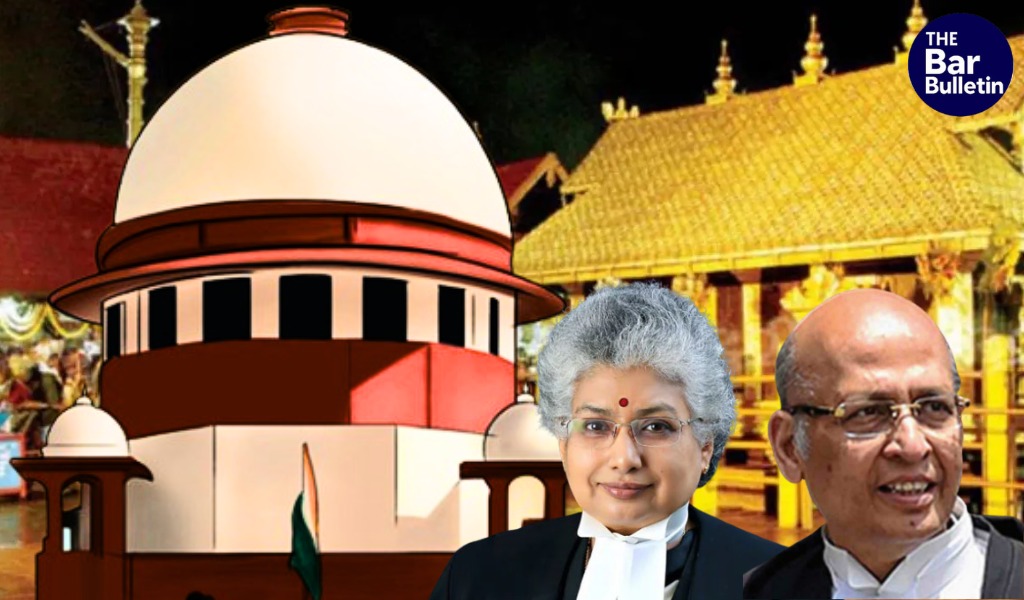
Before a nine-judge Constitution Bench of the Supreme Court, Senior Advocate Abhishek Manu Singhvi laid out a structured framework on the interpretation of Article 25, emphasising that religion must be understood primarily through the lens of community beliefs and practices, rather than judicially imposed standards.
Setting out his submissions in five broad propositions, Singhvi argued that religion constitutes a set of shared beliefs and practices of a group or denomination, and while Article 25 guarantees individuals the right to profess, practise and propagate religion, such rights cannot extend to encroach upon the collective rights of other adherents. He stressed that courts are bound to accept the beliefs of a community so long as they are genuine and not fanciful, and cannot sit in judgment over their correctness.
He further contended that it is impermissible to read additional limitations into the constitutional text, cautioning against the expansion of doctrines such as “essential religious practices” beyond what is expressly contemplated under Article 25. According to him, the Constitution already incorporates a carefully balanced framework of permissible restrictions public order, morality, and health and any further judicial dilution would disturb this equilibrium.
Addressing precedent, Singhvi sought to harmonise the ruling in Seshammal with Article 16(5), submitting that while denominational institutions may restrict appointments based on religion, such protection does not extend to discrimination on other grounds such as caste, sex, or place of birth. He clarified that religion alone is immunised under Article 16(5), not broader forms of exclusion within the same denomination.
He also highlighted that courts should apply only a limited, subjective test to determine whether a practice forms part of a religion, resisting the use of external or “objective” standards. Even practices that may appear irrational or lacking in empirical basis, he argued, would merit protection if they are integral to the community’s belief system.
During the hearing, an exchange arose with Justice B.V. Nagarathna, who observed that commonality in beliefs and practices ultimately relates to a “relationship between man and God.” Singhvi responded by broadly accepting the formulation, while cautioning that it may not universally apply to non-theistic traditions such as Charvaka philosophy, where atheistic beliefs may still fall within the ambit of Article 25.