
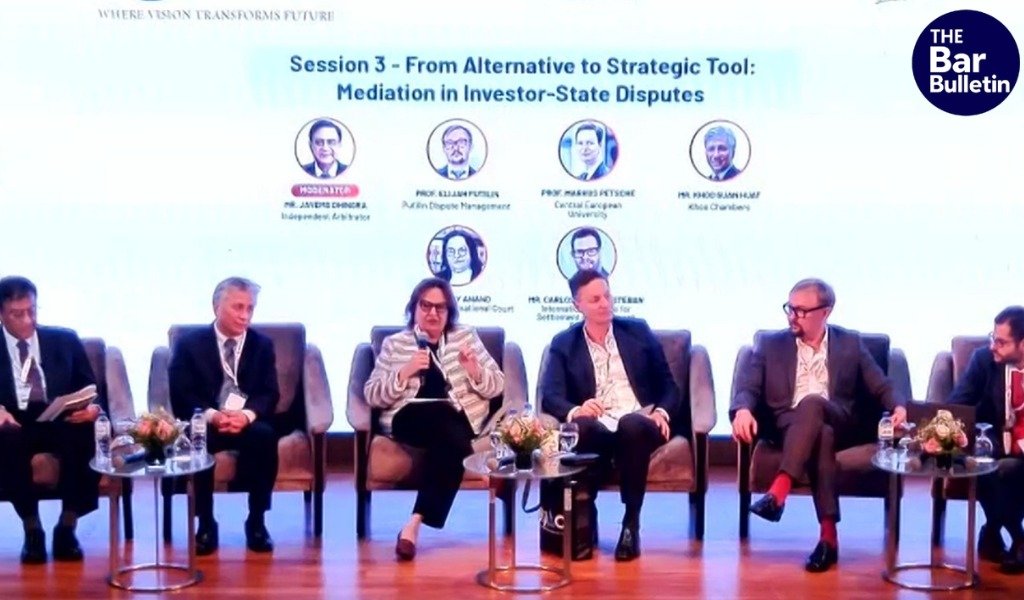

Dr Pinky Anand, Judge at the Bahrain International Commercial Court, has called for mediation to be integrated into the broader investor-state dispute settlement framework, observing that mediation may not always provide a complete resolution but can help parties resolve parts of a dispute while working towards an overall settlement.
Speaking at Session 3, “From Alternative to Strategic Tool: Mediation in Investor-State Disputes”, during Asia ADR Week 2026, Anand emphasised the need to move beyond viewing mediation in isolation and instead consider how it can operate alongside arbitration, conciliation and other dispute resolution mechanisms.
“
“I do believe that mediation might not provide a complete solution in this state. So what you really need to do is to work it into a system so that you have partial working out, and maybe the final one worked out as a settlement,” she said.
She highlighted the distinctive challenges of investor-state disputes, which frequently involve questions of state sovereignty, legislation, public policy, taxation, licensing and expropriation. Unlike ordinary commercial disputes, these matters can require governments to balance investor protection against broader regulatory and public-interest considerations.
Also Read “Arbitrators Do Not Become Selectors”: Dato’ M. Rajasekaran on Fairness in Sports Selection Disputes
She suggested that mediation could be introduced within the cooling-off period provided under investment treaties and considered alongside arbitration, allowing parties to explore settlement without necessarily abandoning formal proceedings.
Pointing to Singapore’s hybrid dispute resolution frameworkPointing to Singapore’s hybrid dispute resolution framework, Dr Anand referred to arrangements combining mediation with mechanisms that can make a settlement enforceable as an arbitral award. She suggested that similar approaches could be explored to integrate mediation more effectively into investor-state dispute resolution, while improving the prospects of enforceable outcomes.
Dr Anand also referred to the growing international recognition of mediation through the Singapore Convention on Mediation, the ICSID Mediation Rules introduced in 2022, and legislative developments such as India’s Mediation Act, 2023. She noted that India has been seeking to promote mediation in commercial disputes and that investor-state disputes could also benefit from a more integrated approach to alternative dispute resolution.
Professor Markus Petsche highlighted the limited use of mediation in investor-state disputes, citing ICSID statistics indicating that, in 2025, 62 arbitration proceedings were filed, compared with one conciliation proceeding and no mediation proceedings. Since the introduction of the ICSID Mediation Rules in 2022, only seven mediation cases had been filed, according to the figures discussed during the session.
Prof Petsche identified concerns over government accountability, complex domestic settlement procedures and the limited incentives of lawyers accustomed to arbitration as obstacles to mediation. He suggested that clearer domestic procedures, greater transparency and independent governmental bodies authorised to approve mediated settlements could help address these concerns.
He also proposed making mediation a mandatory preliminary step under investment treaties, subject to appropriate time limits. Referring to a 2020 Queen Mary University of London survey, he noted that 64% of the investors interviewed reportedly held favourable views towards mandatory mediation regimes in investment treaties.
Professor Elijah Putilin discussed recent developments in investment treaties and the institutional framework supporting investor-state mediation. He explained that investors have traditionally favoured arbitration as a more established mechanism, while treaty provisions expressly referring to mediation or conciliation remain limited.
Prof Putilin pointed to newer treaty approaches that incorporate mediation into the dispute resolution process, including provisions allowing mediation during a cooling-off period and arrangements under which a host state may require the parties to attempt mediation. He also highlighted initiatives by Asian countries to promote investor-state mediation and conciliation through international discussions and institutional developments.
Mr Carlos Molina Esteban outlined the framework under the ICSID Mediation Rules introduced in 2022. He explained that mediation is available where the dispute involves a state or regional economic integration organisation, relates to an investment, and the parties provide written consent.
He highlighted the flexibility of the rules, including the ability to agree to mediation after a dispute arises and to use mediation at different stages of an investment’s life cycle. Mediation may also proceed in parallel with arbitration, allowing parties to explore an amicable resolution without necessarily suspending formal proceedings.
Molina Esteban noted that the rules were developed in response to the interest in amicable settlements reflected in ICSID’s caseload, as well as broader international efforts to strengthen investment mediation. He also discussed the relevance of the Singapore Convention on Mediation to the enforceability of mediated settlement agreements, subject to its applicable requirements and any relevant state reservations.
Mr Khoo Guan Huat addressed the practical difficulties that may arise when investors and states consider mediation. He observed that the parties may have different interests and resources, while investors may be concerned about a state’s financial capacity or willingness to negotiate.
He also highlighted the importance of good-faith participation and the authority of government representatives to make settlement decisions. Officials may be reluctant to settle disputes if they fear subsequent scrutiny of their decisions, potentially making arbitration appear preferable because the outcome is determined by an independent tribunal.
These concerns formed part of the broader discussion on how institutions and governments can create conditions in which mediation is viewed as a credible and effective dispute resolution option.
The discussion highlighted that expanding mediation in investor-state disputes requires more than introducing procedural rules. It also calls for reforms to investment treaties, clear domestic authority for settlement, greater awareness among legal practitioners and mechanisms that address concerns about accountability and enforceability.
The panellists explored how mediation could complement arbitration rather than compete with it, giving states and investors greater flexibility to address commercial interests alongside legitimate regulatory and public-policy considerations.