
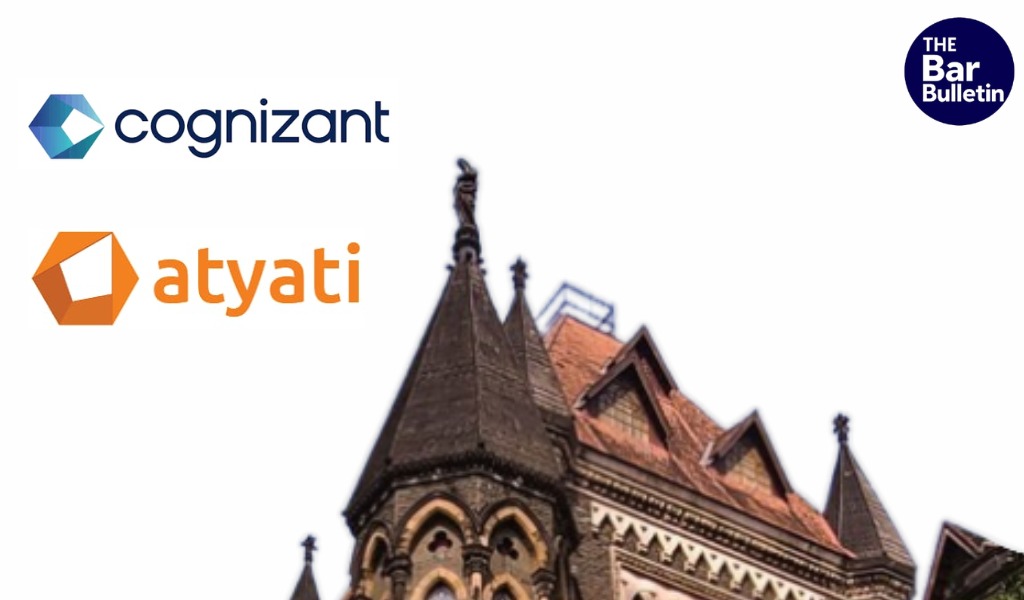

Finding that Atyati had failed to establish a prima facie case of copyright infringement as well as passing off/reverse passing off, the Bombay High Court has held that no interim injunction could be granted against Cognizant’s use of its logo. The Court clarified that in a copyright action involving logos, mere visual resemblance and prior adoption are not enough to justify interim relief. The plaintiff must show a reasonable possibility of access and a prima facie causal link between its work and the defendant’s work; if the defendant produces persuasive material showing independent creation, the inference of copying is displaced.
Here, although the logos resembled each other in adopting a hexagonal device, Cognizant’s evidence of a substantial and documented design process, coupled with the absence of material showing reasonable access to Atyati’s logo, defeated the copyright claim at the interim stage, added the Court.
On passing off, the Court held that reverse passing off is maintainable in principle under Section 27(2) of the Trade Marks Act and ordinary passing off principles can cover a case where a junior but stronger market player overwhelms a senior user. However, the plaintiff must still establish the classic trinity of goodwill, misrepresentation, and damage. Since Atyati failed to show protectable goodwill in its standalone logo and the relevant consumers were sophisticated institutional buyers unlikely to be confused, no prima facie case of passing off or reverse passing off was made out.
A Single Judge Bench of Justice Sharmila U. Deshmukh first framed the broad issues for decision, including whether Atyati owned copyright in the logo, whether the logos were similar, whether mere chronological priority and public availability could justify an inference of copying, whether there was reasonable opportunity of access, whether Cognizant had prima facie shown independent creation, and whether the facts supported reverse passing off.
On copyright ownership, the Bench held that Atyati had prima facie established ownership of copyright in the ATYATI logo. Cognizant had tried to weaken this by referring to an allegedly similar Spanish logo from 2015, but the Bench said that mere existence of a similar logo somewhere in the world was not enough. What mattered was copying. Since there was no pleading or material to show that Atyati had a reasonable opportunity to view and copy the Spanish logo, the Court was not willing to reject Atyati’s originality at this stage only on the basis of archived internet screenshots.
On similarity, the Bench accepted that there was resemblance between the ATYATI logo and Cognizant’s logo because both used a similar hexagonal-shaped device. At the same time, it noted differences such as colour contrast, orientation, and presentation. The Bench emphasised the settled principle that copyright protects the form and expression of an idea, not the idea itself, and that resemblance by itself is not enough unless it crosses into actionable copying.
The Bench found that the underlying concept in both logos involved a geometrically structured expression connected to the alphabet “C”, but said that when a similar idea is expressed in a geometric hexagonal form, some similar reflections may naturally occur. It therefore treated the case as one where resemblance had to be examined alongside access and causal connection, not in isolation.
The decisive issue, according to the Bench, was copying. It examined Cognizant’s documentary record in detail and found that the defendants had placed on record substantial material showing an extensive design process beginning in December 2020 and developing through multiple stages, including branding engagements, time records, survey materials, logo iterations, refinement work, and final guidelines. The Bench said these documents prima facie showed a gradual and documented process of independent creation of the Cognizant logo.
The Bench also held that Atyati had failed to show that Cognizant had a reasonable opportunity to view Atyati’s logo. Mere public availability of the logo, Atyati’s prior adoption, Cognizant’s business presence in India, or the fact that many Cognizant employees were Indian nationals was not enough. The Bench said access cannot be inferred from bare possibility or speculation; there must be a chain of circumstances showing exposure, availability, and opportunity. That chain was missing here.
As a result, the Bnch held that Atyati’s copyright infringement case failed at the interim stage. It expressly stated that what is actionable is copying, not mere resemblance, and once Cognizant had prima facie established independent creation and Atyati had not shown reasonable opportunity of access, interim restraint for copyright infringement could not be granted.
On passing off, the Bench accepted in principle that reverse passing off is legally cognisable and is not foreign to Indian trade mark law. It disagreed with the Delhi High Court view in Western Digital Technologies Inc. vs. Geonix International Private Limited [FAO (OS) (COMM) 146/2024] to the extent that it denied an enforceable cause of action for reverse passing off, and instead referred to the Bombay High Court view in Sheila Mahendra Thakkar and Others vs. Mahesh Naranji Thakkar [2003 SCC OnLine Bom 441] that reverse passing off is not a separate tort but a form of actionable misrepresentation governed by ordinary passing off principles.
Even so, the Bench held that Atyati had not made out a passing off case. It found no prima facie evidence that Atyati’s standalone logo, independent of the word “ATYATI”, had acquired such goodwill that customers would immediately associate that device alone with Atyati. The materials on record showed use of the logo together with the word mark “ATYATI”, and the Court considered the word “ATYATI”, not the logo of recent origin, to be the leading and essential source identifier.
The Bench also stressed that the rival services were not ordinary consumer products. Although both parties operated broadly in the technology sector, their businesses, customer segments, scale, and decision-makers were materially different. Atyati served banks and financial inclusion ecosystems, while Cognizant catered to Fortune 500 corporations and global enterprises. These were sophisticated, well-informed, institutional purchasers taking deliberated decisions, making confusion or mistaken association unlikely.
Briefly, the suit alleged infringement of copyright and trade mark rights in Atyati’s “ATYATI” device mark and also passing off. At the interim stage, however, Atyati restricted its case to copyright infringement in its logo/device mark and passing off, because Cognizant had already obtained registration for the impugned mark. Atyati said it was incorporated in 2006, adopted the house mark “ATYATI” in 2008, and in 2019 created and adopted a distinctive orange hexagonal honeycomb/hive style logo to be used with its corporate name. It claimed this logo was an original in-house artistic work, protected by copyright, and asserted that it had registrations for composite ATYATI device marks in multiple classes, while applications for the standalone logo were pending.
According to Atyati, it discovered in October 2023 that Cognizant was using a logo for identical or similar services, and that the impugned logo substantially reproduced the essential visual features of the ATYATI device mark, especially the hexagonal honeycomb/hive device and the “C”-like shape. A cease-and-desist notice was issued on 30 October 2023, but Cognizant denied the allegations. Atyati also pointed out that Cognizant’s website was accessible in India and that rectification proceedings against Cognizant’s trade mark registration were pending.
Also Read Bombay HC Injuncts Former Group Entity From Using ‘HAMON’ Trademark
As far as procedural history was concerned, an ex-parte ad interim injunction had initially been granted on 19 March 2024 restraining Cognizant from infringing Atyati’s copyright in the artistic work comprising the ATYATI device mark. That relief was later declined by a Single Judge on 13 June 2024, restored by the Division Bench on 26 August 2025, and then the Supreme Court directed that the 13 June 2024 order would continue until final disposal of the temporary injunction application. As a result, by the time the present interim application was finally heard, Atyati had no ad interim protection operating in its favour.
Cognizant’s defence was that its logo was independently created in the United States with the help of professional designers, without any knowledge of Atyati or its logo. Cognizant said its logo was a unique representation of the alphabet “C”, naturally associated with “COGNIZANT”, and formed part of a long-standing branding evolution in which the name and the letter “C” had always been central. It also relied on international and Indian registrations, market materials, design records, branding agreements, research decks, time sheets, and affidavits of designers to show an extensive and documented creative process.
Atyati, in response, argued that the resemblance between the rival logos was striking, that copyright law recognises indirect copying, and that even if the designers had no direct knowledge of Atyati’s logo, the design brief or inputs given by Cognizant could have been derived from Atyati’s work. It also challenged the internal consistency and evidentiary value of Cognizant’s design documents, and argued that Cognizant, being a much larger market player, was causing reverse passing off by overwhelming Atyati’s identity in the market.
