
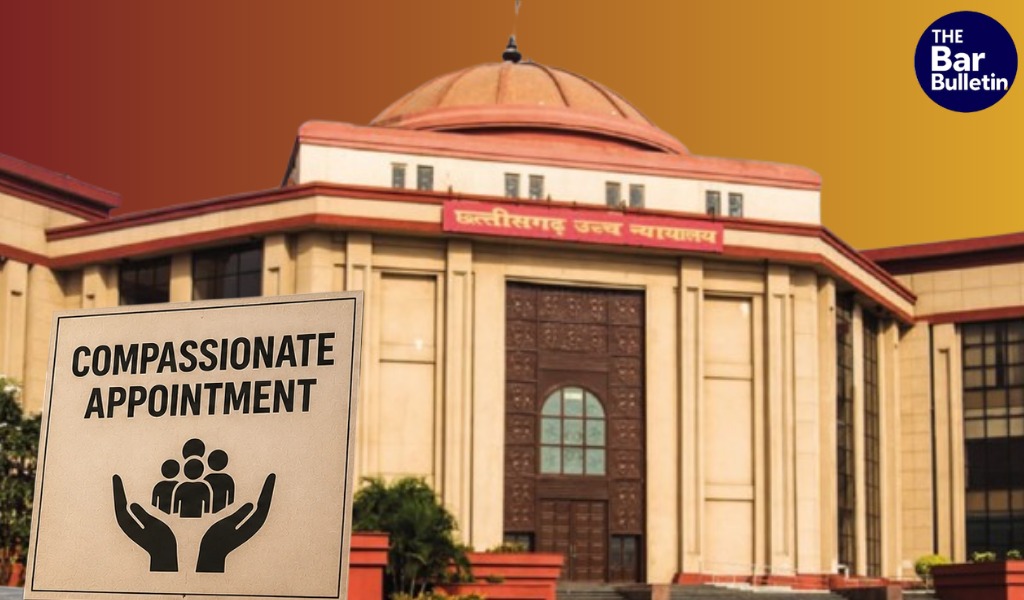

The High Court of Chhattisgarh at Bilaspur Bench has held that the Bank’s policy does not expressly exclude married daughters, and the impugned rejection order was therefore contrary to both the policy and the constitutional mandate. Dependency is a question of fact and cannot be conclusively determined by reference to marital status alone. Excluding a married daughter solely on the ground of her being married is manifestly arbitrary and violates Articles 14 and 15(1) of the Constitution of India.
A Single Judge Bench of Justice Sanjay K. Agrawal noted that the petitioner had clearly stated in her application that she was dependent upon her father due to personal economic reasons and was also assisting her mother. There was no evidence on record to disprove this dependency. The Bank had merely assumed dependency on the husband by virtue of her marital status, without any factual basis.
The Court extensively relied upon the Supreme Court’s ruling in Kulsum Nisha v. State of U.P. [2026 SCC OnLine SC 1059], which categorically held that the exclusion of a married daughter from the definition of “family” cannot be sustained. The Supreme Court in that case observed that the relevant considerations for compassionate appointment are dependency, financial need, residence, and the ability to discharge obligations, and that marital status bears no rational nexus to any of these considerations.
The Supreme Court in Kulsum Nisha case further held that the assumption that a daughter ceases to be a member of or dependent upon her parental family upon marriage is constitutionally impermissible. Marriage neither extinguishes the bond between a daughter and her parental family nor furnishes a valid basis to presume absence of dependency, given that many married daughters continue to reside with, support, or remain dependent upon their parents. The said judgment also highlighted the glaring gender discrimination embedded in such policies, a married son is never excluded from consideration, whereas a married daughter is excluded solely because of her marital status.
Also Read Delhi HC Restrains Baseless Copyright Threats Against TVS Motor Over Vague Cease-and-Desist Notice
Briefly, the petitioner, Afifa Khan @ Devangi Choudhary, is the married daughter of one Dewashish Choudhary, who served as Deputy Manager at Bank of Maharashtra, Raipur Zone, and died in harness. Being the sole surviving family member in need, the petitioner applied for compassionate appointment in place of her deceased father. The Bank of Maharashtra rejected her application on the singular ground that she is a married daughter and is therefore presumed to be dependent upon her husband, and consequently, not a “dependent family member” of her deceased father for the purposes of the Bank’s compassionate appointment policy. The petitioner challenged this rejection, contending that the rejection was illegal, invalid, and unconstitutional.
