
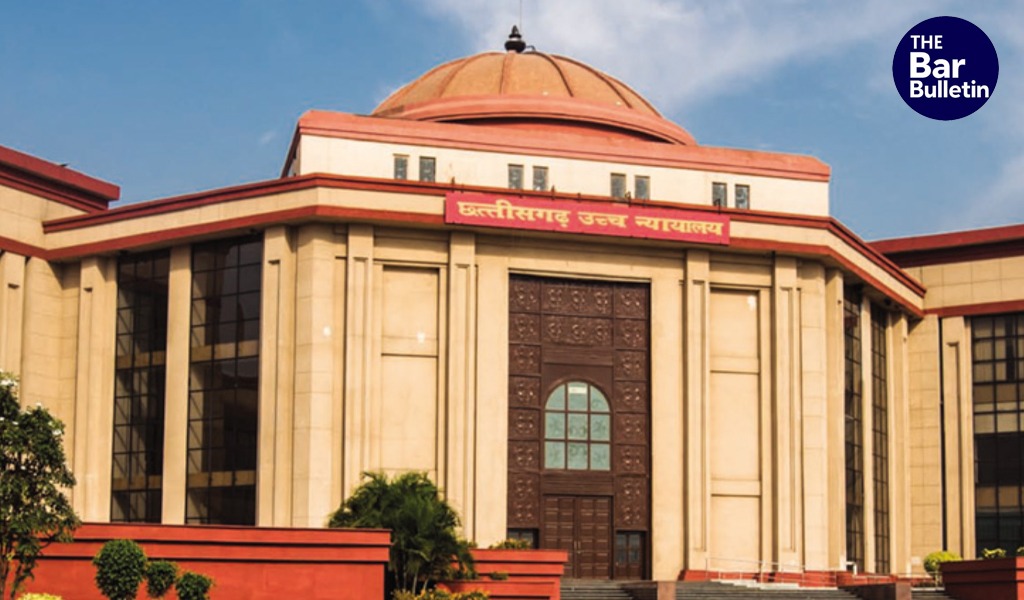

The High Court of Chhattisgarh at Bilaspur Bench has held that creation of promotional avenues, promotional hierarchy and cadre structuring are policy matters for the rule-making authority under Article 309, and courts exercising jurisdiction under Article 226 cannot interfere unless the rule is shown to be manifestly arbitrary, discriminatory, unconstitutional or beyond competence. The Court also held that there is no fundamental or vested right to promotion, and the absence of a promotional avenue for a particular cadre does not by itself render service rules unconstitutional. It further held that employees in different cadres cannot claim parity merely because they fall within a broad common service classification, unless they are similarly situated in all material respects.
The Court also laid down that service rules framed by one State cannot be invalidated by comparing them with a different policy adopted in another State. Further, Article 21 is not attracted merely because a service rule does not provide promotional progression. A writ court cannot direct the Government to amend statutory rules or create promotional posts, since that would amount to rewriting the rules and entering the legislative or policy domain of the State.
The Division Bench comprising the Chief Justice Ramesh Sinha and Justice Ravindra Kumar Agrawal observed that the core challenge was only to the absence of a promotional avenue for Drivers under the Chhattisgarh Jail Non-Gazetted (Class-III Ministerial and Non-Ministerial) Services Recruitment Rules, 2022, while such avenues were available to Warders, Ministerial Staff and Teacher Staff. The Court observed that framing service rules, prescribing qualifications, deciding methods of recruitment, creating promotional channels, restructuring cadres and fixing hierarchy are all matters of policy lying within the exclusive domain of the rule-making authority. Judicial review in such matters is extremely limited and can be exercised only where a statutory rule is manifestly arbitrary, discriminatory, unconstitutional or beyond legislative competence.
The Court noted that the 2022 Rules were framed under the proviso to Article 309 of the Constitution and that the State’s competence to make those rules had not been challenged. It emphasized that no government servant has a fundamental or vested right to promotion. At best, an employee has a right to be considered for promotion only if the service rules provide such a promotional channel. The Constitution does not require that every cadre must necessarily have a promotional avenue or that promotional posts must be created for every category of employees.
Also Read Delhi HC Restrains Baseless Copyright Threats Against TVS Motor Over Vague Cease-and-Desist Notice
Relying on settled service law principles, the Court observed that mere chances of promotion are not conditions of service and that reduction or abolition of such chances does not by itself make service rules unconstitutional. It rejected the petitioner’s attempt to equate Drivers with Teacher staff merely because both fall broadly within the Class-III non-ministerial category. According to the Court, Article 14 applies only where persons are similarly situated in all material respects. Different posts may fall in the same broad class, but if their duties, responsibilities, qualifications and functional requirements differ, the employer can classify them differently for recruitment and promotion purposes.
The Court also rejected the argument based on the Madhya Pradesh rules, holding that each State is entitled to frame its own service rules based on its own administrative requirements, cadre structure and policy considerations. Comparative policy choices of another State cannot be used as the basis for striking down Chhattisgarh’s statutory rules. It further held that absence of a promotional avenue does not violate Article 21. The Court additionally noted that the State had adopted a policy measure to lessen financial stagnation by granting Time Pay Scale benefits to employees in cadres with limited or no promotional avenues, and the petitioner had already received that benefit.
Briefly, the petitioner had challenged the Chhattisgarh Jail Non-Gazetted (Class-III Ministerial and Non-Ministerial) Services Recruitment Rules, 2022 to the limited extent that they do not provide any promotional avenue for the post of Driver in the Jail Department. He stated that he was appointed as Vehicle Driver on May 27, 2008, joined on June 12, 2008, and had rendered more than sixteen years of unblemished service. His case was that although Drivers are part of the Class-III non-ministerial cadre, the 2022 Rules do not provide them any path of promotion, with the result that a Driver remains on the same post throughout service without career advancement.
The petitioner specifically pointed out that under Schedule-II, Part-A of the 2022 Rules, 50% of the posts of Assistant Jail Superintendent are to be filled by promotion through competitive examination, and within that quota, 40% is earmarked for Warder staff, 5% for Ministerial staff and 5% for Teacher staff, but no promotional quota has been reserved for Drivers. He argued that Teacher staff, like Drivers, fall within the non-ministerial Class-III cadre, yet Teacher staff have been granted promotional opportunities while Drivers have been completely excluded. According to him, this amounted to an unreasonable classification and hostile discrimination among similarly placed employees.
The petitioner further relied on the position in Madhya Pradesh, where corresponding jail service rules were said to provide promotional opportunities to Class-III ministerial and non-ministerial employees, including Drivers. On that basis, he contended that Drivers in Chhattisgarh had been arbitrarily denied similar treatment. He argued that complete denial of promotional opportunity caused stagnation, affected dignity and efficiency, and violated Articles 14 and 21 of the Constitution.
The State opposed the petition by arguing that the challenge was legally unsustainable because service rules in one State cannot be used to invalidate statutory rules framed by another State. It said the 2022 Rules were framed under the proviso to Article 309, and the petitioner had not challenged the State’s competence to frame them or shown that they were contrary to any parent law. The State maintained that there is no fundamental right to promotion, only a right to be considered where a promotional channel exists under the rules, and courts cannot direct the State to create promotional posts or rewrite service rules. It also pointed out that employees in cadres with limited promotional avenues are granted Time Pay Scale benefits, and that the petitioner had already received the First Time Pay Scale after completing the required service period.
