
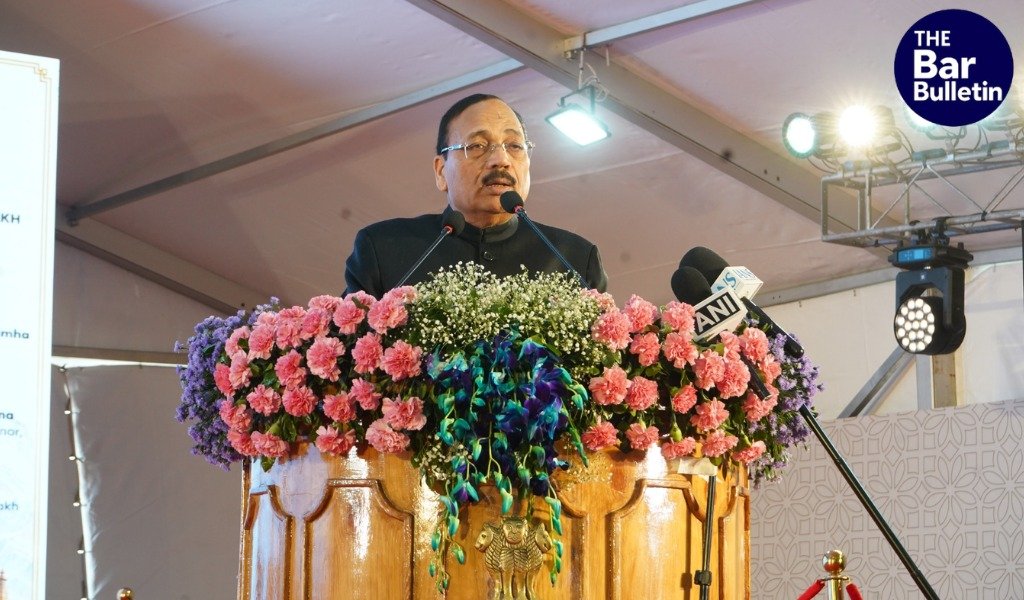

Chief Justice of India Surya Kant, while inaugurating the Ladakh Bench of the High Court of Jammu & Kashmir and Ladakh in Leh, emphasised that the establishment of the Bench must translate into meaningful access to justice for people living in remote parts of the Union Territory. He said that the significance of the new Bench would ultimately be measured by its ability to meet the expectations of people who have long faced geographical and logistical barriers in approaching courts.
Describing the inauguration as a historic moment in Ladakh’s judicial journey, the CJI noted that the Bench was situated at an altitude of approximately 3,500 metres above sea level. However, he said that its elevation was not the only reason to celebrate, stressing that the larger objective was to ensure that people in distant villages could approach the justice system without having to undertake difficult journeys to Jammu or Srinagar.
“
“The important thing is the purpose for which this High Court Bench has been established here. It is about how far we are able to fulfil the expectations and demands of people from remote villages of the Ladakh region who come seeking justice,” CJI Surya Kant said.
He observed that merely including Ladakh in the name of the High Court had not, by itself, eliminated the difficulties faced by residents in accessing judicial institutions. The new Bench, he said, represented a more substantive step towards bringing the justice delivery system closer to the people.
The CJI congratulated the Union Government, Lieutenant Governor of Ladakh Vinai Kumar Saxena and the High Court of Jammu & Kashmir and Ladakh for facilitating the establishment of the Bench. He said that the development reflected the principle of access to justice and the idea of taking justice to people’s doorsteps.
Technology and Legal Aid Must Bridge the Remaining Distance
CJI Surya Kant stressed that establishing a physical Bench in Leh would not, by itself, resolve every access-related difficulty. He pointed out that several villages remain far from Leh, public transport is not always regular, and severe winter conditions and snowfall can make travel difficult even within the region.
He identified technology and legal aid as two essential means of addressing these challenges, calling for a system through which court services could reach people in their own villages. The CJI further suggested that technology should be used to enable litigants to access information about hearing dates, orders and the filing of documents and evidence without having to travel to the court premises for every procedural requirement.
“
“The use of technology should be such that the court reaches every village, every town and every lane. People should be able to find out the date fixed in their case, whether an order has been passed, and how they can file documents or produce evidence. Through technology, the court must reach people wherever they are,” he said.
He added that the objective should not merely be to establish judicial infrastructure in urban centres, but to make court services practically accessible to residents in remote areas who may otherwise be unable to use them because of distance, weather or financial constraints.
CJI Surya Kant said legal aid must go beyond providing lawyers to include awareness of legal rights and entitlements, enabling people to access government benefits and judicial remedies. He highlighted how financial constraints, lack of awareness and geographical distance prevent people in remote areas from securing their rights.
He urged the High Court to strengthen outreach through legal aid counsel and paralegal volunteers, assuring support from the Supreme Court and NALSA. He also called for constitutional, fundamental and civil rights awareness to be incorporated into school education across Ladakh.
CJI Offers Special Supreme Court Bench for Pending Ladakh Cases
In a significant announcement, CJI Surya Kant said that he would arrange a special sitting of the Supreme Court to hear pending cases relating to Ladakh. He also proposed enabling advocates from Leh and Kargil to argue those matters through an online facility from the newly inaugurated High Court Bench.
The announcement followed a suggestion by Attorney General for India R. Venkataramani that a Constitution Bench of the Supreme Court should one day sit in Ladakh. Responding to the suggestion, the CJI praised the courtrooms and facilities at the new judicial complex and expressed his own enthusiasm for strengthening the Supreme Court’s engagement with the region.
“
“I will certainly arrange one day on which a special Bench will sit to hear cases pending in the Supreme Court relating to Ladakh. But there is one condition: those cases will have to be argued by advocates from Kargil and Leh. We will provide you with an online facility, and you can sit here at this High Court Bench, in its conference room, and argue your cases while we hear them from the Supreme Court,” he said.
Explaining the reasoning behind the proposal, the CJI said he wanted members of the local Bar to feel integrated with the Supreme Court and to recognise themselves as part of the wider Indian legal fraternity.
“
“I want every member of the Bar Associations of Kargil and Leh to feel integrated with the Supreme Court, and I want the Supreme Court to feel that you do not represent this region alone. You are representatives of the Bar Association of India. I can assure you that in your competence, ability and articulation, you are no less than members of the Bar appearing before the Supreme Court. You are not lagging behind in any manner in providing the best assistance to us,” he said.
CJI Highlights Ladakh’s Traditional Dispute-Resolution Practices
Reflecting on Ladakh’s legal history, CJI Surya Kant said that the region should not be viewed as backward, pointing to its longstanding community-based methods of resolving disputes.
He referred to traditional local institutions and customary practices through which community disputes, including those concerning the sharing of scarce water resources, were resolved. He said these practices reflected a longstanding understanding of justice within Ladakh’s social and community life.
“
“I tried to learn a little about your history before coming here. You have a very old tradition of resolving disputes between people. There are customary rules and community practices that you have followed for centuries to settle disagreements. Even the sharing of water, which has been scarce in this region, has traditionally been governed by arrangements to determine who receives water and when. It seems to me that justice is in your blood,” he said.
The CJI also referred to the establishment of a special court in the region in 1870, explaining that it had faced operational difficulties because access routes would close during severe winters and snowfall. He noted that the new Bench represented an important development in overcoming the historical barriers that had restricted access to judicial institutions.
Appeals for Environmental Protection and Greening Ladakh
Apart from judicial access, CJI Surya Kant also addressed environmental concerns, congratulating Lieutenant Governor Vinai Kumar Saxena on the initiative to develop a green wall through plantation activities in Ladakh. He appealed to residents to adopt a tree for every family member, urging them to make plantation and tree care a collective responsibility.
“
“If there are five members in your family, take a pledge to plant at least five trees. If you count 50 members among your relatives, plant 50 trees. Every family should ensure that one tree is adopted for every member, because this region has a great need for greenery,” he said.
He added that increased greenery could contribute to addressing water-related challenges, support agricultural activity, improve livelihoods and help maintain ecological balance. He also called for citizens across the country to participate in efforts to protect and strengthen the environment.
The inauguration of the Ladakh Bench, the CJI said, should therefore be seen as part of a wider effort to make institutions more accessible and responsive to the people. He emphasised that the ultimate measure of the new judicial infrastructure would be whether people in the remotest parts of the Union Territory could understand their rights, approach the courts and obtain effective remedies.