
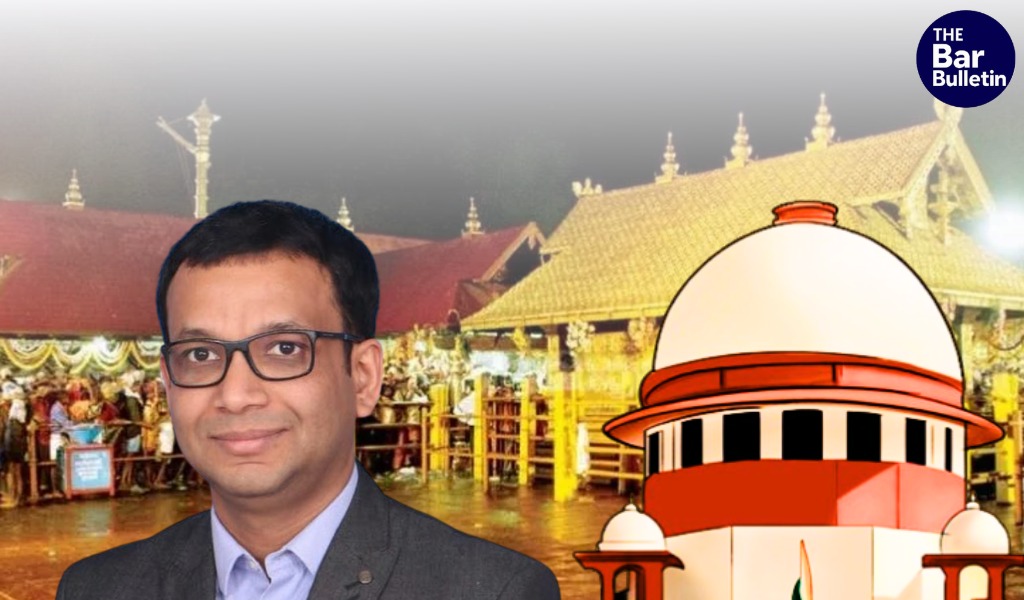

Senior Advocate Shadan Farasat on Tuesday urged the Supreme Court’s nine-judge Bench hearing the Sabarimala reference to abandon the “essential religious practices” doctrine and adopt a constitutional framework centred on proportionality, dignity and freedom of conscience. Appearing for two professors belonging to the Scheduled Castes who had married each other, Mr Farasat argued that constitutional morality serves as a safeguard against majoritarian prejudice embedded within prevailing public morality.
At the outset, Mr Farasat rejected the “false binary” between constitutional morality and public morality. According to him, constitutional morality is itself rooted in values adopted by “We the People” through the Constitution’s Preamble, though in certain situations it must override prevailing societal prejudice.
“Public morality can, in a large number of instances, be nothing more than the prejudices of society at that time. In such situations, constitutional morality must prevail. The Constitution was created precisely to ensure that transient social prejudice does not become the measure of rights.”
The Bench actively engaged with his submissions on morality and social attitudes. Chief Justice Surya Kant questioned the reliability of social surveys reflecting public morality, cautioning against reliance on studies prepared by “people sitting in air-conditioned rooms with a prejudged agenda.” Justice B. V. Nagarathna and Justice M. M. Sundresh also observed that social choices in marriage may arise from several cultural and economic factors rather than prejudice alone. Mr Farasat responded that constitutional courts must nonetheless be prepared to recognise situations where social attitudes conflict with constitutional guarantees of equality and dignity.
He, then, argued on dismantling the “essential religious practices” test, which had wrongly evolved from a limited inquiry under Article 25(2) into a threshold barrier restricting access to Article 25(1) protections altogether.
“Essentiality entered constitutional doctrine only to distinguish religious from secular practices under Article 25(2). But it then cast a shadow over Article 25(1) itself. The bottleneck became so narrow that almost nothing could enter the bottle. The essentiality doctrine must now go.”
Drawing extensively from comparative constitutional jurisprudence in South Africa and Canada, Mr Farasat argued that constitutional protection should extend not only to mandatory religious practices but also to sincerely held personal beliefs and voluntary cultural practices. Referring to a South African case involving a Tamil schoolgirl prohibited from wearing a nose stud, he argued that dignity and identity, rather than rigid notions of obligation, should determine constitutional protection.
“There is more to protecting religion and culture than saving believers from impossible choices. Religious and cultural practices are protected because they are central to identity and dignity. A voluntary practice may, in fact, carry even deeper personal meaning precisely because it is chosen freely.”
Mr Farasat proposed that courts adopt a proportionality-based framework in place of essentiality, under which sincerely held beliefs would first receive protection under Article 25(1), after which courts could balance them against competing rights and legitimate state interests.
“If the belief is sincere, Your Lordships should permit it to enter the balancing stage under Article 25(1). The Court should then weigh it against competing constitutional interests through proportionality instead of excluding it at the threshold through essentiality.”
He further argued that certain constitutional guarantees, particularly Articles 17, 23 and 24 prohibiting untouchability, trafficking and child labour, are absolute and must always prevail over religious claims. In all other conflicts involving religious freedom, equality or denominational rights, Mr Farasat submitted that proportionality offered the most coherent constitutional tool for harmonising competing rights.
He also addressed debates surrounding the Hindi translation of the Constitution, contending that the term “Sadachar” appearing in the Hindi text of Articles 25 and 26 cannot override the English text because Article 394A treats the Hindi version as a translated text intended primarily for public access rather than constitutional interpretation.