
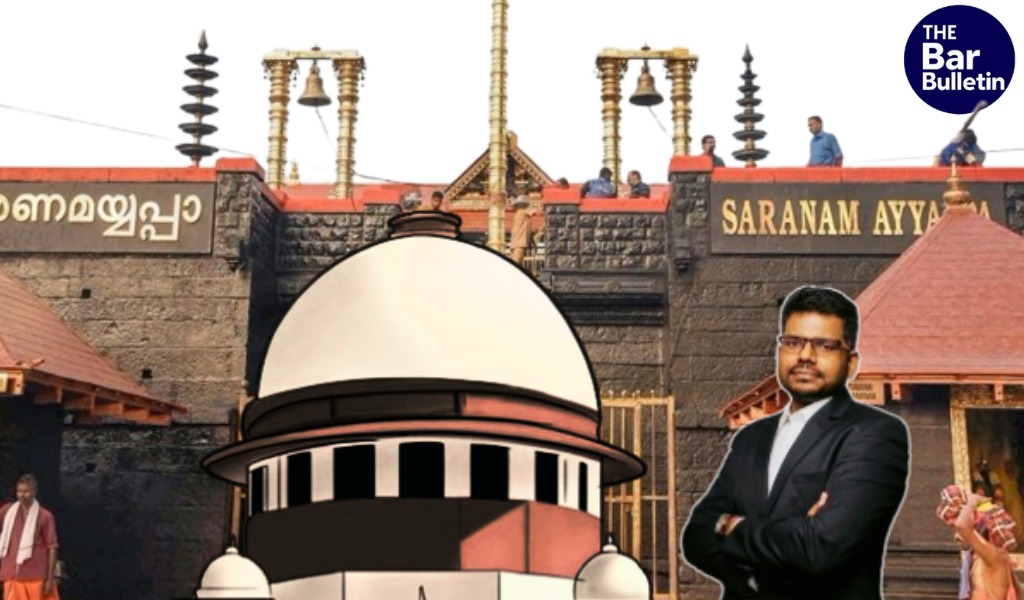

Senior advocate J. Sai Deepak, appearing in the Sabarimala Reference before the Supreme Court 9 Judge Bench, argued that courts cannot indirectly examine or rewrite the religious practices when such scrutiny is not permissible directly.
Opening his submissions, Mr Deepak said the reference requires a holistic reading of Part III, particularly the relationship between Articles 25 & 26 of the Constitution. He framed the inquiry through key constitutional questions- who holds these rights, against whom they operate, and what their limits are.
He further argued that the concept of a “religious denomination” has been overstated in judicial interpretation. According to him, denomination evolved from the idea of a religious association, representing the collective exercise of individual rights. He also linked Article 26 to the freedom of association under Article 19 of the Constitution, submitting that it is a religious manifestation of associational freedom, rather than a separate elevated category.
“Every body of people which comes together under a common belief… will be entitled to rights under Article 26.”
On the scope of social reform under Article 25(2)(b), he argued for a narrow interpretation, contending that terms like “class” and “section” were historically used in a caste-based sense and should not be expanded in a manner that undermines denominational rights.
He then questioned the extent of judicial review in religious matters, submitting: “When something cannot be done directly, it cannot be done indirectly.”
Responding to a query from Justice B. V. Nagarathna on whether courts can examine the rationality of customs, Mr Deepak submitted that entertaining such challenges would effectively amount to rewriting religious practices, which falls outside the scope of judicial review.
He also argued that mere codification of a pre-existing religious practice does not make it open to constitutional challenge, as the underlying character of the practice remains religious.