
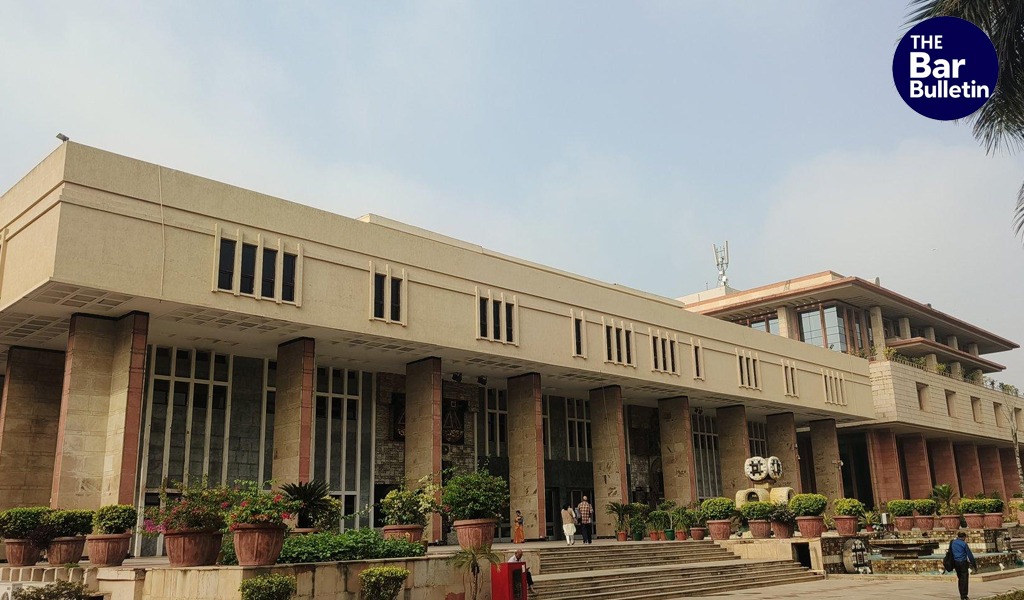

The Delhi High Court has dismissed two petitions filed by the Union of India challenging a common arbitral award in favour of ISC-YUG (JV), holding that the challenge was hopelessly barred by limitation and that receipt of the signed arbitral award by the government’s counsel constituted valid receipt under the Arbitration and Conciliation Act, 1996.
Justice Harish Vaidyanathan Shankar rejected the Union’s contention that limitation commenced only when it obtained another copy of the arbitral award from the Delhi International Arbitration Centre (DIAC) in July 2024. The Court held that the signed copy had already been collected by the Union’s counsel on October 9, 2023, which was sufficient to trigger the limitation period prescribed under Section 34(3) of the Arbitration Act.
The dispute arose from contracts awarded by the Union of India to ISC-YUG (JV) for construction works pursuant to tenders floated in 2016. Following arbitral proceedings, a common award was passed on September 22, 2023. The Union sought to set aside the award under Section 34 of the Arbitration and Conciliation Act, contending that no signed copy had been served upon it personally and that it received only a “copy-to-copy” from DIAC on July 18, 2024.
The respondent objected to the maintainability of the petitions, arguing that they were filed well beyond the statutory limitation period. It submitted that the Union had knowledge of the award from the date it was pronounced and that its counsel had admittedly collected the signed copy on October 9, 2023.
Accepting the preliminary objection, the Court observed that the petitions were “carefully worded” to state only that the Union itself had not received the signed copy, while omitting to plead that its counsel lacked authority to receive it or that the award had never been communicated by counsel to the department. The Court found these omissions to be material.
The Court also refused to place reliance on an affidavit filed nearly two years later by the Union asserting that its erstwhile counsel was not authorised to collect the award, noting that no contemporaneous material supported such a claim. It held that an advocate representing a party in arbitral proceedings ordinarily acts as its recognised agent unless specific restrictions on authority are established.
Rejecting the Union’s argument that limitation began only after DIAC supplied another copy of the award, the Court held that accepting such a contention would undermine the legislative scheme of Section 34(3).
“
“A litigant cannot be permitted to take advantage of its own inaction and thereafter seek to postpone the commencement of limitation on the ground that it obtained another copy of the Award at a later point in time.”
The Court further held that permitting parties to revive limitation by seeking fresh copies months or years later would defeat the objective of ensuring finality and expedition in arbitral proceedings. It distinguished the Supreme Court’s decision in State of Maharashtra v. ARK Builders (P) Ltd., (2011) 4 SCC 616, observing that the ruling could not protect a party whose counsel had admittedly received the signed award but remained inactive.
Holding that the limitation period commenced on October 9, 2023, the date on which the Union’s counsel received the signed award, the Court concluded that even the maximum period permissible under Section 34(3), including the additional thirty-day grace period, had expired long before the petitions were instituted. Consequently, the Court sustained the respondent’s preliminary objection and dismissed both petitions as barred by limitation, without examining the merits of the arbitral award.
