
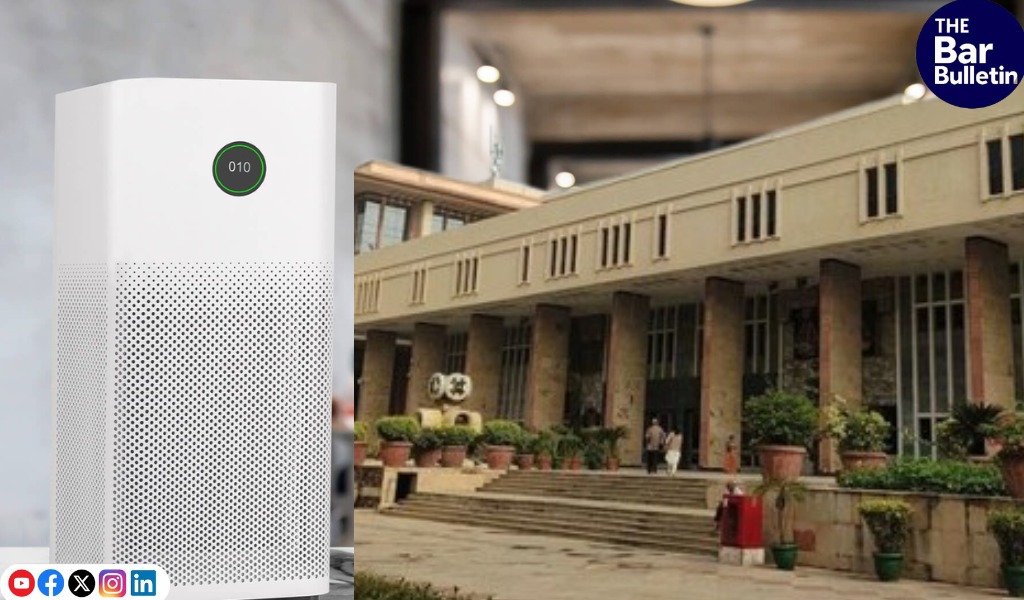

During the hearing before the Delhi High Court, the Union of India raised serious constitutional and procedural objections to a petition seeking reduction of GST on air purifiers from 18% to 5%, contending that the plea was “loaded,” misconceived, and incapable of adjudication in writ jurisdiction.
Appearing for the Centre, Additional Solicitor General N. Venkatraman submitted that the petition sought sweeping declarations beyond the competence of the Court, including directions to treat air purifiers as medical devices and to mandate a specific GST rate without impleading the Ministry of Health or following the statutory framework governing medical device classification.
The ASG argued that classification of air purifiers under GST fell within Chapter 84 (machinery) and not Chapter 90 (medical devices), and that any reclassification or rate change could only be undertaken by the GST Council, a constitutional body under Article 279A, involving the Finance Ministers of all States and the Union. He cautioned that issuance of a mandamus directing the Council to convene or decide in a particular manner would violate the doctrine of separation of powers under Article 50, forming part of the Constitution’s basic structure.
Highlighting that a Parliamentary Standing Committee had already made recommendations on the issue to the Ministry of Environment, the ASG submitted that the matter was undergoing an institutional process, including action-taken reports by the Department of Revenue, and could not be short-circuited through judicial directions. He also pointed out that, under GST Council regulations, voting if required could only take place through physical meetings, not via video conferencing.
The Centre offered two options: either the petition be treated as a representation to the GST Council through the Secretariat, or sufficient time be granted to file a detailed counter affidavit addressing the multiple prayers and legal issues raised. The ASG stressed that the petition was not a public interest litigation in the true sense and questioned the bona fides behind seeking declarations affecting taxation policy and regulatory classifications.
Responding to the objections, Advocate Kapil Madan, appearing in person, submitted that the petition was not adversarial and only sought consideration of the issue in light of the public health emergency arising from severe air pollution in Delhi-NCR. He contended that air purifiers were being taxed under an incorrect GST category and relied on existing GST notifications to support his claim, asserting that the matter warranted urgent consideration.
Taking note of the submissions, the Court granted time to the Union of India to file a detailed counter affidavit within ten days, with liberty to the petitioner to file a rejoinder thereafter. The matter is expected to be listed on 10th of January for further hearing in January.